Iran asks UN’s highest court to suspend US sanctions

1 / 2
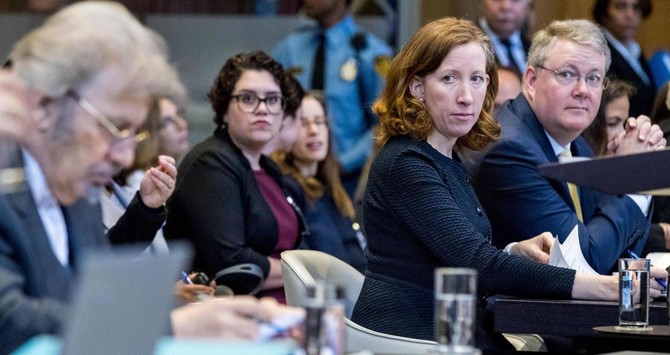
Members of the International Court of Justice attend a hearing for alleged violations of the 1955 Treaty of Amity, Iran vs US, in the court room of the International Court in The Hague, Netherlands August 27, 2018. (Reuters)
2 / 2
Jennifer G Newstead (C), lawyer of lawyer for the United States and representative of Iran Mohsen Mohebi (L) are pictured during the opening of case between Iran and the United States at the The International Court of Justice (ICJ) in the Hague, August 27, 2018. (AFP)
Updated 27 August 2018
Follow

Iran asks UN’s highest court to suspend US sanctions

  • Iran warns re-imposed US sanctions would cripple its economy and plunge the volatile region deeper into crisis
  • Pompeo calls Iran’s claims ‘meritless’ and defended the sanctions as a way of keeping Americans safe

THE HAGUE: Iran demanded Monday that the UN’s top court order the United States to suspend nuclear-linked sanctions against Tehran, but Washington vowed to “vigorously” fend off the legal challenge.
The Islamic Republic launched a suit at the International Court of Justice over US President Donald Trump’s decision to reimpose sanctions that were lifted in a landmark 2015 accord.
Trump says the sanctions are needed to ensure Iran never builds a nuclear bomb. But Iran’s representative Mohsen Mohebi branded them “naked economic aggression.”
His team of lawyers told the court in The Hague that the measures were already devastating Iran’s economy and threatening the welfare of its citizens.
“The United States is publicly propagating a policy intended to damage as severely as possible Iran’s economy and Iranian nationals and companies,” Mohebi said.
“Iran will put up the strongest resistance to the US economic strangulation, by all peaceful means.”
US lawyers are due to give their response in arguments before the court on Tuesday, with experts expecting them to challenge the ICJ’s jurisdiction.
“We will vigorously defend against Iran’s meritless claims this week in The Hague,” said US Secretary of State Mike Pompeo.
He said Iran’s lawsuit was “an attempt to interfere with the sovereign rights of the United States to take lawful actions, including re-imposition of sanctions, which are necessary to protect our national security.”
ICJ judgments are binding, final and without appeal.
However, whether any decision will be implemented remains unclear, with both Iran and the US in the past ignoring ICJ rulings against them.
The US measures have added to Iran’s economic woes, fueling strikes and protests across the country and political spectrum.
The sanctions target financial transactions and imports of raw materials, cars and aircraft among other sectors.
A second wave of punitive measures is due to hit the OPEC member state in early November, targeting its vital energy sector including oil exports.
Iran’s lawyers said the sanctions would cause it “irreparable prejudice.” They urged the court to order the suspension of the sanctions pending a definitive ruling.
London-based lawyer Samuel Wordsworth, for Iran, told the court the measures were threatening Iranians’ access to medicines as well as disrupting business deals.
The ICJ is expected to take a couple of months to decide whether to grant Tehran’s request for a provisional ruling. A final decision could take years.
After years of diplomacy, the 2015 deal was signed by Iran and the five permanent members of the UN Security Council plus Germany.
Sanctions were lifted in return for Iran committing not to pursue nuclear weapons.
Trump, who took office in 2016, called it a “horrible one-sided deal.”
He said it “failed to achieve the fundamental objective of blocking all paths to a Iranian nuclear bomb.”
Iran’s lawyers said the US sanctions had disrupted tens of billions of dollars’ worth of business deals with foreign companies.
Iran’s currency the rial has lost around half its value since April.
International companies including French oil firm Total and Germany’s Siemens have suspended operations in Iran since Trump announced the US withdrawal in May.
Trump said the sanctions would turn up the financial pressure on Tehran to come to a “comprehensive and lasting solution” regarding its activities such as its “ballistic missile program and its support for terrorism.”
The case is the second brought by Tehran against Washington since 2016. That year it brought a suit at the ICJ against the freezing of around $2 billion of Iranian assets abroad which US courts say should go to American victims of terror attacks.
Hearings in that case are due to start on October 8.
In both cases Iran is basing its claim on the obscure 1955 Treaty of Amity and Economic Relations, signed long before the country’s Islamic revolution.
Despite the treaty, the two countries have not had diplomatic ties since 1980. Iran routinely refers to the US as “the enemy” and its officials chant “Death to America” at official functions.


Beirut’s Commodore Hotel, a haven for journalists during Lebanon’s civil war, shuts down

Updated 58 min 45 sec ago
Follow

Beirut’s Commodore Hotel, a haven for journalists during Lebanon’s civil war, shuts down

  • The hotel, located in Beirut’s Hamra district, shut down over the weekend
  • Officials have not commented on the decision

BEIRUT: During Lebanon’s civil war, the Commodore Hotel in western Beirut’s Hamra district became iconic among the foreign press corps.
For many, it served as an unofficial newsroom where they could file dispatches even when communications systems were down elsewhere. Armed guards at the door provided some sense of protection as sniper fights and shelling were turning the cosmopolitan city to rubble.
The hotel even had its own much-loved mascot: a cheeky parrot at the bar.
The Commodore endured for decades after the 15-year civil war ended in 1990 — until this week, when it closed for good.
The main gate of the nine-story hotel with more than 200 rooms was shuttered Monday. Officials at the Commodore refused to speak to the media about the decision to close.
Although the country’s economy is beginning to recover from a protracted financial crisis that began in 2019, tensions in the region and the aftermath of the Israel-Hezbollah war that was halted by a tenuous ceasefire in November 2024 are keeping many tourists away. Lengthy daily electricity cuts force businesses to rely on expensive private generators.
The Commodore is not the first of the crisis-battered country’s once-bustling hotels to shut down in recent years.
But for journalists who lived, worked and filed their dispatches there, its demise hits particularly hard.
“The Commodore was a hub of information — various guerrilla leaders, diplomats, spies and of course scores of journalists circled the bars, cafes and lounges,” said Tim Llewellyn, a former BBC Middle East correspondent who covered the civil war. “On one occasion (late Palestinian leader) Yasser Arafat himself dropped in to sip coffee with” with the hotel manager’s father, he recalled.
A line to the outside world
At the height of the civil war, when telecommunications were dysfunctional and much of Beirut was cut off from the outside world, it was at the Commodore where journalists found land lines and Telex machines that always worked to send reports to their media organizations around the globe.
Across the front office desk in the wide lobby of the Commodore, there were two teleprinters that carried reports of The Associated Press and Reuters news agencies.
“The Commodore had a certain seedy charm. The rooms were basic, the mattresses lumpy and the meal fare wasn’t spectacular,” said Robert H. Reid, the AP’s former Middle East regional editor, who was among the AP journalists who covered the war. The hotel was across the street from the international agency’s Middle East head office at the time.
“The friendly staff and the camaraderie among the journalist-guests made the Commodore seem more like a social club where you could unwind after a day in one of the world’s most dangerous cities,” Reid said.
Llewellyn remembers that the hotel manager at the time, Yusuf Nazzal, told him in the late 1970s “that it was I who had given him the idea” to open such a hotel in a war zone.
Llewellyn said that during a long chat with Nazzal on a near-empty Middle East Airlines Jumbo flight from London to Beirut in the fall of 1975, he told him that there should be a hotel that would make sure journalists had good communications, “a street-wise and well-connected staff running the desks, the phones, the teletypes.”
During Israel’s 1982 invasion of Lebanon and a nearly three-month siege of West Beirut by Israeli troops, journalists used the roof of the hotel to film fighter jets striking the city.
The parrot at the bar
One of the best-known characters at the Commodore was Coco the parrot, who was always in a cage near the bar. Patrons were often startled by what they thought was the whiz of an incoming shell, only to discover that it was Coco who made the sound.
AP’s chief Middle East correspondent Terry Anderson was a regular at the hotel before he was kidnapped in Beirut in 1985 and held for seven years, becoming one of the longest-held American hostages in history.
Videos of Anderson released by his kidnappers later showed him wearing a white T-shirt with the words “Hotel Commodore Lebanon.”
With the kidnapping of Anderson and other Western journalists, many foreign media workers left the predominantly-Muslim western part of Beirut, and after that the hotel lost its status as a safe haven for foreign journalists.
Ahmad Shbaro, who worked at different departments of the hotel until 1988, said the main reason behind the Commodore’s success was the presence of armed guards that made journalists feel secure in the middle of Beirut’s chaos as well as functioning telecommunications.
He added that the hotel also offered financial facilities for journalists who ran out of money. They would borrow money from Nazzal and their companies could pay him back by depositing money in his bank account in London.
Shbaro remembers a terrifying day in the late 1970s when the area of the hotel was heavily shelled and two rooms at the Commodore were hit.
“The hotel was full and all of us, staffers and journalists, spent the night at Le Casbah,” a famous nightclub in the basement of the building, he said.
In quieter times, journalists used to spend the night partying by the pool.
“It was a lifeline for the international media in West Beirut, where journalists filed, ate, drank, slept, and hid from air raids, shelling, and other violence,” said former AP correspondent Scheherezade Faramarzi. “It gained both fame and notoriety,” she said, speaking from the Mediterranean island of Cyprus.
The hotel was built in 1943 and kept functioning until 1987 when it was heavily damaged in fighting between Shiite and Druze militiamen at the time. The old Commodore building was later demolished and a new structure was build with an annex and officially opened again for the public in 1996.
But Coco the parrot was no longer at the bar. The bird went missing during the 1987 fighting. Shbaro said it is believed he was taken by one of the gunmen who stormed the hotel.