





AMMAN: King Abdullah of Jordan said his country would hold all those accountable for undermining the security of the Kingdom and the safety of its citizens after four security officers were killed in a shoot-out.
Jordanian forces laid siege to a building in a residential part of Salt on Saturday night in search of those responsible for a bomb attack on a police van on Friday.
The raid on the apartment in a four-story residential block followed a bomb blast on Friday under a police patrol car at a music festival in the town of Al-Fuhais, west of Amman, that killed a police sergeant and injured six other people.
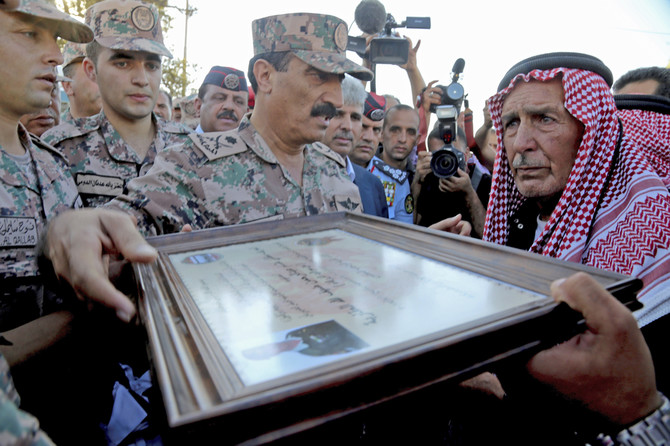
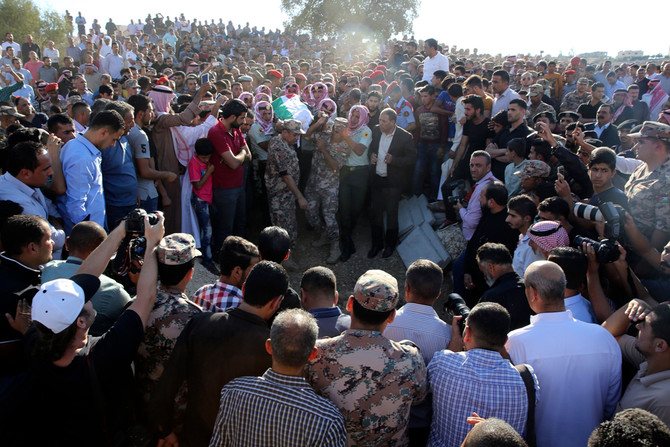
A joint unit of special forces, police and troops raided the building in Salt on Saturday in search of a terrorist cell. The militants opened fire, and three terrorists and three officers died in the shoot-out. A fourth officer died in hospital on Sunday.
The terrorists “blew up the building in which they were hiding, and which they had booby-trapped earlier,” said government spokeswoman Jumana Ghneimat. The rest of the building was later demolished. Five suspected terrorists were arrested during the raid, and all those involved are thought to be Jordanians from Salt.
King Abdullah said Jordan would “strike mercilessly and forcefully” against those who sought to harm the country.
“This cowardly terrorist act, and any act that targets the security of Jordan, will only add to our unity, strength and determination to wipe out terrorism and its criminal gangs,” he told a meeting of security officials.
“Jordanians are stronger when they face such events, and they are more enthusiastic to clean our country and the region and protect our religion.
“Our goal is always to break the back of terrorism and we will not depart from this goal despite the sacrifices," he said.
Prime Minister Omar Al-Razzaz, who chaired the meeting, said Jordan would “not be complacent in the hunt for terrorists.”
Jordan was hit by a string of attacks in 2016, including a shooting rampage by Daesh in Karak that killed 10 people. “This time the situation is more complicated,” security analyst Maj. Gen. Fayez Dweiri told Arab News.
“They went after security forces and not civilians. Also it is clear that the terrorists were expecting the reaction of the security forces, and we saw how they blew up the building they were trapped in.
“This is a big challenge, it requires a revision to the security situation and an increase in monitoring some of these lone wolf cells.”
Dweiri said: “I know that in the past 18 months Jordanian security stopped a number of potential attacks, but they didn’t make their actions public. Daesh is not in Jordan but there are a few dormant cells and they must be followed and monitored.”
The attack bore all the hallmarks of Daesh, said Hassan Abu Hanieh, an expert on Islamist radicalism. “Al-Qaeda and other militant groups have said they are no longer attacking Jordan, so the only party with an ideological position that supports attacking Jordan is Daesh,” he said.
“What has happened in the past few years is the decentralization of Daesh, they are no longer bound in the execution of their attacks to any central power. Their weakness and loss of their land control has resulted in numerous revenge attacks.”
Hanieh said he believed Daesh had not admitted the attack because members of the terror cell were captured alive.
The Jordanian government also appeared to have learned from previous experience, and provided regular news and updates, observers said. Radio presenter Mohammad Ersan said the difference was noticeable.
“Jumana Ghnaimat, the government spokesperson, was literally producing updates every 15 minutes, and this played a big role in shutting down the possibility of unnecessary and harmful rumors,” he said.
Amer Al-Sabaileh, an independent security and geopolitical analyst, told Arab News Jordanians should prepare for a new wave of terror as the Syrian conflict winds down.
“These acts of terror are not many, but they are different,” he said. “They are targeting the security forces, and this is also the first time inside Jordan that individuals have blown up a building and blown themselves up, and ambushed security forces.
“Why is this important? We are dealing with Jordanians who have returned with experience from abroad. They could have attacked civilians but they wanted to attack what they consider tyrant forces, which are illegitimate in their eyes.”
However, Al-Sabaileh said, it was clear that such attacks on the security forces had no public support. “The security forces are well respected in Jordan,” he said.


