ISLAMABAD: Pakistan Tehreek-e-Insaf (PTI) Chairman Imran Khan, set to be the country’s next prime minister, emphasized the importance of resuming dialogue with India on all outstanding issues, including the Kashmir dispute, at a meeting with Indian High Commissioner Ajay Bisaria in Islamabad on Friday.
Khan is scheduled to be sworn in as prime minister on August 18, after his party secured 116 general seats in last month’s elections. He has already been congratulated and welcomed by envoys of several other countries.
The Indian High Commissioner also congratulated Pakistan’s former cricket captain over his performance in the recent electoral contest and presented him with a cricket bat signed by India’s national team.
Bisaria told his host that there was renewed optimism in India that New Delhi’s relations with Islamabad would improve under his leadership.
Khan welcomed the positive message conveyed by the Indian High Commissioner on behalf of his government, pointing out that it was imperative for both countries to move forward for the betterment of their people.
He also expressed his hope that the SAARC Summit would soon be held in Islamabad.
After the meeting, PTI’s Fawad Chaudhry told a group of journalists that Khan wants regional peace and cooperation.
Another PTI leader, Faisal Javed Khan, said that former Indian cricketers Kapil Dev, Sunil Gavaskar and Navjot Singh Sidhu, had been invited to Khan’s oath-taking ceremony, along with Pakistan’s 1992 World Cup-winning squad.


Imran Khan meets Indian envoy, hopes to resume bilateral talks
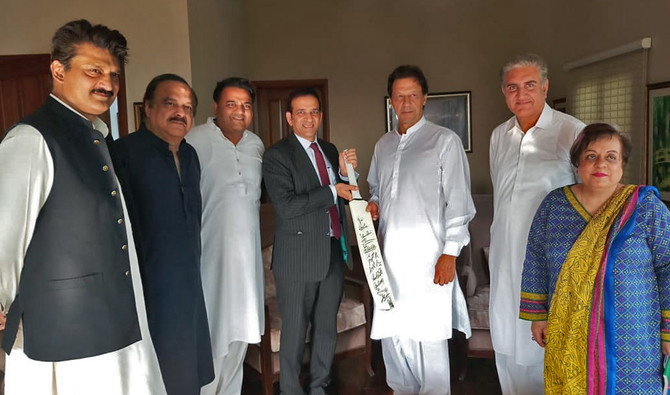
Imran Khan meets Indian envoy, hopes to resume bilateral talks
- Pakistan’s prime minister-in-waiting hoped for resumption of dialogue with India in his meeting with the Indian High Commissioner
- The Indian envoy expressed ‘optimism’ for improved bilateral ties under Khan’s leadership


‘Fully stand with Bangladesh’: Pakistan PM backs decision to boycott India match
- Pakistan’s government have not allowed the national cricket team to play its World Cup match against India on Feb. 15
- Pakistan has accused India of influencing ICC decisions, criticized global cricket body for replacing Bangladesh in World Cup
ISLAMABAD: Prime Minister Shehbaz Sharif on Wednesday backed his government’s decision to bar the national men’s cricket team from playing against India in the upcoming T20 World Cup tournament, reaffirming support for Bangladesh.
Pakistan’s government announced on social media platform X last week that it has allowed its national team to travel to Sri Lanka for the World Cup. However, it said the Green Shirts will not take the field against India on their scheduled match on Feb. 15.
Pakistan’s participation in the tournament was thrown into doubt after Pakistan Cricket Board (PCB) Chairman Mohsin Naqvi criticized the International Cricket Council (ICC) for replacing Bangladesh with Scotland. The decision was taken after Bangladesh said it would not let its team travel to India out of security concerns.
During a meeting of the federal cabinet, Sharif highlighted that Pakistan has said that politics should be kept away from sports.
“We have taken this stand after careful consideration and in this regard, we should stand fully with Bangladesh,” Sharif said in televised remarks.
“And I believe this is a very reasonable decision.”
Pakistan has blamed India for influencing the ICC’s decisions. The global cricket governing body is currently led by Jay Shah, the head of the Board of Control for Cricket in India. Shah is the son of Indian Home Minister Amit Shah.
Pakistan’s boycott announcement has triggered media frenzy worldwide, with several Indian cricket experts and analysts criticizing Islamabad for the decision. An India-Pakistan cricket contest is by far the most lucrative and eagerly watched match of any ICC tournament.
The ICC has ensured that the two rivals and Asian cricket giants are always in the same group of any ICC event since 2012 to capitalize on the high-stakes game.
The two teams have played each other at neutral venues over the past several years, as bilateral cricket remains suspended between them since 2013 due to political tensions.
Those tensions have persisted since the two nuclear-armed nations engaged in the worst fighting between them since 1999 in May 2025, after India blamed Pakistan for an attack in Indian-administered Kashmir that killed tourists.
Pakistan denied India’s allegations that it was involved in the attack, calling for a credible probe into the incident.


