

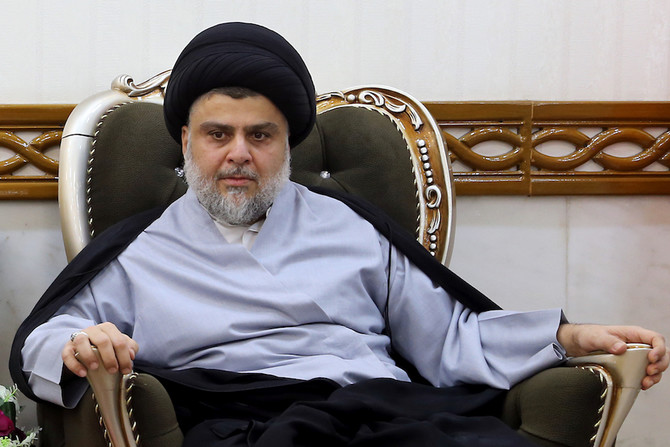

BAGHDAD: Muqtada Al-Sadr threatened to give up his pursuit of a governing coalition on Thursday, raising further doubts about the country’s political stability.
The influential cleric was the biggest winner in parliamentary elections in May but three months of negotiations and maneuvering have made little progress.
If Al-Sadr follows through with his threat, it would open the door for a coalition dominated by parties representing Iran-backed paramilitaries.
Al-Sadr said he would join the “parliamentary and popular opposition” if his rivals did not implement his conditions to form the next government within 15 days of the results of a manual recount completed this week.
The Shiite cleric, who controls millions of followers across the country, formed the Saeiroon List to contest the election. Preliminary results placed his alliance first with 54 seats.
Al-Sadr has been leading negotiations to form the biggest parliamentary bloc, which would then be able to form a government. But his efforts have yielded no results because of his attempts to impose his will and vision for the country on his potential allies.
Last month, Al-Sadr set 40 conditions to choose the next prime minister, including being independent, without a parliamentary seat, and not necessarily a Shiite. 
Al-Sadr’s threat means he has reached a dead end in his negotiations with the leaders of other Shiite parties.
The cleric, whose fighters once battled US soldiers before he turned against Iran, said he would return to being a powerful opposition leader and that he was trying hard to save the Iraqi people of all the “plots and conspiracies that are woven against you.”
The election also handed big wins to the various forces backed by Iran, which ran under the umbrella of the Fattah List. Fattah finished second to Saeiroon with 49 seats.
The unexpected poor showing by the previously prominent Shiite and Sunni parties and veteran figures prompted many claim widespread fraud in the electoral process.
The election was conducted using electronic devices for the first time.
A Federal Court ruling allowed for a manual recount of ballots at polling stations where fraud was suspected to have taken place.
The result of that recount was expected to be announced later on Thursday.
Officials involved in the counting told Arab News that the recount was unlikely to change the overall positions of the top three alliances: Saeiroon, Fattah and Nassir, which is led by Prime Minister Haider Al-Abadi.
Shiite politicians involved in talks with Al-Sadr said the cleric had been planning to announce a 120-seat parliamentary coalition in the last few days, but his efforts failed.
“We had reached an agreement with Al-Sadr last week to open the door for all the winning political blocs to join our alliance based on our governmental program but in a minute everything collapsed,” a senior Fattah leader and one of the negotiators told Arab News.
They blamed Nuri Al-Maliki, the former Iraqi prime minister, of sabotaging the agreement.
Maliki, who heads the State of Law coalition won just 25 seats and has no chance to compete for the post of prime minister.
But the Iranian backed political forces are keen to have him as a part of any ruling alliance.
The hostility between Al-Maliki and Al-Sadr dates back to 2008 when as prime minister he led a military campaign in coordination with the US military to hunt down fighters from Al-Sadr’s Mahdi Army.
This week, Al-Maliki said Al-Sadr had agreed to join an alliance led by him.
“Maliki knows that Al-Sadr does not want him … so he deliberately presented himself as a sponsor of the negotiations with Al-Sadr and said that Al-Sadr agreed to join an alliance-led by him, so Sadr rebelled and broke the agreement,” Fattah’s negotiator said.
“He (Al-Sadr) feels that we will go without him, but this will not happen. We are keen to have Saeiroon with us aboard and will do our best to achieve this.
“But if Sadr insists on his stubbornness, we will not sit down to cry over the ruins.”


