

Assad’s forces retake Golan Heights frontier with Israel

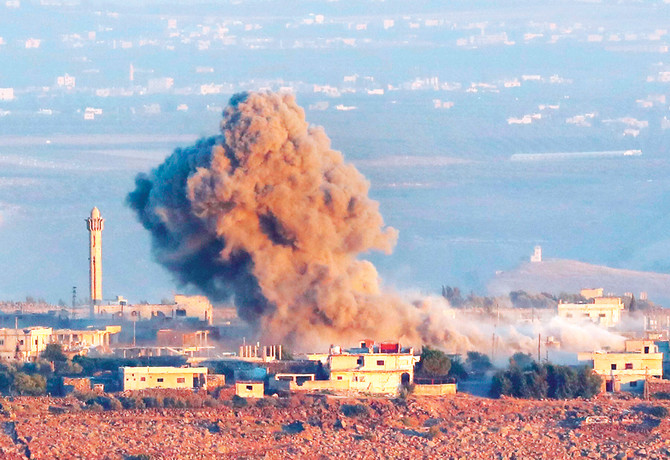
Smoke rises above buildings across the border during a regime-led offensive in Quneitra, Syria. (AFP)
Updated 31 July 2018
Follow

Assad’s forces retake Golan Heights frontier with Israel

  • Opposition captured the area along the Golan Heights after a popular uprising broke out against Bashar Assad in 2011
  • The Observatory said an estimated 1,200 Daesh-linked fighters agreed to give up their pockets near the Golan Heights on Monday

BEIRUT: The Syrian regime regained control of the frontier with the Israeli-occupied Golan Heights for the first time in seven years on Monday, after Daesh-linked militants gave up their last pocket of territory in the area.

The breakthrough against the militants, reported by state media and an opposition-linked war-monitoring group, capped a six-week-long campaign to retake the southwest corner of the country.

Opposition captured the area along the Golan Heights after a popular uprising broke out against Bashar Assad in 2011. A Daesh-linked outfit known as the Khaled bin Al-Waleed Army later seized the area from the opposition fighters.

The Britain-based Syrian Observatory for Human Rights said the militants surrendered control of the Yarmouk Basin in southwestern Syria on Monday.

The regime-affiliated Central Military Media outlet said Syria’s military secured the length of the Golan Heights frontier.

 Israel seized the Golan Heights in the 1967 Mideast war and later annexed it in a move not recognized internationally.

UN peacekeeping forces first deployed along the frontier in 1974 to separate Syrian and Israeli forces.

Israel has largely kept to the sidelines of the Syrian civil war, but has said it will not allow Iran or the Lebanese militant group Hezbollah to establish a permanent military presence near the frontier. Both are allied with Assad and have provided crucial military support to his forces.

Syrian regime forces pressed ahead with their offensive despite threats by Daesh to kill civilians it recently captured in a nearby province.

The extremists abducted around 18 people, mostly women, in a wave of attacks in the nearby province of Sweida last Wednesday that killed more than 200 people.

On Saturday, the group released a hostage video of a woman saying she was being held along with other women from Sweida. The woman said she would be freed if the regime halted its offensive against the militants and released Daesh detainees. She said she was being threatened with death if the regime pressed its offensive.

The Sweida 24, an activist collective in Sweida, said Daesh sent the photos of 14 women they are holding to their relatives, saying they want to negotiate over them.

Sweida 24 said Daesh is believed to be holding 30 people, including 20 women whose ages range between 18 and 60. It said Daesh is also believed to be holding 16 young boys and girls.

The activist group said the bodies of two women were found near the village of Shabki, a focus of Wednesday’s attack. One had been shot in the head and the other, an elderly woman, apparently died of exhaustion. Four other women were found alive hiding in a cave, it said.

Those abducted are members of the minority Druze sect. Daesh has been driven from virtually all the territory it once controlled in Syria and Iraq, but holds scattered pockets in southern Syria and along the border.

The Observatory said an estimated 1,200 Daesh-linked fighters agreed to give up their pockets near the Golan Heights on Monday. Their fate was unclear.


Spain highlights importance of Gaza reconstruction

Palestinian prime minister, Mohammed Mustafa, and the Spanish foreign minister, Jose Manuel Albares. (AP)
Updated 02 January 2026
Follow

Spain highlights importance of Gaza reconstruction

  • Spain officially recognized Palestine as a state in May 2024, in a coordinated move alongside Ireland and Norway

RAMALLAH: The Palestinian prime minister, Mohammed Mustafa, and the Spanish foreign minister, Jose Manuel Albares, on Friday discussed the latest developments in the West Bank and Gaza Strip.
During their telephone conversation they emphasized the need to intensify international efforts to end the Israeli occupation and halt attacks and settler violence, and to secure the release of Palestinian funds held by Israeli authorities.
They affirmed the importance of ongoing efforts relating to plans for the reconstruction of Gaza, and Europe’s significant role in this process. Mustafa and Albares highlighted the need to unify Palestinian institutions in Gaza with those in the West Bank, with the aim of establishing a Palestinian state in line with international resolutions, including last year’s New York Declaration.
They also discussed coordination between their countries, and the strengthening of Spain’s political, diplomatic and financial support for Palestine, and Mustafa thanked Spain for its ongoing support.
Spain officially recognized Palestine as a state in May 2024, in a coordinated move alongside Ireland and Norway. Estephan Salameh, the Palestinian finance and planning minister, is set to visit Spain this month to discuss enhanced cooperation, particularly in the areas of development and reconstruction. Meanwhile, Israel continues operating in the occupied West Bank.
The Palestinian Prisoners media office said on Friday that Israel carried out numerous raids across the territory, including the major cities of Ramallah and Hebron, according to The Associated Press.
Nearly 50 people were detained, following the arrest of at least 50 other Palestinians on Thursday, most of those in the Ramallah area.
As 2026 begins, the shaky 12-week-old ceasefire between Israel and Hamas has largely ended large-scale Israeli bombardment of Gaza. 
But Palestinians are still being killed by Israeli fire, especially along the so-called Yellow Line that delineates areas under Israeli control, and the humanitarian crisis is compounded by frequent winter rains and colder temperatures.
On Friday, American actor and film producer Angelina Jolie visited the Rafah border crossing between Egypt and the Gaza Strip. 
The only crossing between the territory and a country other than Israel, it remains closed despite Palestinian requests to reopen it to people and aid.
Jolie met with members of the Red Crescent on the Egyptian side of the Rafah border crossing and then visited a hospital in the nearby city of Arish to speak with Palestinian patients on Friday, according to Egyptian officials.
Aid groups say not enough shelter materials are getting into Gaza during the truce.