Pakistani helicopter plucks stranded Russian climber from peak

1 / 2
Pakistan Army aviation pilots on Tuesday rescued Russian climber Alexander Gukov from 20,650 feet high high Latok Peak in Biafo Glacier in Northern areas of the country. (Photo courtesy: ISPR)
2 / 2
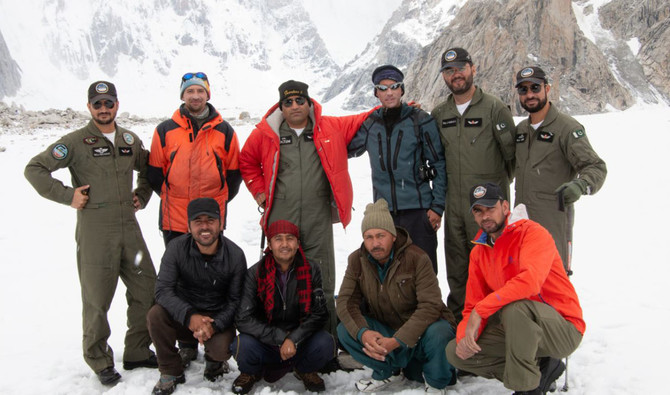
Pakistan Army team that took part in the rescue mission. (Photo courtesy: ISPR)
Updated 31 July 2018
Follow

Pakistani helicopter plucks stranded Russian climber from peak

  • Russian climber Alexander Gukov was stuck at 20,650 feet high Latok Peak in Biafo Glacier since July 25
  • The rescue mission was the first-ever for army aviation helicopters under extreme weather conditions at such height

ISLAMABAD: Helicopter pilots on Tuesday plucked a stranded Russian mountaineer from a northern peak in Pakistan’s first such rescue at a height of more than 6,000 meters (20,000 ft), ending his six-day ordeal, the military said.
The rescue of Alexander Gukov from Latok I, a mountain in the Karakoram range that is 7,145 m (23,442 ft) high, following the death of his climbing partner, came after seven unsuccessful attempts, the military said in a statement.
The partner, Sergey Glazunov, fell to his death as the pair were descending the mountain on Wednesday, said Karrar Haidri, the secretary of Pakistan’s Alpine Club.
“Gukov sent out an SOS and was forced to wait in the hope of rescue, clinging to the wall without equipment to descend,” Haidri said.
“He managed to build a snow cocoon to shield himself from the elements and was able to stay in contact with rescuers via a satellite phone.”
The Russian has been airlifted to the nearest hospital in the town of Skardu, and is said to be in good health, despite having gone three days without food while trapped at a height of 6,294 m (20,650 ft).
“Though he is very weak, he has no frostbite,” Haidri added.
The military said snow clouds had forced it to call off the previous rescue bids. The pair began climbing on July 12, but eventually abandoned the effort and started their descent two weeks later in the mountain range bordering India and China.
Pakistan is considered a climbers’ paradise, rivaling neighboring Nepal in the number of its peaks exceeding 7,000 m (23,000 ft), but fatalities are common among the enthusiasts who flock there in summer.
This month, Pakistani military helicopters also rescued two British mountaineers from Ultar Sar, another peak in the same range, after an avalanche killed their Austrian climbing partner.
Pakistan’s tallest peaks include K2, the world’s second highest peak, at 8,611 m (28,251 ft), and Nanga Parbat, known as “Killer Mountain,” for the numerous deaths on its treacherous slopes.
In January, a team of Polish climbers rescued French mountaineer Elisabeth Revol from the peak, but were unable to save her climbing companion, Tomasz Mackiewicz.


Pakistan seeks wider access to Canadian market as both sides want deeper agricultural cooperation

Updated 4 sec ago
Follow

Pakistan seeks wider access to Canadian market as both sides want deeper agricultural cooperation

  • Islamabad urges faster certification for canola and halal products in a bid to expand agricultural exports
  • Canada pledges collaboration on pest management, invites Pakistan to the Canada Crops Convention

ISLAMABAD: Pakistan on Wednesday pressed for improved access to Canadian agricultural markets and faster certification procedures for key exports as Islamabad looks to modernize its climate-strained farm sector and resolve long-standing barriers to trade, according to an official statement.

The push comes as Pakistan, a largely agricultural economy, faces mounting challenges from erratic weather patterns, including floods, droughts and heatwaves, which have hurt crop yields and raised food security concerns. Islamabad has increasingly sought foreign partnerships and training to upgrade farm technology, while pursuing export-oriented growth to diversify markets for mangoes, rice, kinnow, dates and halal meat.

Federal Minister for National Food Security Rana Tanveer Hussain and Canadian High Commissioner Tarik Ali Khan met to discuss “strengthening bilateral collaboration in agriculture, enhancing market access for key commodities, and advancing ongoing phytosanitary and technical cooperation,” according to the statement.

“Minister Rana Tanveer Hussain stressed the importance of resolving market access challenges to ensure uninterrupted trade in priority commodities, particularly canola, which constitutes Pakistan’s major agricultural import from Canada," it continued. "He highlighted that Pakistan seeks robust and timely certification and registration processes to facilitate predictable canola imports."

"The Minister emphasized that Pakistan is eager to strengthen its halal export footprint in Canada and sought CFIA’s [Canadian Food Inspection Agency’s] support in accelerating certification procedures for halal gelatin, casings, and value-added poultry," it added.

High Commissioner Khan  acknowledged Pakistan’s concerns, the statement said, and assured Hussain of Ottawa’s readiness to deepen technical collaboration.

He also briefed the minister on Canada’s pest management systems and grain supply chain controls, adding that his country looked forward to facilitating Pakistan’s plant protection team during an upcoming systems-verification visit.

Khan also invited Pakistani officials to the Canada Crops Convention in April 2026 and confirmed participation in the Pakistan Edible Oil Conference, reaffirming that “Canada views Pakistan as a priority partner in the region.”

Hussain proposed forming a joint working group to maintain momentum on technical discussions and regulatory issues as both officials agreed to strengthen agricultural cooperation.