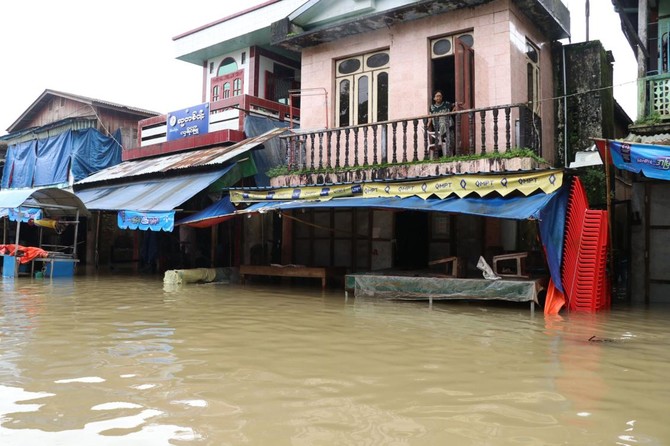
MYANMAR: Floodwaters have forced thousands from their homes in southeast Myanmar, local police said Friday, as authorities and volunteers scrambled to provide food and aid to the victims.
Heavy monsoon rains have pounded Karen state, Mon state and Bago region in recent days and show no sign of abating, raising fears that the worst might be yet to come.
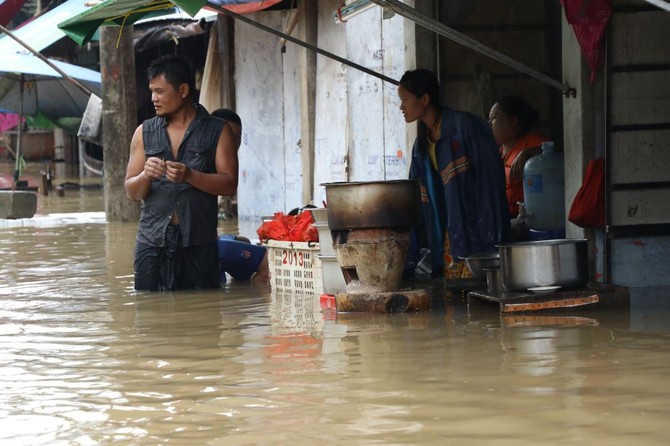
Photos and videos showed residents of Karen’s state capital Hpa-an boating down streets that had turned into rivers while others were forced to escape on foot through waist-deep water.
Vast swathes of the surrounding land lay submerged while 11 temporary camps have been set up around the city.
“There are more than 6,000 people displaced in Hpa-an and about 4,000 in Myawaddy,” the head of Karen state police force Kyi Linn told AFP, referring to a second town on the border with Thailand.
A social welfare ministry official previously said 16,000 people had been displaced across eight townships in Karen state.
The number affected in Mon state and Bago region has not yet been confirmed.
“The children’s school has closed,” said Khin San Win, who fled her home which was thigh-deep in water for a shelter in Hpa-an along with her sick husband and their three children.
“We’re being given food but we aren’t able to pay for anything else as we can’t work.”
State-run media published pictures on Friday of civilian leader Aung San Suu Kyi visiting Karen state the day before, talking to victims, relief workers and volunteers.
The Global New Light Of Myanmar said her government had freed up 200 million kyat ($140,000) to help those displaced and that rebuilding destroyed bridges would be a priority.
“We are now delivering food to flood victims who don’t want to leave their homes,” said volunteer Ni Ni Aung in Kyonedoe town, adding they would have no choice but to leave if the rains worsened.
So far no casualties have been reported.
Like its neighbors, Myanmar faces severe flooding every year and climate scientists in 2015 even ranked it top of a global list of nations hardest hit by extreme weather.
That year more than 100 people died in floods that also displaced hundreds of thousands across the country.
Some 138,000 people were killed in 2008 when Cyclone Nargis lashed vast stretches of Myanmar’s coast.

Floods force thousands from homes in Myanmar
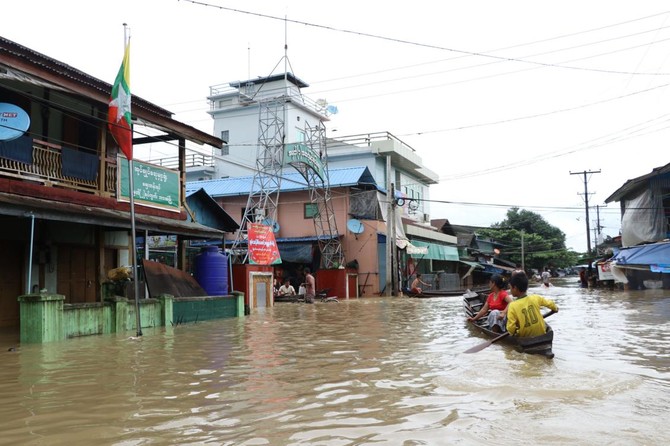
- Heavy monsoon rains have pounded Karen state, Mon state and Bago region in recent days and show no sign of abating, raising fears that the worst might be yet to come.
- Photos and videos showed residents of Karen’s state capital Hpa-an boating down streets that had turned into rivers while others were forced to escape on foot through waist-deep water.
Trump Maritime Action Plan eyes levies on China goods to resurrect US shipbuilding
- Maritime prosperity zones proposed to boost investment and workforce training
- Maritime Security Trust Fund to finance shipyard revitalization
WASHINGTON: The Trump administration on Friday released its plan to rebuild US shipbuilding and other maritime businesses, paid for in part by port fees on cargo delivered to the United States on ships made in China — levies the US and China agreed to pause for one year.
The Maritime Action Plan offers a road map for the revival of US shipbuilding, which has shrunk since World War Two and now severely lags China and other nations.
Coming in at more than 30 pages, the plan calls for establishing maritime prosperity zones to bolster investment, reforming workforce training and education, expanding the fleet of US-built and US-flagged commercial ships, establishing a dedicated funding stream through a Maritime Security Trust Fund and reducing regulations.
The Trump administration early last year announced plans to levy fees on China-linked ships to loosen the country’s grip on the global maritime industry and help pay for a US shipbuilding renaissance. The so-called Section 301 penalties followed a US probe that concluded China uses unfair policies and practices to dominate global shipping.
The fees, which sparked intense pushback from the global shipping industry and intensified tensions between the world’s two largest economies, hit on October 14 and were expected to generate an estimated $3.2 billion annually from Chinese-built vessels sailing to US ports.
But China retaliated with its own port fees on US-linked ships and the tit-for-tat fees disrupted global shipping. Soon after, the two sides struck a deal to put the levies on hold for 12 months.
On Friday, Shipyard owners, investors and the bipartisan sponsors of the Shipbuilding and Harbor Infrastructure for Prosperity and Security (SHIPS) for America Act welcomed President Donald Trump’s maritime plan, which landed months later than hoped.
US Senator Todd Young, a Republican from Indiana, said there is substantial overlap between Trump’s vision and the plan in that proposed law, which he reintroduced last year with Democratic Senator Mark Kelly of Arizona and other lawmakers.
Importantly, the SHIPS Act would establish a Maritime Security Trust Fund to reinvest port fee proceeds into maritime security and infrastructure projects such as shipyard revitalization. It has rare backing from both Democratic and Republican lawmakers in Washington, but has not made swift progress.
“The announcement today should serve as a wake-up call for Congress to act quickly on this bill in order to provide the legal authorities and resources necessary to make this plan a reality,” Young said. “It’s time to make American ships again.”
The Maritime Action Plan offers a road map for the revival of US shipbuilding, which has shrunk since World War Two and now severely lags China and other nations.
Coming in at more than 30 pages, the plan calls for establishing maritime prosperity zones to bolster investment, reforming workforce training and education, expanding the fleet of US-built and US-flagged commercial ships, establishing a dedicated funding stream through a Maritime Security Trust Fund and reducing regulations.
The Trump administration early last year announced plans to levy fees on China-linked ships to loosen the country’s grip on the global maritime industry and help pay for a US shipbuilding renaissance. The so-called Section 301 penalties followed a US probe that concluded China uses unfair policies and practices to dominate global shipping.
The fees, which sparked intense pushback from the global shipping industry and intensified tensions between the world’s two largest economies, hit on October 14 and were expected to generate an estimated $3.2 billion annually from Chinese-built vessels sailing to US ports.
But China retaliated with its own port fees on US-linked ships and the tit-for-tat fees disrupted global shipping. Soon after, the two sides struck a deal to put the levies on hold for 12 months.
On Friday, Shipyard owners, investors and the bipartisan sponsors of the Shipbuilding and Harbor Infrastructure for Prosperity and Security (SHIPS) for America Act welcomed President Donald Trump’s maritime plan, which landed months later than hoped.
US Senator Todd Young, a Republican from Indiana, said there is substantial overlap between Trump’s vision and the plan in that proposed law, which he reintroduced last year with Democratic Senator Mark Kelly of Arizona and other lawmakers.
Importantly, the SHIPS Act would establish a Maritime Security Trust Fund to reinvest port fee proceeds into maritime security and infrastructure projects such as shipyard revitalization. It has rare backing from both Democratic and Republican lawmakers in Washington, but has not made swift progress.
“The announcement today should serve as a wake-up call for Congress to act quickly on this bill in order to provide the legal authorities and resources necessary to make this plan a reality,” Young said. “It’s time to make American ships again.”
© 2026 SAUDI RESEARCH & PUBLISHING COMPANY, All Rights Reserved And subject to Terms of Use Agreement.