

Lebanon’s shoreline: where garbage rules and endangered turtles are struggling to lay their eggs

Zouk Mosbeh beach, north of Beirut, in January.
Updated 26 July 2018
Follow

Lebanon’s shoreline: where garbage rules and endangered turtles are struggling to lay their eggs

  • “We don’t need an environmental minister who understands the environment, we need an environmentally-friendly government
  • Lebanon gained worldwide notoriety in summer 2015 for the garbage crisis that began when the Naamah landfill site reached capacity and was closed

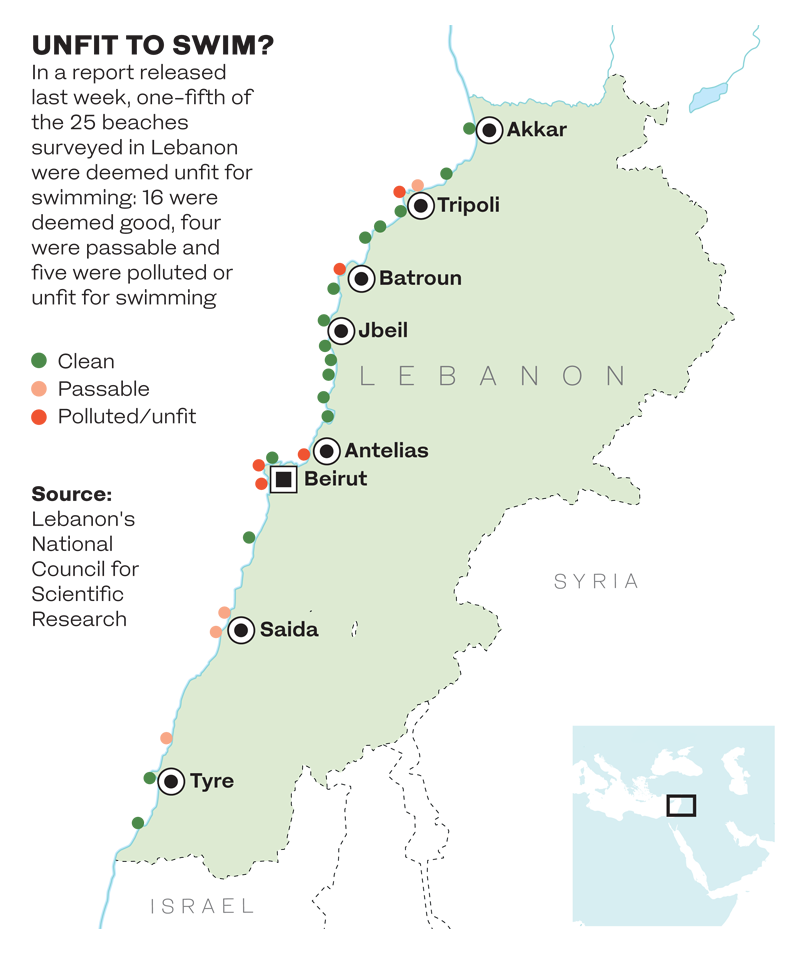
DUBAI: Lebanon is getting used to making headlines worldwide for its littered beaches and streets piled high with rubbish. Now a fifth of its beaches have been declared “unfit for swimming,” in a recent report by the National Council for Scientific Research (CNRS).

At a press conference last week, Mouin Hamze, the council’s secretary-general, announced that the 30-page report had found that “five of the 25 points surveyed were described as very polluted and not fit for swimming, while a further four were deemed acceptable and 16 deemed good.”
Those areas included Beirut’s only public beach, Ramlet Al-Bayda, and beaches in Antelias, Manara and Tripoli.

“Why isn’t the government serious about the clean-up of the Mediterranean Sea in Lebanon?” asked Paul Abi Rached, the founder of T.E.R.R.E. Liban, an environmental NGO.
“The government opens sea dumps on purpose. They keep the waste-water treatment plants closed. We have between 30 and 50 wastewater treatment plants that are closed.
“It’s unacceptable to leave sewage and solid waste lying in the ocean when they’ve signed the Barcelona Convention,” Abi Rached added.
Lebanon signed up to the Barcelona Convention in 1995, along with 15 other Mediterranean countries. The convention now has 22 entities signed up “to protect the Mediterranean marine and coastal environment while boosting regional and national plans to achieve sustainable development.”

Among the priorities for the 22 signatories are to “bring about a massive reduction in pollution from land-based sources” and “protect marine and coastal habitats and threatened species.” Both appear to be a long way from being implemented.
“The only way to solve this is to declare an environmental state of emergency,” said Abi Rached, who is also president of the Lebanon Eco Movement.
“We don’t need an environmental minister who understands the environment, we need an environmentally-friendly government — it’s the only solution for Lebanon.”
Lebanon gained worldwide notoriety in summer 2015 for the garbage crisis that began when the Naamah landfill site reached capacity and was closed. For months afterwards, with no alternative site, Beirut’s streets were filled with piles of rubbish that stretched for miles.
In January this year, the crisis resurfaced as rubbish was found strewn across a Lebanese beach, believed to have been washed down by stormy weather from a nearby landfill site on the coast, although the government denies this claim. Images of the beach, blanketed in rubbish, were shared on social media, fueling anger among residents and politicians.
A toxicology report by the Lebanese Agricultural Research Institute warned of sewage waste and found high concentrations of chemical and bacterial contamination, including large levels of mercury, copper, lead and cadmium.

Fishermen across the country are also protesting about the continuous pollution that is affecting the livelihoods that they depend on.
“Generally speaking, I am seeing that the beach is looking filthier and filthier by the day,” local diver Abdel Fattah Amhaz told Arab News.
“No one in Lebanon is abiding by the rules and taking care of the cleanliness of the beach.
“You have joggers running and throwing their trash in the sea, and the garbage dumps across the coast are leaking into the sea,” he said.
Amhaz added that various types of marine animals that used to be seen and caught in the sea are no longer found, with the main cause being heavy pollution and its effects on the ecosystem.
To illustrate his point about the declining marine life, Amhaz said that when he was a boy, as he and his friends walked along the seashore in Beirut they would feel the sea urchin shells prickling their feet. Now there is nothing.
“They transferred the sewers to our beach to displace us. We voted for you to fight corruption, but
instead, you’re fighting us,” said Idrees Atrees, head of the fishermen’s syndicate, addressing politicians in televised remarks to local media.
Many have been unable to fish as wastewater is being redirected from central Beirut to Jnah’s seaside, which has been causing the fishermen to change fishing locations several times to avoid sewage.
While all eyes may be on Lebanon for not taking care of its seashore, reports surfaced in Morocco earlier this week about the dire garbage situation on the country’s coast, stretching from the Atlantic Ocean to the Mediterranean Sea.
Despite a 2016 nationwide ban on plastic bags, rubbish still keeps piling up on the shores across the North African country, despite authorities keeping a strict and close eye on its implementation.
An analysis of 165 beaches at the start of the summer season showed 97 percent of waters “conform with microbiological standards,” compared to 72 percent in 2002, according to the Moroccan secretary of state for the environment.



Syrian military tells civilians to evacuate contested area east of Aleppo amid rising tensions

Updated 15 January 2026
Follow

Syrian military tells civilians to evacuate contested area east of Aleppo amid rising tensions

  • Syria’s military has announced it will open a “humanitarian corridor” for civilians to evacuate from an area in Aleppo province
  • This follows several days of intense clashes between government forces and the Kurdish-led Syrian Democratic Forces

DAMASCUS: Syria’s military said it would open a corridor Thursday for civilians to evacuate an area of Aleppo province that has seen a military buildup following intense clashes between government and Kurdish-led forces in Aleppo city.
The army’s announcement late Wednesday — which said civilians would be able to evacuate through the “humanitarian corridor” from 9 a.m. to 5 p.m. Thursday — appeared to signal plans for an offensive in the towns of Deir Hafer and Maskana and surrounding areas, about 60 kilometers (40 miles) east of Aleppo city.
The military called on the Kurdish-led Syrian Democratic Forces and other armed groups to withdraw to the other side of the the Euphrates River, to the east of the contested zone.
Syrian government troops have already sent troop reinforcements to the area after accusing the SDF of building up its own forces there, which the SDF denied. There have been limited exchanges of fire between the two sides, and the SDF has said that Turkish drones carried out strikes there.
The government has accused the SDF of launching drone strikes in Aleppo city, including one that hit the Aleppo governorate building on Saturday shortly after two Cabinet ministers and a local official held a news conference there.
The tensions in the Deir Hafer area come after several days of intense clashes last week in Aleppo city that ended with the evacuation of Kurdish fighters and government forces taking control of three contested neighborhoods. The fighting killed at least 23 people, wounded dozens more, and displaced tens of thousands.
The fighting broke out as negotiations have stalled between Damascus and the SDF, which controls large swaths of northeast Syria, over an agreement to integrate their forces and for the central government to take control of institutions including border crossings and oil fields in the northeast.
Some of the factions that make up the new Syrian army, which was formed after the fall of former President Bashar Assad in a rebel offensive in December 2024, were previously Turkiye-backed insurgent groups that have a long history of clashing with Kurdish forces.
The SDF for years has been the main US partner in Syria in fighting against the Daesh group, but Turkiye considers the SDF a terrorist organization because of its association with the Kurdistan Workers’ Party, or PKK, which has waged a long-running insurgency in Turkiye. A peace process is now underway.
Despite the long-running US support for the SDF, the Trump administration has also developed close ties with the government of interim Syrian President Ahmad Al-Sharaa and has pushed the Kurds to implement the integration deal. Washington has so far avoided publicly taking sides in the clashes in Aleppo.
The SDF in a statement warned of “dangerous repercussions on civilians, infrastructure, and vital facilities” in case of a further escalation and said Damascus bears “full responsibility for this escalation and all ensuing humanitarian and security repercussions in the region.”
Adm. Brad Cooper, commander of US Central Command, said in a statement Tuesday that the US is “closely monitoring” the situation and called for “all parties to exercise maximum restraint, avoid actions that could further escalate tensions, and prioritize the protection of civilians and critical infrastructure.” He called on the parties to “return to the negotiating table in good faith.”
Al-Sharaa blasts the SDF
In a televised interview aired Wednesday, Al-Sharaa praised the “courage of the Kurds” and said he would guarantee their rights and wants them to be part of the Syrian army, but he lashed out at the SDF.
He accused the group of not abiding by an agreement reached last year under which their forces were supposed to withdraw from neighborhoods they controlled in Aleppo city and of forcibly preventing civilians from leaving when the army opened a corridor for them to evacuate amid the recent clashes.
Al-Sharaa claimed that the SDF refused attempts by France and the US to mediate a ceasefire and withdrawal of Kurdish forces during the clashes due to an order from the PKK.
The interview was initially intended to air Tuesday on Shams TV, a broadcaster based in Irbil — the seat of northern Iraq’s semi-autonomous Kurdish region — but was canceled for what the station initially said were technical reasons.
Later the station’s manager said that the interview had been spiked out of fear of further inflaming tensions because of the hard line Al-Sharaa took against the SDF.
Syria’s state TV station instead aired clips from the interview on Wednesday. There was no immediate response from the SDF to Al-Sharaa’s comments.