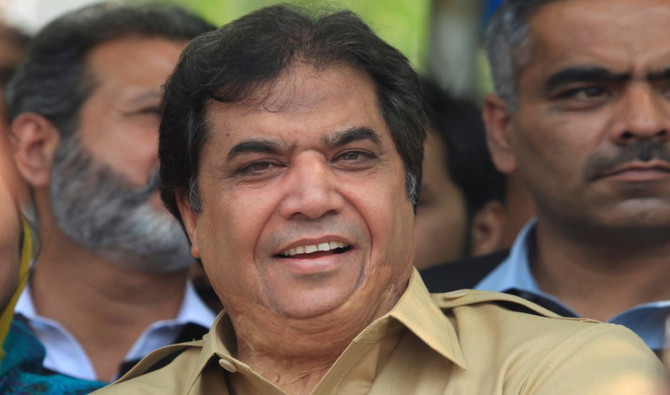
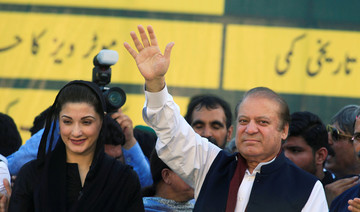
ISLAMABAD: A court on Saturday handed a life sentence to Pakistan Muslim League-Nawaz (PML-N) candidate Hanif Abbasi for misusing the controlled chemical ephedrine.
Abbasi and his supporters were in the courtroom during the verdict. He was to have contested the July 25 general election against Awami Muslim League chief Sheikh Rashid in the Rawalpindi NA-60 constituency.
Abbasi had failed to provide evidence that the ephedrine was used for pharmaceutical purposes, said the Control of Narcotic Substances court, which had been hearing the case since 2012. Critics are questioning the timing of the verdict, just four days before the election.


![]()



PML-N candidate given life sentence days before election

PML-N candidate given life sentence days before election
- Hanif Abbasi was contesting the July 25 general election against Awami Muslim League chief Sheikh Rashid in the Rawalpindi NA-60 constituency
- Abbasi had failed to provide evidence that the ephedrine was used for pharmaceutical purposes, said the Control of Narcotic Substances court
Pakistan urges climate change collaboration with UAE after record rains hit Gulf nation
- The storm first hit Oman over the weekend, before pounding the UAE on Tuesday with its heaviest rains in 75 years
- PM Shehbaz Sharif telephoned the UAE president, called for collective actions after rains kill over 70 people in Pakistan
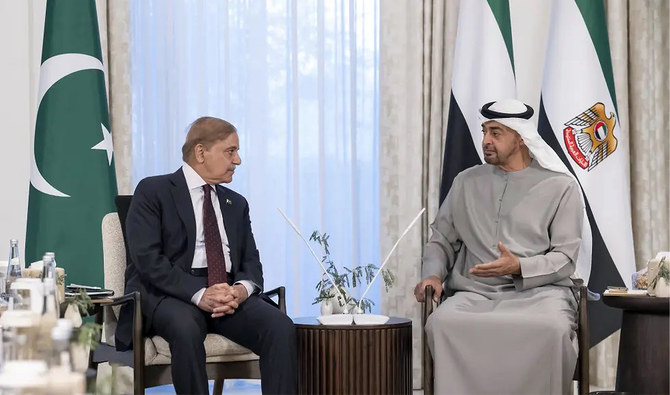
ISLAMABAD: Pakistan Prime Minister Shehbaz Sharif on Friday telephoned United Arab Emirates (UAE) President Sheikh Mohamed bin Zayed Al-Nahyan and urged collaboration between the two countries to tackle impacts of climate change, Pakistani state media reported, days record-breaking rains hit the Gulf nation.
The United Arab Emirates was still grappling on Friday with the aftermath of a record-breaking storm this week, with the main road connecting Dubai, the most populous emirate, with Abu Dhabi partially closed for traffic.
The storm first hit Oman over the weekend, killing at least 20 people, before pounding the UAE on Tuesday with its heaviest rains in 75 years of records. Scientists blame increasingly common extreme weather events, such as the rains in UAE and Oman, on human-led global warming.
During the telephonic conversation, Sharif lauded the UAE president for his “outstanding leadership qualities” and strong commitment to ensure the welfare of the Emirati people, the state-run APP news agency reported.
“The prime minister said that Pakistan had also witnessed heavy rains in recent days, resulting in loss of many precious lives,” the report read.
“He called for collective actions to combat the challenge of climate change and suggested that both countries strengthen their collaboration in the field.”
Pakistan has been prone to natural disasters and consistently ranks among one of the most adversely affected countries due to the effects of climate change. Torrential rains have killed more than 70 people in the South Asian country this month, according to authorities.
The UAE president appreciated the prime minister’s good wishes and reciprocated the warm sentiments for the people affected from rains and flooding in Pakistan, according to the APP report.
“Both leaders reaffirmed their commitment to enhance bilateral cooperation in multifaceted areas,” it added.
Over 600 IT firms, 100 foreigners attend ITCN tech conference in Lahore
- The three-day exhibition is set to fetch nearly $500 million investment from a dozen countries
- The companies participating in the expo include Microsoft, Inbox, Lenovo, HP, NetSol and Dell
ISLAMABAD: More than 600 IT companies, 55,000 participants, and around a hundred foreign delegates are attending an ongoing 24th edition of the Information Technology Commerce Network (ITCN) Asia Conference in the eastern Pakistani city of Lahore, Pakistani state media reported on Friday, citing officials.
The main sessions at the three-day tech event include the Artificial Intelligence Summit, Global Security Symposium, Gaming and Scholars Roundtable, Investor Summit, Freelancer Summit, Made in Pakistan Roundtable Conference.
State Minister for Information Technology and Telecommunication Shaza Fatima Khawaja said the objective of the event was to highlight the expertise and products of Pakistan’s IT sector at the international level.
“Sixty eight percent of Pakistan’s population consists of young people and IT is a field that has a lot of opportunities available for them,” she told Radio Pakistan broadcaster. “The government’s vision is to bring as much skill training as possible for the youth in the IT sector.”
Khawaja said the government would provide cheap loans to the IT sector so that freelancers could thrive.
“The government has started the Industry Academia Bridge Program under which IT students in universities can collaborate with the private sector to get practical training while studying and secure their jobs,” she added.
Speaking on the opening day of the event at Lahore’s Expo Center on Friday, Khawaja said it was an honor for Pakistan to be a founding partner of the Digital Cooperation Organization, a global multilateral body launched in November 2020 to help enable digital prosperity for all, and a testimony to the country’s readiness to be one of the leading stakeholders in the global IT ecosystem.
“Pakistan’s digital progress and its position as a global stakeholder is underscored by its vibrant youth as Pakistan produces 10,000 IT graduates every year,” she said.
“Together we will make Pakistan an IT hub as IT is the key toward growth of all sectors.”
A delegation of international investors belonging to 12 different countries is participating in the event that is expected to attract around $500 million investment, according to Pakistani state media.
Renowned international and national technology companies, including Microsoft, Inbox, Red Hat, TP-Link, Lenovo, HP, NetSol, Abacus and Dell, are participating in the three-day exhibition.
The event is being jointly supported by the Pakistani Ministry of Information Technology and Telecommunication, Pakistan Telecommunication Authority, Special Investment Facilitation Council (SIFC), Pakistan Software Export Board and Pakistan Software Houses Association.
Pakistan stocks close at record high amid IMF talks, tensions in Middle East
- The benchmark KSE-100 index surged by 647 points after morning trading hiccups due to reports of Israel’s attack on Iran
- Pakistani analysts say escalating tensions in Middle East will impact supply chain and increase import bill for Pakistan
KARACHI: Pakistan’s stock market recorded on Friday its highest-ever closing at 70,909 points, stock brokers and analysts said, attributing it to ongoing talks with the International Monetary Fund (IMF), but cautioning about potential economic impact of Israel-Iran tensions in the Middle East.
Explosions were heard in Iranian city of Isfahan on Friday that were described as an Israeli attack by western media. However, Tehran has not officially confirmed the development as its response remains muted.
The Pakistan Stock Exchange witnessed some nervousness in the morning trading session, when news of Israel’s attack on Iran came in. But despite the development, the benchmark KSE-100 index surged by 647 points to close at 70,909 points.
“When news of the attack on Iran came this morning, its impact was seen in the Asian and European markets at one point,” Shehryar Butt, portfolio manager at the Karachi-based Darson Securities, told Arab News.
“Nikkei saw a decline of more than a thousand points, but despite this, the Pakistan Stock Exchange performed much better.”
The Pakistani bourse has recently been trading at record highs amid positive sentiment prevailing among investors due to hopes of the country’s successful talks with the IMF.
“The basic reason for this is that Pakistan is currently in the IMF program, and very serious discussions are taking place in Washington at this time,” Butt said.
Pakistan’s finance minister, Muhammad Aurangzeb, is currently in Washington to hold talks with IMF officials for a new long-term loan program as Pakistan’s current $3 billion program is due to expire this month. The finance minister has expressed his hopes that the outline of the new program will be agreed next month.
Pakistan is expected to demand a loan size of around $7 billion but Jihad Azour, the IMF Middle East and Central Asia Director, said on Wednesday the reform package was more important than the size of the program.
“I would say the package of reform is now more important than the size of the program because we saw recently that the right measures provided the right response,” Azour said at a press briefing.
The surge in global oil prices amid geo political tensions and the Pakistani rupee’s recovery played “a catalyst role in Friday’s record close,” according to Ahsan Mehanti, CEO of the Arif Habib Corporation.
Though Pakistan’s market downplayed the Middle East tensions, but analysts said if the situation escalated, it would disrupt supply chain and impact Pakistan’s economy.
“The conflict between Iran and Israel will affect the Pakistani economy, quite a negative effect will be seen on the Pakistani economy because immediately after that, we saw geo-political situation worsening and oil started to rise,” Butt said, adding the rising global oil prices would impact Pakistan’s import bill.
Pakistan has imported petroleum products worth $12 billion during the July-March period of the current fiscal year, including $3.9 billion worth of crude oil and 2.9 billion worth of liquefied natural gas (LNG), according to official data.
Butt feared that if the situation persisted, then the attention of Saudi Arabia would also be drawn to the Middle East and the investment commitments made by the Kingdom with Pakistan could be delayed.
Haroon Sharif, an economist and former chairman of the Pakistan Board of Investment, said if the tensions in the Middle East escalated, their first impact would be on the stock market as foreign investors would like to shift their capital to safer markets.
“Another impact would be oil price escalation, hitting Pakistan’s trade deficit and traveling and cargo price would also escalate, increasing the cost of doing business,” Sharif said, adding that investors would hold their future expansion and investment plans till situation becomes stable.
Husain Haqqani, a former Pakistani ambassador to the United States and scholar at Washington DC’s Hudson Institute, said a prolonged conflict between Iran and Israel would increase uncertainty and instability across the Middle East.
“If Iran’s drone and missile attack on Israel was meant to show Iran’s reach, Israel has demonstrated its ability to strike deep inside Iran,” Haqqani told Arab News.
“Iran has several proxies that it can use while Israel has tremendous military and intelligence capabilities. Leaders of both countries have domestic political reasons to not be forgiving toward one another.”
Haqqani said the US would likely restrain Israel, while Iran would be constrained by its limited capability.
“After all, even after attacking with hundreds of missiles and drones, Iran was unable to cause real damage on ground in Israel,” he added.
After Pakistan alert, WHO likely to issue wider warning on contaminated J&J cough syrup
- The UN health body said it puts out global medical product alerts to ‘encourage diligence’ by authorities
- The WHO this week sent out alert on five batches of contaminated cough syrup ingredients found in Pakistan
LONDON: The World Health Organization is likely to issue a wider warning about contaminated Johnson and Johnson-made children’s cough syrup found in Nigeria last week, it said in an email.
Nigeria’s regulator recalled a batch of Benylin paediatric syrup last Wednesday, having found a high level of diethylene glycol in the product during routine testing.
The contaminant, alongside another closely related toxin, ethylene glycol, has been linked to the deaths of more than 300 children in Cameroon, Gambia, Indonesia and Uzbekistan since 2022, though there is no evidence that these incidents are linked with the latest recalls.
The UN health body said it puts out global medical product alerts to “encourage diligence” by national authorities and was likely to do so in this instance, “subject to confirmation of certain details from parties.”
The recalled batch of Benylin syrup was made by J&J in South Africa in May 2021, although Kenvue now owns the brand after a spin-off from J&J last year.
J&J has referred requests for comment to Kenvue. In an emailed statement on Friday, Kenvue said it had carried out tests on the batch recalled by Nigeria and had not detected either diethylene or ethylene glycol.
“We continue to work closely with health authorities and the WHO and are engaging with NAFDAC to understand their test results, including verifying the authenticity of the sampled product, the testing methodology used, and results reported by the agency,” the statement added.
Since Nigeria’s recall, five other African countries have also pulled the product from shelves — Kenya, Rwanda, Tanzania, Zimbabwe and South Africa, where the drug was made.
South Africa’s regulator has also recalled another batch of the syrup, which is used to treat coughs, hay fever and other allergic reactions in children.
Diethylene glycol is toxic to humans when consumed and can result in acute kidney failure, although there have been no reports of harm in the latest incident.
RAW MATERIALS
In the 2022 cases, the contamination in the syrups came from the raw materials used by manufacturers in India and Indonesia.
The WHO said it was collaborating with both the manufacturer and regulatory authority in South Africa to investigate the Benylin paediatric syrup, and had information on the source of the ingredients used. Kenvue has previously said it tested its ingredients before manufacture.
The agency said the possibility that the syrup was counterfeit was also “under consideration as part of investigations.”
Earlier this week the WHO sent out a separate alert on five batches of contaminated cough syrup ingredients found in Pakistan that appeared to have been falsely labelled as Dow Chemical products.
It was the first alert the WHO has sent on excipients — elements of a medicine other than the active pharmaceutical ingredient — rather than finished products, the agency confirmed on Friday.
The batches of propylene glycol were contaminated with ethylene glycol.
“It was critical for WHO to also alert manufacturers that may have been procuring this material to exercise more caution,” a WHO spokesperson said by email.
Propylene glycol is not an ingredient in Benylin paediatric syrup, a Kenvue spokesperson said on Friday.
Death toll from heavy rains in northwest Pakistan rises to 39
- The rains that began last Friday have damaged 2,391 houses across the northwestern Khyber Pakhtunkhwa province
- In southwestern Balochistan province, heavy rains have killed 15 people, triggered flash floods in several areas
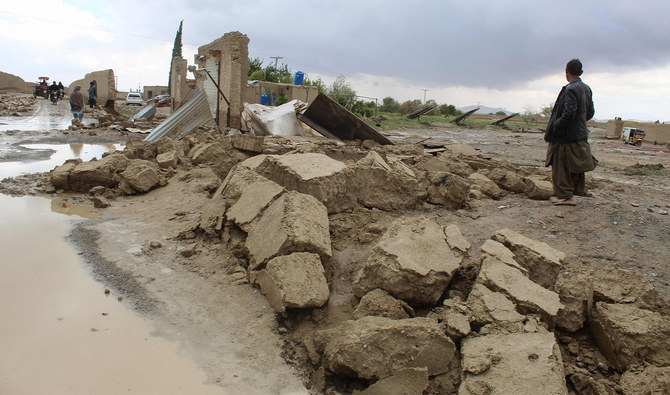
PESHAWAR/QUETTA: The death toll from continuing rains in Pakistan’s northwestern Khyber Pakhtunkhwa (KP) province has risen to 39, while another 54 people have been injured in various incidents, the KP Provincial Disaster Management Authority (PDMA) said on Friday.
The rains that began last Friday have caused damages to 2,391 houses in several districts across the province, according to the PDMA.
Khyber, Dir Lower and Upper, Chitral Upper and Lower, Swat, Shangla, Bajaur, Malakand, Karak and Tank districts have been declared the most affected by the downpours.
“As many as 23 children, eight men and eight women are among those died in rain related incidents during the last eight days,” the PDMA said in a statement on Friday.
The current spell of showers, which began on April 17, was likely to continue till April 21, the PDMA said this week.
The provincial government has released Rs110 million to be distributed among the affected families and dispatched aid, including tents, kitchen kits, blankets, hygiene kits, mosquito nets and mattresses, to the affected areas, according to the authority.
As the rains were expected to continue intermittently until April 21, the PDMA said it had already a letter to administration of all districts to remain alert and take precautionary measures.
In the southwestern Balochistan province, heavy rains have killed 15 people since Friday and triggered flash floods in several areas, according to provincial authorities.
Balochistan Chief Minister Sarfaraz Bugti said climate change had become a “challenge” for the provincial government.
“Current rains are unusual which were never reported in a thousand years,” he told reporters on Friday. “The government has been helping the masses with available resources and our teams have reached all districts to help the people affected by rains and floods.”
Pakistan has received heavy rains in the last three weeks that have triggered landslides and flash floods in several parts of the South Asian country.
The eastern province of Punjab has reported 21 lighting- and roof collapse-related deaths, while Balochistan, in the country’s southwest, reported 10 deaths as authorities declared a state of emergency following flash floods.
In 2022, downpours swelled rivers and at one point flooded a third of Pakistan, killing 1,739 people. The floods also caused $30 billion in damages, from which Pakistan is still trying to rebuild.
Latest updates





Recommended



© 2024 SAUDI RESEARCH & PUBLISHING COMPANY, All Rights Reserved And subject to Terms of Use Agreement.