WASHINGTON: A 29-year-old gun-rights activist served as a covert Russian agent while living in Washington, gathering intelligence on American officials and political organizations and working to establish back-channel lines of communications for the Kremlin, federal prosecutors charged Monday.
The announcement of the arrest of Maria Butina came just hours after President Donald Trump met with Russian President Vladimir Putin and just days after special counsel Robert Mueller charged 12 Russian intelligence officials with directing a sprawling hacking effort aimed at swaying the 2016 election.
Mueller didn’t file the charge against Butina, but court papers show her activities revolved around American politics during the 2016 campaign and included efforts to use contacts with the National Rifle Association to develop relationships with US politicians and gather intelligence for Russia.
Court papers also reveal that an unnamed American who worked with Butina claimed to have been involved in setting up a “private line of communication” ahead of the 2016 election between the Kremlin and “key” officials in an American political party through the NRA.
The court papers do not name the political party mentioned in the October 2016 message, but they contain details that appear to refer to the Republican Party. The documents don’t say whether the back channel was ever established.
The NRA, which has previously been connected to Butina in public reporting and information released by members of Congress, did not immediately respond to requests for comment.
Butina, a Russian national who has been living in the US, was charged with conspiracy to act as an unregistered agent of the Russian government. A federal judge in Washington ordered her jailed until a hearing set for Wednesday, according to a statement from the Justice Department and Jessie Liu, the US Attorney for the District of Columbia.
In a statement, Butina’s attorney, Robert Driscoll, called the allegations “overblown” and said prosecutors had criminalized mundane networking opportunities. Driscoll said Butina was not an agent of the Russian Federation but was instead in the US on a student visa, graduating from American University with a master’s degree in international relations.
“There is simply no indication of Ms. Butina seeking to influence or undermine any specific policy or law or the United States — only at most to promote a better relationship between the two nations,” Driscoll said in a statement. “The complaint is simply a misuse of the Foreign Agent statute, which is designed to punish covert propaganda, not open and public networking by foreign students.”
He said Butina’s Washington apartment was raided by the FBI in April, and said she had offered to answer questions from the Justice Department and Mueller’s team but the special counsel’s office “has not expressed interest.”
Court papers filed in support of Butina’s arrest accuse her of participating in a conspiracy that began in 2015 in which an unnamed senior Russian official “tasked” her with working to infiltrate American political organizations with the goal of “reporting back to Moscow” what she had learned.
The charging documents include several emails and Twitter direct message conversations in which she refers to the need to keep her work secret or, in one case, “incognito.”
Authorities did not name the Kremlin official accused of directing Butina’s efforts, but details in the court papers match the description of Alexander Torshin, a Russian official who has been publicly connected to her.
Torshin, who became an NRA life member in 2012, was among a group of Russian oligarchs and officials targeted in April with Treasury Department sanctions for their associations with Putin and their roles in “advancing Russia’s malign activities.” Torshin, who was listed as “State Secretary-deputy Governor of the Central Bank of the Russian Federation,” was designated under the sanctions as a Russian official.
The sanctions affect the targeted Russians by freezing all of their assets subject to US jurisdiction and banning Americans and US businesses from conducting transactions with them.
Prosecutors say Butina, at the official’s direction, met with US politicians and candidates, attended events sponsored by special interest groups — including two National Prayer Breakfast events — and organized Russian-American “friendship and dialogue” dinners in Washington as part of her work.
Court papers also show that after the 2016 election, Butina worked to set up a Russian delegation’s visit to the 2017 National Prayer Breakfast, describing it in an email as an effort to “establish a back channel of communication.” After the visit, Butina emailed the organizer of the breakfast thanking him for a gift and “for the very private meeting” that followed the breakfast.
“A new relationship between two countries always begins better when it begins in faith,” Butina wrote, saying she had “important information” that would further the new relationship.
Two days later, she emailed another American who had been involved in some of the email communication surrounding the prayer breakfast and her efforts to arrange several dinners between Russians and people involved in US politics.
“Our delegation cannot stop chatting about your wonderful dinner,” Butina wrote. “My dearest President has received ‘the message’ about your group initiatives and your constructive and kind attention to the Russians.”
Butina has previously surfaced in US media reports related to her gun-rights advocacy.
In 2011, she founded a pro-gun organization in Russia, the Right to Bear Arms, and she has been involved in coordinating between American gun rights activists and their Russian counterparts, according to reports in The New York Times, Time and the Daily Beast.
Butina hosted several leading NRA executives and pro-gun conservatives at her group’s annual meeting in 2015, according to those reports. Among those who attended were former NRA President David Keene, conservative political operative Paul Erickson and former Milwaukee County Sheriff David Clarke, later a strong Trump supporter.
Butina also says she met with Wisconsin Gov. Scott Walker at his presidential campaign launch event in 2015, according to a report by Mother Jones magazine earlier this year.


![]()

US arrests, accuses woman of acting as Russian agent
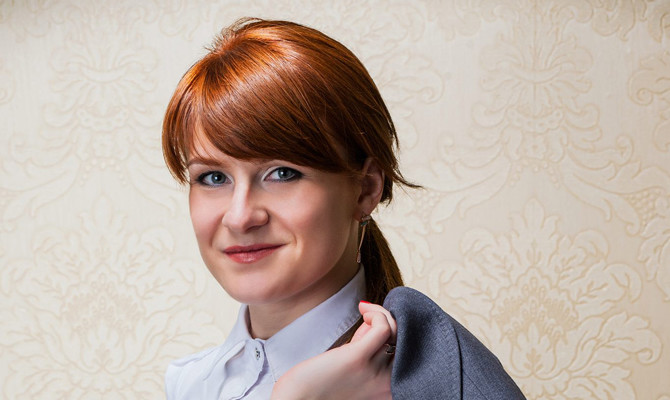
US arrests, accuses woman of acting as Russian agent
- Butina, a Russian national who has been living in the US, was charged with conspiracy to act as an unregistered agent of the Russian government
- The charging documents include several emails and Twitter direct message conversations


Latest updates




© 2026 SAUDI RESEARCH & PUBLISHING COMPANY, All Rights Reserved And subject to Terms of Use Agreement.