
JEDDAH: Sometimes you have to wonder what you have gotten yourself into. Arriving at the home of a woman who owns 300 rescued cats is such a time. It all seems too good to be true, like some sort of ruse or lure to ensnare the innocent or naive.
As we were led to her first-floor living room, however, we were reassured by the obvious warmth radiating from Farah Al-Gonzalas and her five domestic cats, which were surprisingly unperturbed by the arrival of strangers.
Like a magician pulling a rabbit from a hat, she plucked a five-week-old kitten, called Lily, from a hammock-style cage. She was still bottle-feeding the tiny creature, and while doing so she showed us a video clip of a man leaving the kitten on her doorstep three weeks earlier.
As if the kittens were magically multiplying, Al-Gonzalas pulled three more kittens, slightly older than the first, from a tent in which they were playing.
She had to drag us away from these cute, fur-coated flurries to begin the actual tour of her home-turned-cat sanctuary. On our way downstairs, pausing to return Lily to her hammock, we noticed closed doors leading to two rooms.
“The cats kept in these rooms are either too mischievous or do not mix well with others,” said Al-Gonzalas.
Her crusade began seven-and-a-half years ago when she and her husband began feeding street cats outside their home. That led to neighbors complaining that they were attracting more cats to the area. Eventually, the couple rescued a cat and took it into their home. It was to be the first of 300.
Care for cats
They now rescue and care for all kinds of cats, including those with special needs, such as the blind and physically challenged, the undesirable, the diseased and the old.
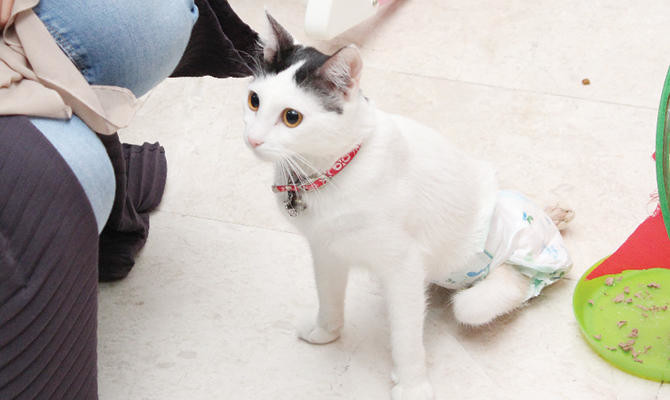
Upon entering the living room, on the ground floor, we were greeted by a hit-and-run survivor who lost the use of his rear legs in the accident.
The brave creature soldiers on, using his front legs to drag himself around and play with the other cats. Al-Gonzalas told how a vet had advised her to have the animal put to sleep, to which she responded: “If he wants to live, who am I to stop him?”
In an adjoining room, we were awestruck by the number of cats that greeted us — so many breeds, some of which we had never seen before, but all well-behaved and loving. They surrounded us, eager to be petted and adored, full of affection and in need of attention.
Al-Gonzalas regularly checks every single cat to make sure they are all in the best of health, and while busy petting and stroking them, she took the chance to do her checkups, immediately noting any that showed signs of illness and treating them as required.
That done we ventured, like Alice in Wonderland, deeper down the rabbit hole — or in this case, the cat hole — descending to the basement. The moment the door closed behind us, we were swarmed by affection-seeking cats; some even ended up on our shoulders. The basement was divided into two sections by sliding, glass doors, which helps to prevent the cats feeling isolated.
“When my husband and I were moving into the house, the moment I saw the basement I visualized it looking like this,” said Al-Gonzalas. Cages upon cages of cats, including entire families, are free to roam the space, with toys scattered across the floor along with bowls of food.
We stepped out into the backyard and met the most loving cat of them all, one who continues to tap people on the shoulder until they pet him.
He turned out to have the saddest story of any of the cats here. He was found to be infected with an extremely contagious disease called calicivirus, which can cause a number of health problems, including bleeding from the eyes and nose, mouth ulcers, pneumonia and respiratory problems. Despite all the difficulties, and the risk of the infection spreading, Al-Gonzalas refused to give up on him.
“I isolated him,” she said. “I used to wear double gloves and sanitize whatever and wherever the cat touched. I was so scared because if any of my other cats caught it, it meant the end for all of them. For 15 days, the cat survived only on antibiotics. The cat is now fully cured otherwise we would’ve not been able to come near him.”
Despite having more than 300 cats to care for, Al-Gonzalas knows every single one of them, their habits, names, conditions and stories — but unsurprisingly, it is not always easy. She has faced many challenges and overcome many obstacles since her crusade began.
She is always looking for people who can help her with her vocation, whether through financial aid or volunteering to lend a hand. She needs both — in addition to the cats she cares for in her home, she also feeds about 600 street cats in her neighborhood every day while cycling.
Al-Gonzalas is selfless in her tireless devotion to her rescue efforts, voluntarily providing an extraordinary community service by taking care of and nurturing animals that would otherwise have been abandoned, ignored and forgotten, especially the most helpless and needy among then — all without asking for a thing in return. She has become a source of solace to her cats, and they to her.