

China launches two satellites for Pakistan

1 / 2
PakTES-1A – is Pakistan’s indigenously developed remote sensing. (Photo courtesy: Press Information Department)
2 / 2
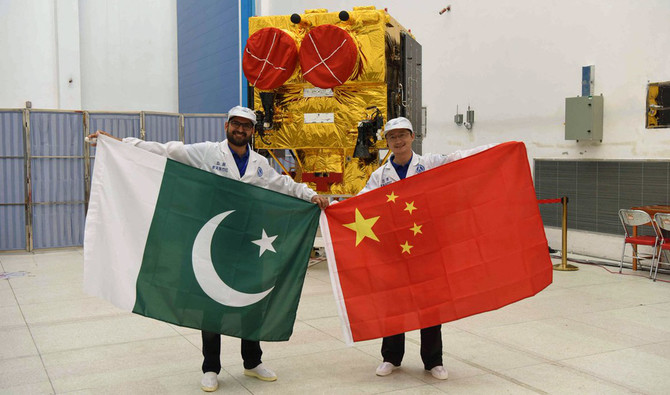
Pakistani and Chinese nationals holding the flags of their respective countries before the launch. (Photo courtesy: Press Information Department)
Updated 10 July 2018
Follow

China launches two satellites for Pakistan

  • PakTES-1A, Pakistan’s indigenously developed remote sensing satellite, was launched from northwest China along with PRSS-1
  • Satellite PRSS-1 will be used for land and resources surveying and monitoring of natural disasters, according to Pakistan officials

ISLAMABAD: China launched two satellites, “PakTES-1A” and “PRSS-1,” for Pakistan on Monday.
Remote Sensing Satellite-1 (PRSS-1) was launched by LM-2C/SMA launch vehicle from Jiuquan Satellite Center, China, said the Ministry of Foreign Affairs in a statement.
“The 1,200 kg satellite PRSS-1 will operate at an altitude of 640 km,” the ministry added.
“The satellite will enable Pakistan to meet its imagery requirements in the areas of land mapping, agriculture classification and assessment, urban and rural planning, environmental monitoring, natural disaster management and water resource management for socio-economic development of the country, the statement said.
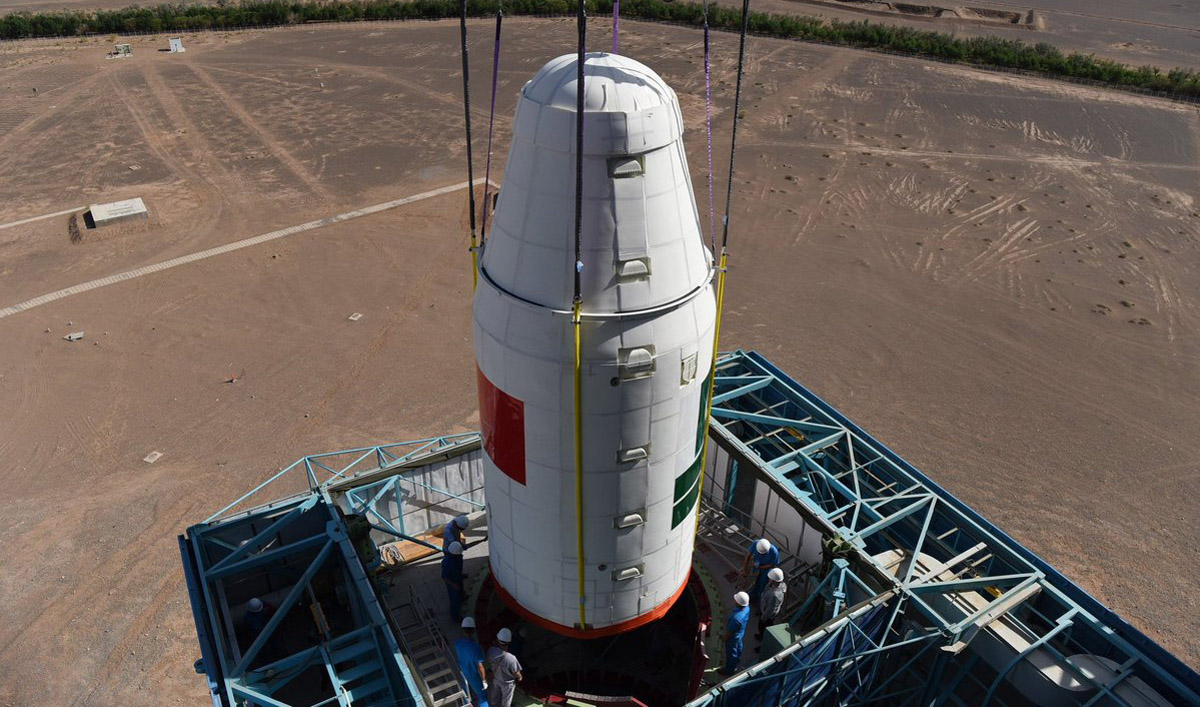


Satellites for Pakistan were launched on a Long March-2C rocket from Jiuquan Satellite Launch Center in northwest China (Photo courtesy: Press Information Department)

Pakistan Technology Evaluation Satellite-1A (PakTES-1A), indigenously designed and developed by the engineers at Space and Upper Atmosphere Research Commission (SUPARCO), has also been co-launched with PRSS-1 by the same launch vehicle, according to the statement.
“PakTES-1A is a 285 kg satellite equipped with an optical payload commensurate with national needs. It has a design life of three years and will operate at an altitude of 610 km,” said the Foreign Ministry.
Pakistan noted that “the successful implementation of PRSS-1 and PakTES-1A projects has further strengthened the space cooperation between Pakistan and China for future collaborations.”
President Mamnoon Hussain and Prime Minister Prime Minister Justice (Retd) Nasir-ul-Mulk have congratulated the nation on this historic event and appreciated SUPARCO’s efforts.
“The prime minister has assured the nation and SUPARCO of complete support for further advancement in space technology, so vital for socio-economic development and the national security of Pakistan,” the Foreign Ministry said.
Pakistan’s first indigenously developed satellite, Badr-1, was launched into low Earth orbit in July 1990 with the help of a Chinese rocket carrier, SUPARCO stated on its website. Badr-2 was launched in December 2001 to explore the upper atmosphere and near space.


EU criticizes Pakistan over jailing of rights lawyers, flags free speech concerns

Updated 4 sec ago
Follow

EU criticizes Pakistan over jailing of rights lawyers, flags free speech concerns

  • EU says the convictions of Imaan Mazari-Hazir, Hadi Ali Chattha violate freedom of expression
  • Both lawyers were arrested last week over social media posts under Pakistan’s cybercrime laws

KARACHI: The European Union on Thursday criticized Pakistan over the conviction of two human rights lawyers for their social media activity, saying the ruling ran counter to freedom of expression and the independence of the legal profession, core democratic principles that Islamabad is committed to uphold under international law.

Imaan Mazari-Hazir and her husband Hadi Ali Chattha were arrested last Friday as they were on their way to a court appearance and were later remanded to two weeks in judicial custody.

Authorities accused them of violating the Prevention of Electronic Crimes Act (PECA) over posts on X that they said incited ethnic divisions and portrayed the military as being involved in “terrorism.” Both deny the allegations.

“The conviction of human rights lawyers Imaan Mazari and Hadi Ali Chattha over social media activity goes against freedom of expression and independence of lawyers,” Anouar El Anouni, the EU’s spokesperson for foreign affairs and security policy, said in a post on X. “These are not only key democratic principles but also part of Pakistan’s international human rights commitments.”

Pakistan is one of the largest beneficiaries of the EU’s Generalized Scheme of Preferences Plus (GSP+), which grants duty-free access to most European markets in return for implementing 27 international conventions covering human rights, labor standards, environmental protection and good governance.

Pakistan’s GSP+ status came under scrutiny in the past after, in April 2021, the European Parliament adopted a resolution calling for an immediate review, citing concerns over violence against religious minorities, curbs on media freedom and broader human rights issues.

Earlier this week, lawyers in Pakistan’s capital went on strike and announced plans to stage a protest against the court ruling, which handed Mazari-Hazir and Chattha a cumulative 17-year sentence.
The Pakistani government has not yet responded to the EU statement.