LONDON: Mosul’s citizens will need to take part in reconstruction efforts, experts have said.
Back in July 2014, the leader of the Daesh, Abu Bakr Al-Baghdadi, made his infamous appearance in the Great Mosque of Al-Nuri in Mosul to proclaim the creation of the new "caliphate" after his forces had taken over the Iraqi city.
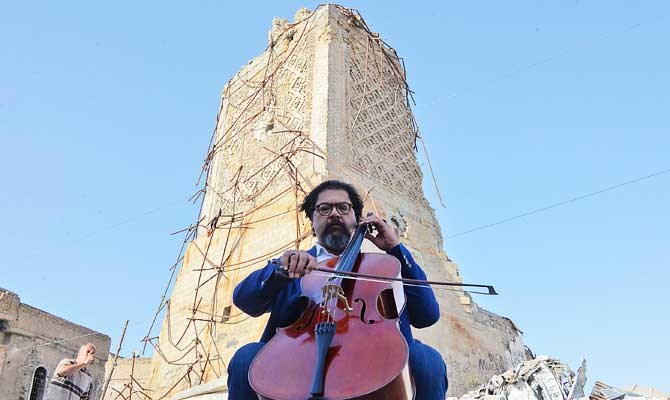
The mosque — which dates back to the 12th century — was later destroyed during fighting between extremist forces and government troops, along with the iconic "leaning" Al-Hadba minaret.
With Mosul now liberated from Daesh forces, efforts are being led by Iraq’s Gulf neighbor, the UAE, along with UNESCO, to rebuild the mosque and tower following a deal agreed on April 23, 2018.
There are plans to restore the site of the mosque, details of which were outlined in an event in London on Monday. Preliminary plans include creating a memorial and a museum on the site of the mosque to document both the history of its recent destruction and its role in Iraqi history over the centuries.
A replica of the minaret is also planned — and after much debate, the tower’s famous "lean" will be recreated. The project will take five years to complete.
It is hoped that the restoration of Mosul’s well-known and revered landmarks will act as a new symbol of unity for a city that continues to be divided by sectarian violence.
“Culture (in Mosul) was directly targeted by Daesh. It was very much part of the warfare strategy of Daesh and how to fragment Iraq,” said Louise Haxthausen, director, UNESCO office for Iraq, on the sidelines of an event in London on Monday.
“Therefore, we believe that cultural heritage, rehabilitation, reconstruction, has to be a key element of building peace and social cohesion and has to be seen as something that unites people,” she told Arab News.
“It is because it is seen as something that unites people that it was destroyed (in the first place) as that is precisely what Daesh didn’t want,” she said.
Noura bin Mohammed Al-Kaabi, Minister of Culture and Knowledge Development in the UAE said during the London event that Daesh had "tainted" the image of Islam, and she emphasized that the rebuilding of the mosque would be a uniting force for Mosul’s people.
“Islam is about coexistence, it is about tolerance,” she said, noting how in the aerial footage of Mosul shown during the talk mosques were situated alongside the city’s churches and synagogues.
“We speak the same language, we share the same culture. There is more to share and there is more in common between us,” she said, explaining why the UAE is stepping in to help with the reconstruction of Iraq.
Yet it is not only the famous sites of Mosul that lie in ruins. People’s homes, shops and restaurants have been reduced to rubble, particularly in the west of the city.
Libraries and other cultural centers were systematically targeted by Daesh, with thousands of books and ancient manuscripts destroyed.
Renad Mansour, research fellow, Middle East and North Africa Program at Chatham House in London, said at the event that given the extent of the destruction of Mosul, together with the increasingly difficult daily lives of its citizens, reconstruction efforts would be tough.
Corruption would continue to hinder attempts to rebuild the city, he told the event attendees.
“We have had a military victory over Daesh – but we have yet to see a political, economic or structural solution that makes Iraqis convinced that the state represents them or serves their needs. The only way to do that is to bridge that gap between elites and citizens,” Mansour said.
“Putting money and investing through these projects doesn’t seem to work when the structure isn’t sufficient, (when) the cash doesn’t trickle down to the citizens,” he added.
Both Al-Kaabi and Haxthausen said the rebuilding of the mosque and minaret would go beyond just providing “symbolic” hope. It would also provide the city’s young people with much-needed jobs and education.
Both the UAE and UNESCO added that they would work closely with both the locals and Mosul authorities to ensure they have a say in the process.
“We are not going to impose on them how the reconstruction will happen. We are going to be there to help strengthen their capacity to do the reconstruction,” said Haxthausen.
“It is not for UNESCO to decide. This is about Iraq – it is for the Iraqis to take the decision.”


![]()

UAE backs restoration of ‘symbolic’ Mosul mosque after destruction by Daesh
UAE backs restoration of ‘symbolic’ Mosul mosque after destruction by Daesh
- Libraries and other cultural centers were systematically targeted by Daesh, with thousands of books and ancient manuscripts destroyed
- A replica of the minaret is also planned — and after much debate, the tower’s famous "lean" will be recreated


Latest updates


© 2026 SAUDI RESEARCH & PUBLISHING COMPANY, All Rights Reserved And subject to Terms of Use Agreement.