


ISLAMABAD, PESHAWAR: Federal and provincial committees of the caretaker setup agreed to an ordinance on Wednesday to streamline issues of the Federally Administered Tribal Areas (FATA) and the northwest province of Khyber-Pakhtunkhwa’s (KP) historic merger bill passed late May — days before the outgoing government finished its five-year term.
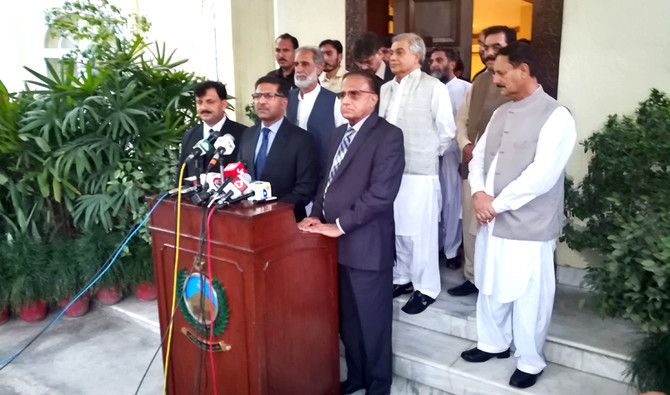
The committees headed by interim Federal Law Minister Barrister Syed Ali Zafar and caretaker Chief Minister (CM) of KP, former Justice Dost Muhammad Khan, held a meeting in the provincial capital city of Peshawar to discuss the draft of the framework which will be conveyed to the federal cabinet for approval.
“Both (committees) agreed to an ordinance or notification by the federal government to remove the legal weaknesses in the law for the merger of new districts (formerly known as tribal agencies) into Khyber Pakhtunkhwa. The process of implementation would take off soon after the ordinance (is promulgated),” said the official statement released after the meeting.
Speaking to media at the Chief Minister Secretariat after a meeting of the federal and provincial implementation committees, Zafar said that they pondered over administrative, infrastructural and judicial reforms, and the tax exemption issue. “The Election Commission of Pakistan (ECP) would carry out delimitation of constituencies and hold provincial assembly elections within a year,” he said.
The law minister acknowledged that the ordinance is designed to address political, judicial, administrative and security challenges in the absence of an elected government following the merger legislation that was passed in haste by the upper and lower house of the parliament without a solid framework.
The two sides also discussed the “developmental package” for the former tribal belt, and “the overall reconstruction and rehabilitation” including “the extension of different public-sector institutions to the newly merged districts.”
The daunting task to uplift the restive area requires serious funding, which KP’s caretaker CM seeks assistance from the federal government to bankroll, but said that his administration would seek donors to “reduce the financial burden.”
KP’s list of challenges, which will be passed on to the political party that wins the majority in the province to form a government, includes the “revival of economic activities, the establishment of public-sector universities and colleges, a new system of governance to mitigate the sufferings of tribal (areas),” tackling unemployment, the “creation of divisional headquarters, district headquarters” and “exemption of taxes” for the tribes from “federal and provincial governments.”
The constitutional bill removed the colonial-era boundaries separating the seven semi-autonomous tribal areas from KP and northern Baluchistan, abolishing the draconian law of Frontier Crimes Regulation (FCR), framed by the British Empire in the 19th century, which Pakistan continued to enforce after partition in the volatile region.
“All the laws applicable to the KP are now applicable to the former FATA, but since no judicial system exists there the law’s implementation will take time and require a system,” Zafar said.
The mountainous tribal region of the country, which straddles across into Afghanistan, has remained Pakistan’s most neglected, impoverished and underdeveloped area lacking all basic facilities. Comprised of at least a dozen tribes, the former FATA has a long history of suffering and setbacks plagued by terrorism, militancy, military operations and displacement.
Zafar agreed to “the provincial government’s proposals” and gave an assurance that “the federal government” would facilitate “the smooth transition of mainstreaming” former FATA into KP. The federation would inject more than $82 million per annum for up to 10 years, he said.
Peshawar-based analyst Lehaz Ali told Arab News that the KP government lacks the resources to expand its governance to new districts.
“I don’t think the newly elected government would be able to address most of the problems within a year; however, the administrations should take on matters one at a time such as health care and education first, and expand policing.”
Zafar said: “It is not possible to provide a provincial law and order force in Fata, extend the jurisdiction of the Supreme Court and high court to the tribal areas and introduce a taxation system there within days. At the time of the merger, the time period was not announced for all those things.”
Meanwhile, a senior official at the FATA Secretariat told Arab News that among the challenges confronting the merger was the Khasadar force (tribal police) comprising personnel inducted from all the tribal districts.
The Khasadar force held a grand jirga in Jamrud and announced a boycott of their duties if the police department was introduced to the new tribal districts.
They said that they would resist structural changes in the administrative hierarchy under the command of the police department.
The Khasadrs jirgaa also demanded salaries on a par with Frontier Corps (FC) personnel and inclusion of all admissible allowances in their monthly pay.
“The situation is growing sensitive and Khasadars may create a law and order situation in the tribal districts,” said the letter issued by Zahid Usman, the assistant commissioner (formerly assistant political agent) of Jamrud in the Khyber tribal district.
Zafar urged everyone, including the Khasadars, to cooperate in FATA mainstreaming, which he called a historical decision since the creation of Pakistan to develop the tribal region.
“We will discuss and decide the issue of Khasadars to find a solution to the matter,” he said.


