MAE SAI: Thai rescuers on Thursday said they may be prodded into a complex extraction of 12 boys and their football coach from a flooded cave if forecast rains hammer the mountainside and jeopardize the rescue mission.
Thirteen sets of diving equipment have been prepared for the team, who have endured 12 nights underground in the Tham Luang cave complex in northern Thailand, a saga that has transfixed a nation and united Thais in prayers for their safe return.
Water is being pumped out from the deluged cave round-the-clock, reducing the flooding by one centimeter an hour.
But with rain forecast to begin on Friday, the Chiang Rai provincial governor helming the unprecedented rescue effort conceded the mission was now “a race against the water.”
“Our biggest concern is the weather. We are calculating how much time we have if it rains, how many hours and days,” Narongsak Osottanakorn told reporters, without providing further details.
In a sign of increased urgency, Narongsak said medics and Thai Navy SEAL divers are assessing whether the boys are fit and well enough to be taken out early — apparently softening his instance on Wednesday that “no risk” will be taken with the evacuation.
The prospect of the stranded team diving out is fraught with risk.
It takes seasoned cave diving experts around six hours to reach the muddy ledge where the boys are sheltering.
Many of the youngsters — who are aged between 11-16 — are unable to swim and none have diving experience.
Three days after contact was made with the group, Thai Navy SEAL experts continued to teach them the basics of diving.
But the areas where diving is still necessary are tight and may require the boys to swim through murky waters unaccompanied.
The looming rains have further tweaked anxiety among relatives of the trapped team, who on Wednesday appeared smiling, wrapped in foil blankets and in good health in video footage circulated by the Thai Navy.
“Yesterday I felt hopeful... today I heard the rain is coming,” said Sunida Wongsukchan, great aunt of one of the boys Ekkarat Wongsukchan, 14, who goes by the nickname ‘Bew’.
“I’m very worried.”
In a two-pronged strategy, rescuers are also hunting for a chimney down to the boys, creating a potential second option for evacuation in the event heavy rains force their hand.
They have enlisted the help of expert bird-watchers attuned to finding hidden holes on forested mountainsides.
Authorities still hope they can manage any fresh deluge, with high-powered pumps draining 128 million liters (34 million gallons) of water so far from the cave in a round-the-clock effort.
“We are draining as much as we can,” said Khao Khieupakdi, a Bangkok disaster prevention official, who like scores of other specialists has been seconded to northern Thailand.
Water has been cleared from the entrance to a rescue base camp in “chamber three” inside the cave, but onward sections toward the boys remain impassable without diving, he said.
“I am concerned as the forecast said is for more rain.”
Officials have ruminated on the possibility of the boys remaining in the cave until the monsoon season passes in three or four months.
But that option is a last resort and may have to be taken off the table if flooding worsens.
Concerns for the mental and physical health of the boys are also mounting after a prolonged ordeal in the dark, claustrophobic cave complex.
Experts say the risk of psychological damage is high for youngsters trapped in traumatic conditions, while the lack of light may cause confusion.
British cave divers found the emaciated and dishevelled group on Monday, huddled on a muddy shelf with flood waters lapping ominously below, after nine days missing.
Several Thai Navy divers and medics are staying with them and the video footage showed the group in seemingly good spirits.
“They cannot do anything... they have to save energy,” said Major General Bancha Duriyaphan.
“They are chit-chatting in general. Talking, eating and sleeping,” he said.


‘Race against water’ as rain threatens Thai boys in the cave
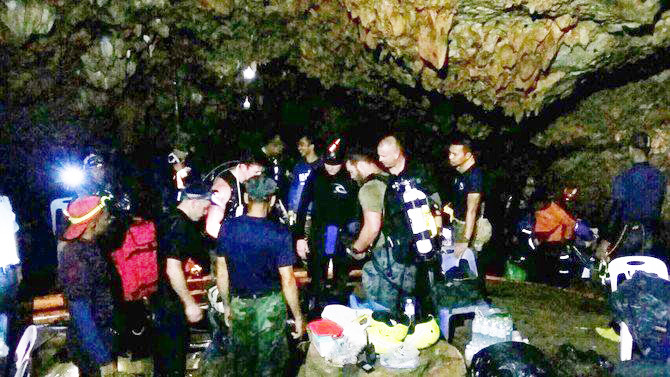
‘Race against water’ as rain threatens Thai boys in the cave


Pakistani fighter jet crashes in Jalalabad, pilot captured: Afghan military, police
- Fighting between Pakistan and Afghanistan’s Taliban military entered its third day on Saturday
- Pakistan’s strikes on Friday hit Taliban military installations and posts, including in Kabul and Kandahar
JALALABAD: A Pakistani jet has crashed in Jalalabad city and the pilot captured alive, the Afghan military and police said Saturday, with residents telling AFP the man parachuted from the plane before being detained.
"A Pakistani fighter jet was shot down in the sixth district of Jalalabad city, and its pilot was captured alive," police spokesman Tayeb Hammad said.
Wahidullah Mohammadi, spokesman for the military in eastern Afghanistan, confirmed the Pakistani jet was downed by Afghan forces "and the pilot was captured alive".
The AFP journalist heard a jet overhead before blasts from the direction of the airport in Jalalabad, the capital of Nangarhar province, which sits on the road between Kabul and the Pakistani border.
Fighting between Pakistan and Afghanistan’s Taliban military entered its third day on Saturday, following overnight clashes as the international community expressed increasing concern about the conflict and called for urgent talks.
Pakistan’s strikes on Friday hit Taliban military installations and posts, including in Kabul and Kandahar, in one of the deepest Pakistani incursions into its western neighbor in years, officials said.
Islamabad accuses the Taliban of harboring Tehreek-e-Taliban Pakistan (TTP) militants, who it claims are waging an insurgency inside Pakistan, a charge the Taliban denies.
Pakistan described its actions as a response to cross-border assaults, while Kabul denounced them as a breach of its sovereignty, saying it remained open to dialogue but warned any wider conflict would result in serious consequences.
The fighting has raised the risk of a protracted conflict along the rugged 2,600-kilometer frontier.
Diplomatic efforts gathered pace late on Friday as Afghanistan said its foreign minister, Amir Khan Muttaqi, spoke by telephone with Saudi Arabia’s Prince Faisal bin Farhan about reducing tensions and keeping diplomatic channels open.
The European Union called for both sides to de-escalate and engage in dialogue, while the United Nations urged an immediate end to hostilities.
Russia urged both sides to halt the clashes and return to talks, while China said it was deeply concerned and ready to help ease tensions.
The United States supports Pakistan’s right to defend itself against attacks by the Taliban, a State Department spokesperson said.
Border fighting continues
Exchanges of fire continued along the border overnight.
Pakistani security sources said an operation dubbed “Ghazab Lil Haq” was ongoing and that Pakistani forces had destroyed multiple Taliban posts and camps in several sectors. Reuters could not independently verify the claims.
Both sides have reported heavy losses with conflicting tolls that Reuters could not verify. Pakistan said 12 of its soldiers and 274 Taliban were killed while the Taliban said 13 of its fighters and 55 Pakistani soldiers died.
Taliban deputy spokesman Hamdullah Fitrat said 19 civilians were killed and 26 wounded in Khost and Paktika. Reuters could not verify the claim.
Pakistan’s Defense Minister Khawaja Muhammad Asif said “our cup of patience has overflowed” and described the fighting as “open war,” warning that Pakistan would respond to further attacks.
Taliban Interior Minister Sirajuddin Haqqani said in a speech in Khost province that the conflict “will be very costly,” and that Afghan forces had not deployed broadly beyond those already engaged.
He said the Taliban had defeated “the world, not through technology, but through unity and solidarity,” and through “great patience and perseverance,” rather than superior military power.
Pakistan’s military capabilities far exceed those of Afghanistan, with a standing army of hundreds of thousands and a modern air force.
In stark contrast, the Taliban lacks a conventional air force and relies largely on light weaponry and ground forces.
However, the Islamist group is battle-hardened after two decades of insurgency against US-led forces before returning to power in 2021.


