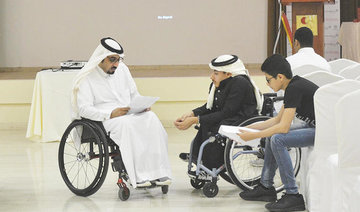
JEDDAH: The King Salman Center for Disability Research (KSCDR) joined a Saudi delegation headed by Dr. Tamader bin Youssef Al-Rammah, deputy minister of labor and social development, to an international conference on rights for the disabled held at the UN headquarters in New York.
KSCDR’s participation in the 11th Conference of States Parties to the Convention on the Rights of Persons with Disabilities is part of its role in highlighting the empowerment and integration of people with disabilities through research in collaboration with government and private sectors.
Dr. Ali bin Nasser Al-Odaib, KSCDR’s director of research and training, said the center had also taken part in scientific sessions to empower people with disabilities and provide them with health, education, training and rehabilitation services.
KSCDR’s efforts included the introduction of the Universal Accessibility Program aimed at creating a barrier-free environment and helping persons with disabilities communicate and use modern facilities and technologies.
Al-Odaib said the center’s delegation reviewed the program of early detection of disability, including the program of early detection for newborn babies to alleviate disability rates.
A number of research projects implemented by the King Salman Center were reviewed, such as the National Health and Life Stress Program, the general education curricula targeting students with disabilities project, and the genetic diagnosis of diseases leading to disabilities such as blindness and hearing loss.
KSCDR training and education were also presented, including a computer program that allows people with disabilities and learning difficulties to receive Ministry of Education training.
The delegation discussed the efforts of the King Salman International Award for Disability Research in its three branches aiming to support scientific research and encourage researchers to tackle the field of disabilities. It also highlighted the center’s efforts in organizing international conferences about disability and rehabilitation since 1992, which help raise the scientific and practical standards of workers in this field.


Saudi delegation participates in global forum on disabled rights at UN

Saudi delegation participates in global forum on disabled rights at UN
- KSCDR’s participation in the 11th Conference of States Parties to the Convention on the Rights of Persons with Disabilities is part of its role in highlighting the empowerment and integration of people with disabilities.
- The center's efforts included the introduction of the Universal Accessibility Program aimed at creating a barrier-free environment and helping persons with disabilities communicate and use modern facilities and technologies.


Riyadh emerges as Gulf evacuation hub for wealthy amid regional escalation
- Saudi capital’s King Khalid International Airport is among the few major airports in the region still operating normally after Iranian missile and drone strikes
RIYADH: Riyadh has become a principal evacuation hub for wealthy residents and senior executives seeking to leave the Gulf amid escalating regional tensions, according to a report by Semafor.
The Saudi capital’s King Khalid International Airport is among the few major airports in the region still operating normally after Iranian missile and drone strikes targeted cities including Dubai and Abu Dhabi over the weekend, as well as locations in Qatar and Bahrain.
With airspace closures elsewhere, stranded executives and high-net-worth individuals have been travelling overland to Riyadh, in some cases undertaking a roughly 10-hour journey from Dubai, in order to board private or commercial flights out of the region.
Citing people familiar with the arrangements, Semafor reported that private security firms have been hiring fleets of SUVs to transport clients to the Saudi capital before arranging chartered aircraft departures.
Those being evacuated include senior figures at global financial institutions as well as affluent individuals who had been in the Gulf for business or leisure.
The surge in demand has sharply increased costs.
Ameerh Naran, chief executive of private jet brokerage Vimana Private, told Semafor that Riyadh is currently “the only real option” for those seeking to exit the region, with private jet charters from the Saudi capital to Europe reaching as much as $350,000.
Alternative routes have narrowed. Security providers initially explored using Oman as an exit corridor, but that option became unviable after reported Iranian strikes on the country’s port infrastructure and a tanker, leaving Riyadh as the most accessible transit point, the report said.
Riyadh’s role marks a notable shift in regional risk perception. In previous years, security concerns — including cross-border Houthi attacks during the Yemen conflict and earlier periods of regional instability — had led many expatriates and business leaders to favour other Gulf cities as transit hubs.
However, Saudi Arabia’s more flexible visa regime, which now allows many nationalities to obtain visas on arrival, combined with the kingdom’s ability so far to keep its airspace open, has reinforced its position as a temporary gateway out of the region.
While some schools have moved to remote learning and certain companies have advised staff to work from home, Semafor reported that daily life in Riyadh has largely continued uninterrupted compared with other Gulf cities that have faced direct attacks.


