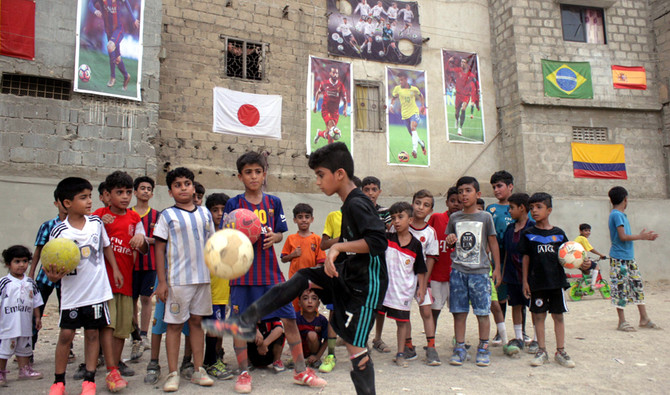
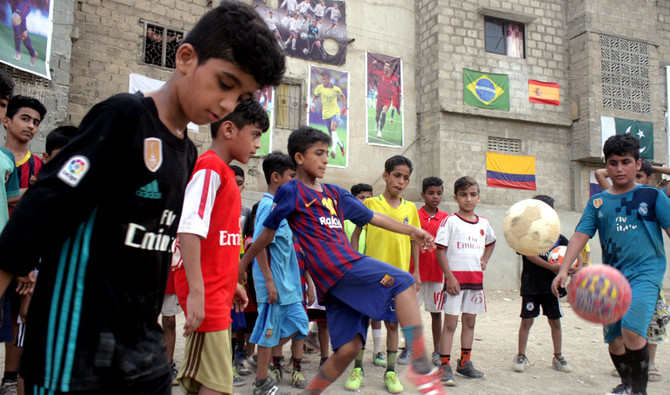
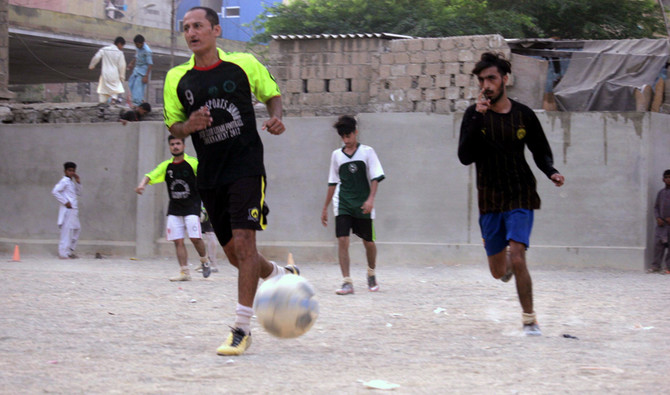
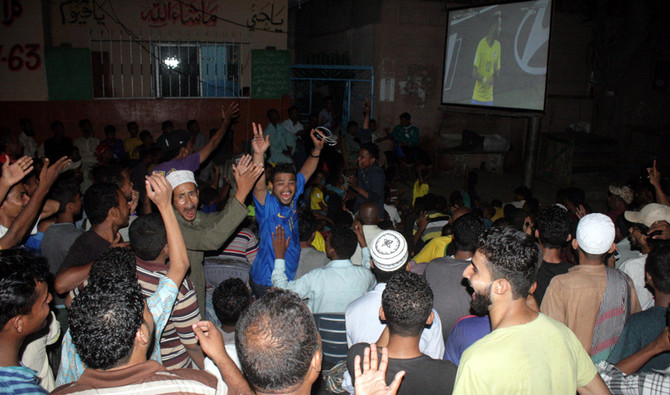
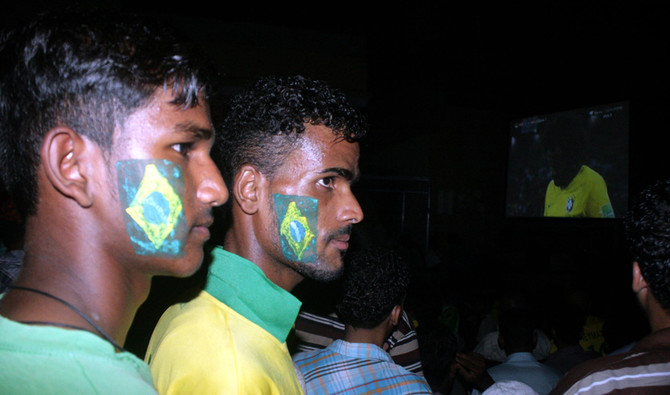
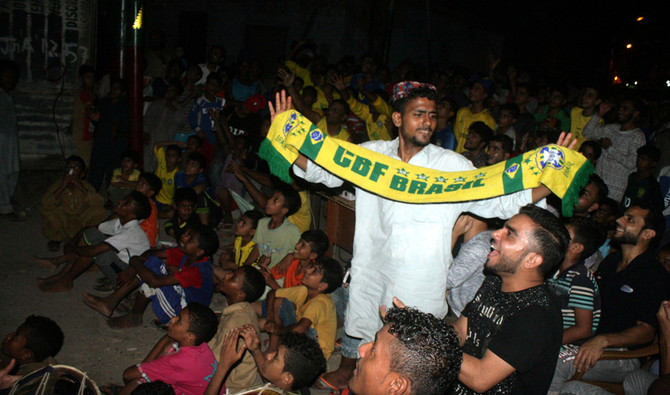
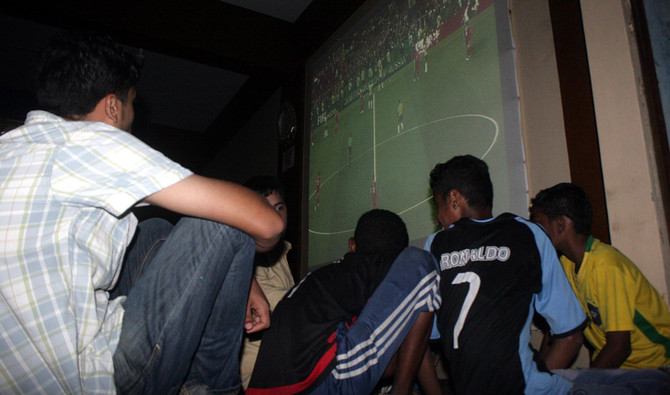
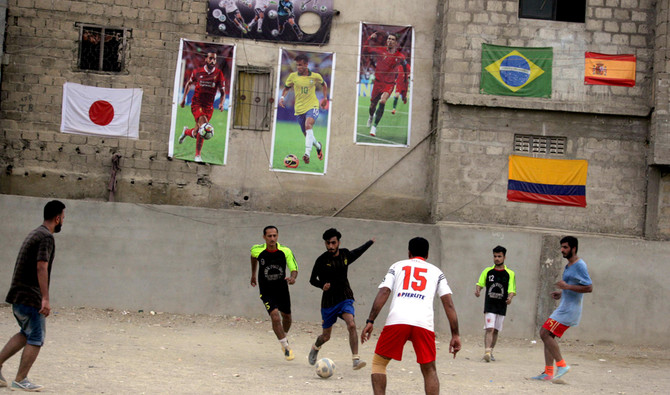
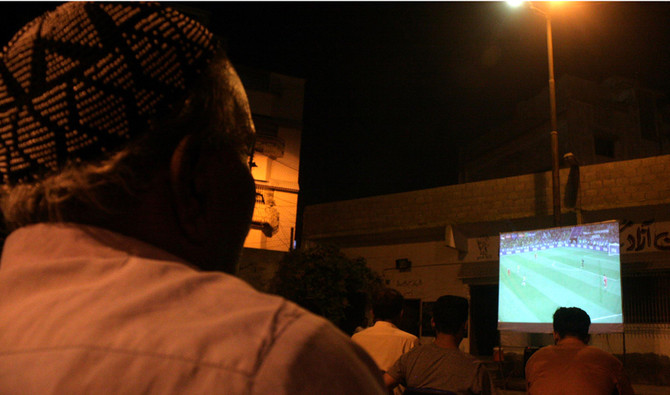
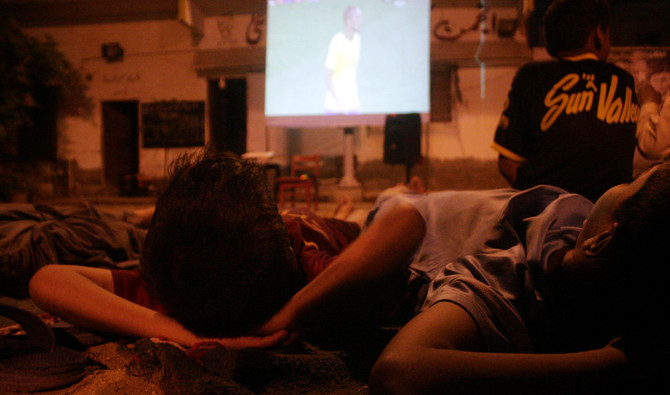
KARACHI: With less than a month left until Pakistan’s general elections, political parties have been unable to start their campaigning in one of the city’s most politicized towns, Lyari — not, for once, due to warring gangs — but due to FIFA World Cup-inspired football fever.
Lyari, the oldest town in Karachi, is known for its love for football and boxing. Warring gangs, however, had made it no-go area for many, law enforcement officials included.
It was reported that in March 2013, Sardar Uzair Jan Baloch, a gang leader now being detained by the government, and his associates, played football using the severed head of rival gang leader Arshad Pappu, in one of the town’s main football grounds.
After the deterioration of law and order in Lyari, area was finally freed from gang violence after a third clean-up attempt.
Football and boxing, however, were always refuges for those trying to steer away from becoming gang members.
But now it is the FIFA World Cup, not gang violence, that has halted political activities in the area, local activists have reported.
Shahid Shehenshai, a worker for the Pak Sarzameen Party (PSP), a former security guard to the assassinated former prime minister Benazir Bhutto, confirmed that political parties have been unable to start their election drive in the town.
“Political activists are clueless as how to conduct their campaigns here. When we call someone telling them about our proposed visit plan, we are told not to come or to come the next day – a tomorrow that never comes,” said Shehenshai.
Maula Bux Baloch, general secretary of the Azad Muslim Football club, who has fought for election as an independent candidate, said: “I wouldn’t be surprised if, God forbid, someone dies and fans ask the deceased’s family to postpone the funeral until after the match. Many fans who are invited to wedding receptions never even bother showing up.”
He asked: “Do you really think the people of Lyari will listen to political leaders at a time when their favorite teams are playing?”
“Lyariites are political people and they don’t love politics less, they just love football more, and if you ask them to choose between the two – they will pick football,” Arshad Ameer, a local leader of the the Pakistan People’s Party (PPP), told Arab News.
Ameer added that peace has returned to Lyari and the town will witness great political activities, but not until after July 15, when the World Cup is over.
“Gangs never stopped anyone from political campaigning during the previous general polls, but people were so scared that they could hardly run their campaigns,” he said.
Raheem Baloch, another local resident, said that the only the PPP ran a campaign in 2013. “Now when the gangs are not around, the field is open for all,” he said.
“Muttahida Majlis Amal (MMA) was the first to hold a jalsa (rally) in the area, but it was before the start of the World Cup. When Shehbaz Sharif held a public gathering most of those present were outsiders who rallied here along with other PML-N leaders from other localities of the city,” said Abu-Bakr Baloch, a local journalist.
“No party has started its political campaign yet; there are no corner meetings and no door-to-door campaigns have taken place either, let alone the big public gatherings in which political parties show their muscle,” he said.
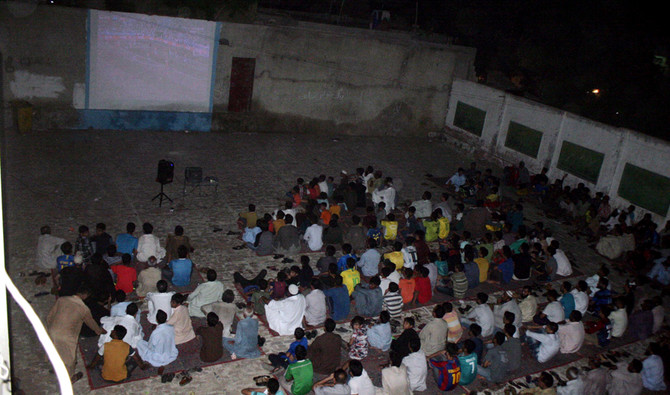
Abu-Bakr added that approximately 300 screens have been installed in the area, where nearly 500 residents turn up to watch the matches.
Maula Bux Bloch claimed that of the 153 football clubs in Karachi’s district south, well over 100 in Lyari, and every major club fixed a huge screen. Bux added that women as well as men of all ages were following the World Cup.
“When matches are being played, my wife and other women of our family are all glued to the TV sets at home,” Bux told Arab News.
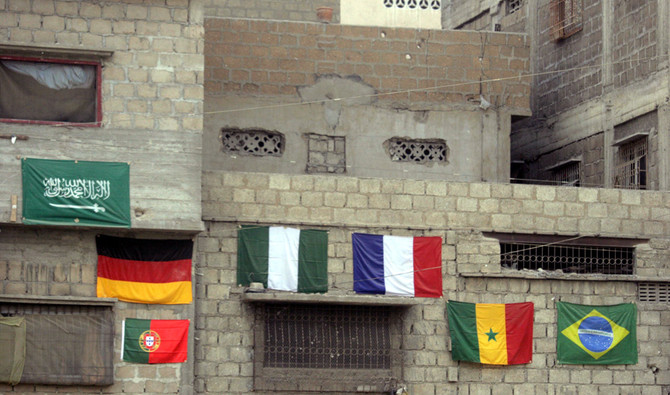
“Brazil, Argentina, Germany, Portugal and France are favorites for Lyariites. A number of people also support Saudi Arabia,” said Ibrahim Gulab, a former football player from the Moosa Lane area. He said that when a match ends, the winning team’s supporters take to the streets to celebrate the victory.
“Earlier, if a street in Lyari was dark, people would turn back for fear of entering a gang area. Now, when all the street lights are switched off and there is complete darkness, it means football fans have setup a big screen to watch the World Cup matches,” Baloch said.

Political campaigning comes to a halt as football fever engulfs Lyari
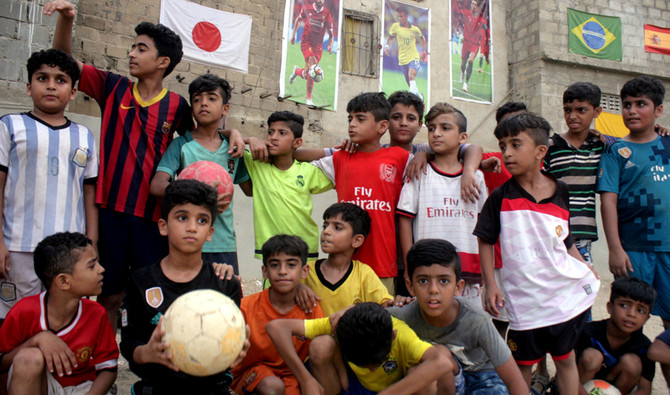
- Lyari, the oldest town in Karachi inhabited by 2.5 million people, has more than 100 football clubs
- Around 300 big screens have been set up in the town, where hundreds of fans come to watch their favorite teams play
Guinea’s tough new migration route for desperate young west Africans
CONAKRY: With a determined look on her weathered face, Safiatou Bah has made up her mind: she will leave her young children behind and migrate to Europe on a new and perilous ocean route from Guinea.
Thousands of young Guineans have attempted to migrate via the Atlantic in recent years, a flow so severe that authorities in the junta-led country have dubbed it a “haemorrhage.”
Lacking both economic opportunity and any hope of change, the migrants are leaving from their own shores after neighboring Senegal and Mauritania and Morocco further north, beefed up controls.
However the longer voyage which begins farther south only increases the number of dangers they will face.
Most west Africans traveling the Atlantic route embark in pirogue canoes toward Spain’s Canary Islands off northwest Africa, the jumping off point for their continued journey to the European continent.
At least eight boats have left Guinea since the spring, each carrying more than a hundred people, according to migration NGOs.
Bah, 33, initially left her village for the capital Conakry where she tried to do NGO work that didn’t pan out. In the end, she started a fruit stand to make money to migrate.
Her husband, whom she was married off to at age 18, is now 75 and can no longer provide for the family.
“I’m the one raising my children alone,” Bah told AFP.
Her decision to leave her three children, age 11 to six months, with her mother is firm: “I’m suffering here. You struggle and there’s no one to support you,” she said.
- New route -
Due to increasingly restrictive visa policies in Europe, migrants say their only option is illegal migration.
The Spanish NGO Caminando Fronteras, which monitors migration, confirmed the existence of the new Guinean route to AFP as well as the significant number of people taking it.
Guineans are now the leading African nationality — and the third largest group after Afghans and Ukrainians — to apply for asylum in France, the country’s former colonial ruler.
In 2024 a total of 11,336 asylum applications were made, according to France’s refugee agency OFPRA.
Mamadou Saitiou Barry, managing director of the Directorate General for Guineans Living Abroad, confirmed that “several thousand” Guineans embark on the journey each year.
“We are aware of this, because it is us who lose our sons and these young people,” he said.
Meanwhile Guinea has increased policing measures in an attempt to staunch the outward flow.
Elhadj Mohamed Diallo, director of the Guinean Organization for the Fight Against Irregular Migration (OGLMI), deals with these young people on a daily basis.
“When you tell them that the route is dangerous, most reply: ‘Where we are, we are actually already dead,’” he said, adding that they believe it is better to try.
Even among those with an education, finding a job can be an impossible task.
- Scarring journey -
Abdourahim Diallo, a young father of two, cannot find work and has lost all hope in his country, much like Bah.
AFP met him at a gathering of dozens of young people in Conakry’s Yattaya T6 suburb, in an unelectrified shack being used as a cafe.
“Here we have more than 150 young people and none of them has a job,” Ibrahima Balde, head of a neighborhood young people’s association, told AFP.
Diallo, who said he has “a lot of family who are counting on me,” is preparing to migrate for the fourth time.
His shocking prior attempts, which left him with physical — and no doubt psychological — scars, span 2011 to 2024, leading him through Mali, Algeria and Morocco.
He spent five years surviving in Morocco’s Gourougou forest, which overlooks the Spanish enclave of Melilla.
Thousands of migrants from sub-Saharan Africa seeking to enter the enclave eke out a living in the surrounding woods.
To reach the area and escape authorities, one must jump from a moving train, according to Diallo, who said “some break their feet while others die.”
In December 2011 he injured his head after attempting, along with hundreds of others, to scale the Melilla fence.
Another time he nearly died when his pirogue capsized off Morocco.
Overall, he said, he has lost count of the arrests in Morocco, extortion by various police, and robberies along the way.
Next door to the cafe, 30-year-old Mamadou Yero Diallo is bent under the hood of a car in his garage.
“We manage, we earn a little for food, nothing more,” he said, insisting he too will attempt the Atlantic route later this year.
As for Bah, she became less confident in her upcoming journey when speaking about conversations she has had with those who returned.
“There are so many risks,” she said, adding that she has heard of migrant women being raped.
“But I’m still going,” she said. “I ask God to protect me.”
Thousands of young Guineans have attempted to migrate via the Atlantic in recent years, a flow so severe that authorities in the junta-led country have dubbed it a “haemorrhage.”
Lacking both economic opportunity and any hope of change, the migrants are leaving from their own shores after neighboring Senegal and Mauritania and Morocco further north, beefed up controls.
However the longer voyage which begins farther south only increases the number of dangers they will face.
Most west Africans traveling the Atlantic route embark in pirogue canoes toward Spain’s Canary Islands off northwest Africa, the jumping off point for their continued journey to the European continent.
At least eight boats have left Guinea since the spring, each carrying more than a hundred people, according to migration NGOs.
Bah, 33, initially left her village for the capital Conakry where she tried to do NGO work that didn’t pan out. In the end, she started a fruit stand to make money to migrate.
Her husband, whom she was married off to at age 18, is now 75 and can no longer provide for the family.
“I’m the one raising my children alone,” Bah told AFP.
Her decision to leave her three children, age 11 to six months, with her mother is firm: “I’m suffering here. You struggle and there’s no one to support you,” she said.
- New route -
Due to increasingly restrictive visa policies in Europe, migrants say their only option is illegal migration.
The Spanish NGO Caminando Fronteras, which monitors migration, confirmed the existence of the new Guinean route to AFP as well as the significant number of people taking it.
Guineans are now the leading African nationality — and the third largest group after Afghans and Ukrainians — to apply for asylum in France, the country’s former colonial ruler.
In 2024 a total of 11,336 asylum applications were made, according to France’s refugee agency OFPRA.
Mamadou Saitiou Barry, managing director of the Directorate General for Guineans Living Abroad, confirmed that “several thousand” Guineans embark on the journey each year.
“We are aware of this, because it is us who lose our sons and these young people,” he said.
Meanwhile Guinea has increased policing measures in an attempt to staunch the outward flow.
Elhadj Mohamed Diallo, director of the Guinean Organization for the Fight Against Irregular Migration (OGLMI), deals with these young people on a daily basis.
“When you tell them that the route is dangerous, most reply: ‘Where we are, we are actually already dead,’” he said, adding that they believe it is better to try.
Even among those with an education, finding a job can be an impossible task.
- Scarring journey -
Abdourahim Diallo, a young father of two, cannot find work and has lost all hope in his country, much like Bah.
AFP met him at a gathering of dozens of young people in Conakry’s Yattaya T6 suburb, in an unelectrified shack being used as a cafe.
“Here we have more than 150 young people and none of them has a job,” Ibrahima Balde, head of a neighborhood young people’s association, told AFP.
Diallo, who said he has “a lot of family who are counting on me,” is preparing to migrate for the fourth time.
His shocking prior attempts, which left him with physical — and no doubt psychological — scars, span 2011 to 2024, leading him through Mali, Algeria and Morocco.
He spent five years surviving in Morocco’s Gourougou forest, which overlooks the Spanish enclave of Melilla.
Thousands of migrants from sub-Saharan Africa seeking to enter the enclave eke out a living in the surrounding woods.
To reach the area and escape authorities, one must jump from a moving train, according to Diallo, who said “some break their feet while others die.”
In December 2011 he injured his head after attempting, along with hundreds of others, to scale the Melilla fence.
Another time he nearly died when his pirogue capsized off Morocco.
Overall, he said, he has lost count of the arrests in Morocco, extortion by various police, and robberies along the way.
Next door to the cafe, 30-year-old Mamadou Yero Diallo is bent under the hood of a car in his garage.
“We manage, we earn a little for food, nothing more,” he said, insisting he too will attempt the Atlantic route later this year.
As for Bah, she became less confident in her upcoming journey when speaking about conversations she has had with those who returned.
“There are so many risks,” she said, adding that she has heard of migrant women being raped.
“But I’m still going,” she said. “I ask God to protect me.”
© 2025 SAUDI RESEARCH & PUBLISHING COMPANY, All Rights Reserved And subject to Terms of Use Agreement.