

Saudi Arabia, UAE, Bahrain and Egypt turn to top UN court in airspace feud with Qatar

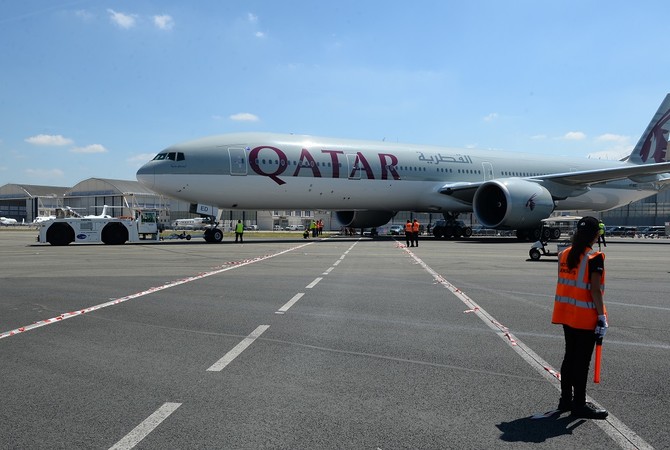
A Qatar Airways Boeing 777-300 is moved on the Tarmac of Le Bourget airport on June 18, 2017. (AFP)
Updated 27 June 2018
Follow

Saudi Arabia, UAE, Bahrain and Egypt turn to top UN court in airspace feud with Qatar

  • Both sides, the quartet and Qatar, are turning to the International Court of Justice in the Hague to hear their grievances
  • The quartet decided to submit the airspace case to the ICJ on the grounds that the International Civil Aviation Organisation was not competent to consider the dispute

Saudi Arabia, the UAE, Bahrain and Egypt said Wednesday they would file a complaint at the highest UN court against Qatar over alleged airspace violations.
Both sides, the quartet and Qatar, are turning to the International Court of Justice in the Hague to hear their grievances.
Saudi Arabia, the UAE, Bahrain and Egypt decided to submit the airspace case to the ICJ on the grounds that the International Civil Aviation Organisation was not competent to consider the dispute, Saudi and UAE state media said.
The UAE has filed two complaints with the ICAO over what Qatar’s rivals say are airspace violations that threaten civil aviation.
The UAE accuses Qatar of sending fighter jets to intercept passenger flights and a civilian helicopter in Bahraini airspace.
Doha has denied approaching any UAE-operated flights.
The Saudi-led bloc cut off relations with Qatar on June 5, 2017, accusing it of supporting terrorism and Iran, which Doha denies.
Qatar has also filed a case at the ICJ accusing the UAE of human rights violations.
Judges at the court in The Hague - which rules in disputes between countries - will start a three-day hearing at Doha’s request on Wednesday.
The row has left the small peninsula nation regionally isolated with its only land border closed, its state-owned airline barred from using its neighbours’ airspace.


Egypt’s central bank raises economic growth forecast to 5.1 percent in current year, 5.5 percent next year

Updated 9 sec ago
Follow

Egypt’s central bank raises economic growth forecast to 5.1 percent in current year, 5.5 percent next year

RIYADH: The Central Bank of Egypt has raised its economic growth forecast to 5.1 percent for the 2025/26 fiscal year and 5.5 percent for 2026/27, up from previous projections of 4.8 percent and 5.1 percent, respectively.

The improved projection is attributed to the anticipated increase in contributions from the non-oil manufacturing and services sectors, with expectations of accelerated growth supported by the continuation of the monetary easing cycle.

This is expected to support real growth in credit extended to the private sector in the coming period, therefore boosting economic activity, according to a statement.

The revised forecast follows Egypt’s 5.3 percent gross domestic product growth in the first quarter of 2025/26, the strongest expansion in more than three years, according to the Minister of Planning and Economic Development Rania Al-Mashat in November.

At the time, Al-Mashat underlined that this acceleration was driven by improvements in productive sectors.

This also supports ministry data released in September showing that the economy expanded 4.4 percent in fiscal year 2024/25, supported by a strong fourth quarter when growth reached a three-year high of 5 percent.

The newly released report from Egypt’s central bank said: “Furthermore, forecasts are further strengthened by an anticipated stronger performance in the extractive sector, underpinned by multiple successful onshore and offshore discoveries of crude oil and natural gas, which are expected to gradually increase domestic production.”

It added: “Additionally, the growth outlook is further reinforced by a projected rebound in Suez Canal activity during the current fiscal year, assuming the normalization of maritime traffic in the Red Sea in light of the recent peace deal in Gaza, which has restored confidence and prompted the return of shipping lines through the Canal, including Maersk and CMA CGM.”

The report said continued strength in manufacturing, services, and Suez Canal activity is likely to support real GDP growth throughout the forecast horizon.

As for inflation, the analysis indicated that annual headline inflation is expected to keep slowing down throughout 2026, although it will remain slightly higher than the original forecast, before returning to the target level by the fourth quarter of 2026.

“As such, annual headline inflation is expected to average 12.5 and 9.0 percent in fiscal years 2025/26 and 2026/27, respectively,” the report said.