

KSRelief launches $40m landmine clearing project in Yemen

1 / 4
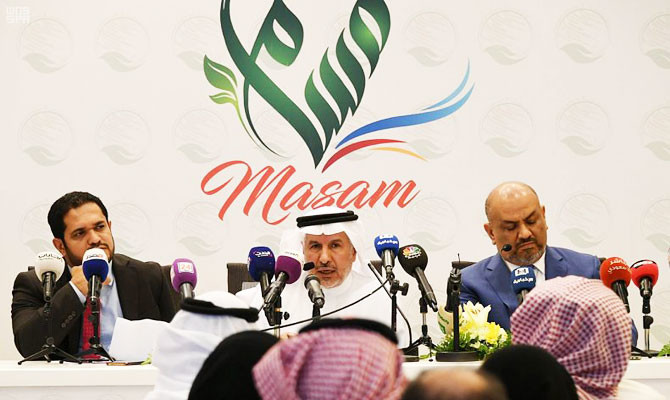
Dr. Abdullah Al-Rabeeah, adviser at the Royal Court and supervisor general of KSRelief, Yemen’s Foreign Minister Khaled Al-Yamani, Minister of Human Rights Mohammed Askar, and Executive Director of Yemen’s National Program for coping with mines and MASAM Program Manager Ousama Al-Gosaibi attended the press conference. (SPA)
2 / 4
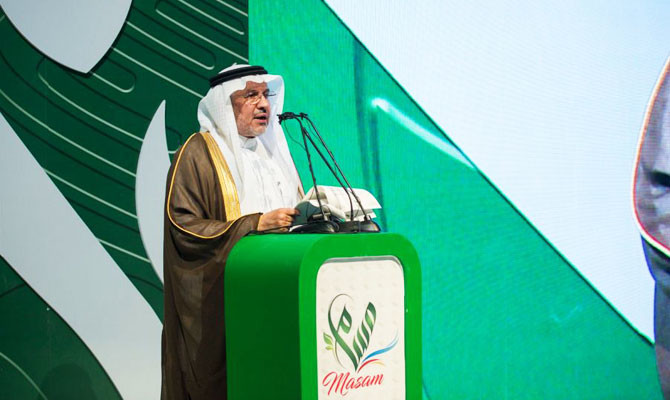
Dr. Abdullah Al-Rabeeah, adviser at the Royal Court and supervisor general of KSRelief. (SPA)
3 / 4
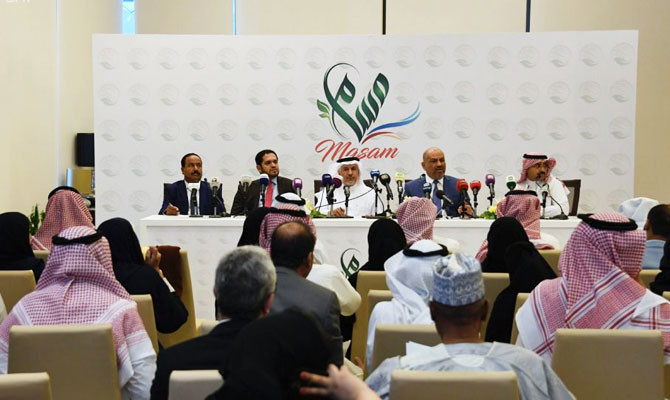
Dr. Abdullah Al-Rabeeah, adviser at the Royal Court and supervisor general of KSRelief, Yemen’s Foreign Minister Khaled Al-Yamani, Minister of Human Rights Mohammed Askar, and Executive Director of Yemen’s National Program for coping with mines and MASAM Program Manager Ousama Al-Gosaibi attended the press conference. (SPA)
4 / 4
Dr. Abdullah Al-Rabeeah, adviser at the Royal Court and supervisor general of KSRelief, Yemen’s Foreign Minister Khaled Al-Yamani, Minister of Human Rights Mohammed Askar, and Executive Director of Yemen’s National Program for coping with mines and MASAM Program Manager Ousama Al-Gosaibi attended the press conference. (SPA)
Updated 26 June 2018
Follow

KSRelief launches $40m landmine clearing project in Yemen

  • The conflict has resulted in the manufacture and deployment of landmines by militias causing more than 1,539 deaths, injury to more than 3,000 and permanent disability to more than 900 Yemenis
  • There have been more than 600,000 mines planted in liberated areas by militias, 130,000 internationally banned sea mines, 40,000 mines in Marib and 16,000 mines on the island of Mayon

RIYADH: The King Salman Humanitarian Aid and Relief Center (KSRelief) has launched the Saudi Project for Landmine Clearance (MASAM), which aims to make Yemen landmine-free to protect civilians and safeguard the delivery of urgent humanitarian supplies.
The initial budget dedicated to the MASAM project, called “Life without landmines” is $40 million.
There have been more than 600,000 mines planted in liberated areas by militias, 130,000 internationally banned sea mines, 40,000 mines in Marib and 16,000 mines on the island of Mayon.
The conflict has resulted in the manufacture and deployment of landmines by militias causing more than 1,539 deaths, injury to more than 3,000 and permanent disability to more than 900 Yemenis.
These recorded figures are far lower than the actual numbers as the national demining program has not been able to identify and register all casualties. Such hostile actions have also resulted in an array of other life-threatening crises and security concerns.
Dr. Abdullah Al-Rabeeah, adviser at the Royal Court and supervisor general of KSRelief, said at the press launch event: “This program will be carried out with participation from numerous Saudi cadres and international experts.
“MASAM’s aim is to eliminate all forms of landmines which have been randomly planted by Houthi militias in a number of Yemeni governorates — particularly Marib, Aden, Sanaa and Taiz.

“The program also strives to help the Yemeni people to overcome the many tragedies caused by the deployment of these landmines, and to enable the country to become more independent to take responsibility in removing mines themselves. Part of the program is to train Yemeni specialists on how to clear the land of mines.”
Yemen’s Foreign Minister Khaled Al-Yamani, Minister of Human Rights Mohammed Askar, and Executive Director of Yemen’s National Program for coping with mines and MASAM Program Manager Ousama Al-Gosaibi also attended the press conference.
“The team is a mixture of Saudi and international experts,” Al-Rabeeah said. “We are also closely cooperating with Yemen’s National Program for coping with mines to identify the most affected areas.”
Al-Rabeeah and Al-Yamani stressed that the military operation was taking place in parallel with humanitarian works.

Al-Yamani said: “Military advances are to liberate areas then to immediately built relief units in cooperation with KSRelief and the UAE Red Crescent. There is no direct prevention of aid from the Houthis. However, the Houthis are using civilians, including women and children, as human shields to stop the aid from reaching needy civilians and they prevent civilians from getting into the liberated areas to get the aid. Also, they randomly put in sea mines and the international community must interfere because it is a danger that threatens the international navy.”
Al-Rabeeah said the MASAM project will be launched over the course of a year in five phases: Preparation, training, team composing, expansion and the transfer of the knowledge to Yemeni specialists so they can become more independent in the long term.
Al-Gosaibi said that MASAM had been through an intensive planning process and preparation to ensure the best outcomes. “We prepared 32 teams to operate across Yemen and five more teams for emergency.”
In addition to the MASAM project, KSRelief has implemented 262 projects worth more than $1.6 billion to help the people of Yemen.


Foreign ministers chair Saudi-Omani coordination council meeting in Muscat

Updated 23 December 2025
Follow

Foreign ministers chair Saudi-Omani coordination council meeting in Muscat

MUSCAT: Saudi Foreign Minister Prince Faisal bin Farhan met with Oman’s Foreign Minister Sayyid Badr bin Hamad Al-Busaidi on Monday.

They reviewed bilateral relations between their nations and ways to enhance and develop them across various fields. Additionally, they discussed regional and international developments.

The ministers co-chaired the third meeting of the Saudi-Omani Coordination Council in the Omani capital, Muscat, with the participation of the heads of the Council’s subsidiary committees and the two heads of the Council’s General Secretariat teams.

The meeting comes as an affirmation of the keenness of Saudi and Omani leaders to strengthen ties and advance them toward greater prosperity for both nations.

In his remarks during the meeting, Prince Faisal affirmed that gathering builds on the previous council meeting, held last year in AlUla, and on its positive and fruitful outcomes within the framework of the approved recommendations and initiatives. 

He stressed the importance of continuing the work of the council’s subsidiary committees to complete the necessary procedures to implement the remaining initiatives, and of the General Secretariat’s role in follow-up and in addressing any challenges that may hinder implementation.

He also underscored the importance of developing and enhancing trade relations, stimulating investment, and strengthening cooperation between the public and private sectors.

He also praised the ongoing work to establish and launch the Coordination Council’s electronic platform, which aims to connect all committee work and initiatives to facilitate follow-up on the Council’s progress. 

Al-Busaidi affirmed in his remarks the qualitative progress in relations between the two countries and the notable development witnessed across numerous sectors toward achieving economic integration and enhancing intra-trade and joint investments. 

The Omani foreign minister also highlighted deeper cooperation in the security and judicial fields, as well as the cultural and tourism sectors, noting the advanced and continuous political cooperation, consultation, and coordination on regional and international issues.