

Azzedine Alaia exhibition at London’s Design Museum captures the essence of his creative spirit

1 / 3
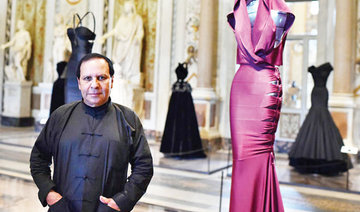
The Azzedine Alaia exhibition, showing at London’s Design Museum. (Photo courtesy: Mark Blower)
2 / 3
The Azzedine Alaia exhibition, showing at London’s Design Museum. (Photo courtesy: Mark Blower)
3 / 3
The Azzedine Alaia exhibition, showing at London’s Design Museum. (Photo courtesy: Mark Blower)
Updated 21 June 2018
Follow

Azzedine Alaia exhibition at London’s Design Museum captures the essence of his creative spirit

LONDON: For lovers of fashion, a visit to the Azzedine Alaia exhibition, showing at London’s Design Museum until 7 October, is a must. Looking at the wonderful displays there is a sense of loss at his passing in November last year, but this is a great retrospective of the Tunisian designer’s life and work, which allows you to go right up to the garments on display and take in the breathtaking quality and detail of Alaia’s designs.

Alaia, born in 1935, trained as a sculptor at the School of Fine Art in Tunis. That background is evident in many of his figure-hugging designs — particularly the stunning, pared-down evening gowns.

When you look at the super slim-line garments on display it can be a bit disheartening when you see the tiny hips and waists. It makes you think of the remark attributed to Wallis Simpson: “You can never be too rich or too thin.”

But Alaia’s world was not for ordinary mortals — it was an extraordinary place for beautiful people living a dream. In the film made by Ellen von Unwerth during the preparation, staging and aftermath of an Alaia show in 1990, you see Naomi Campbell, Helena Christensen  and Christy Turlington at the height of their beauty and fame reminding us of the ‘supermodel’ era, when these women dominated the international tabloid press.

Alaia himself said, “I make clothes, women make fashion.” And you only have to think of stars such as Rihanna and Penelope Cruz wearing his designs on the red carpet to understand what he means.

The film of models walking in his designs is mesmerising – each model is filmed in sequence with close up shots of what she is wearing — an excellent way of showing the fabrics, cut, patterns and innovation and how they are all brought alive through movement. Alaia’s designs flatter the female form and seem enhance women’s beauty.

The influence of Arab architecture is evident in some of his designs. His use of lace and perforated fabrics, especially broderie anglaise and punched or laser-cut leather, recalls the mashrabiya.

His ability to transform leather into such a soft, wearable, high-fashion fabric was stunning to see up close.

Also notable was his avoidance of surface embellishment such as embroidery or applied decoration. Instead, Alaia keyed pattern into the very fabric of his garments, making it an integral part of their structure, altering both their weight and form.

His fascination with African influences is also evident in his use of unusual materials including flax rope, raffia, shells or Nile crocodile skin and animal patterns.

Alaia was also deeply inspired by Spanish culture — his earliest fashion memories were reportedly of the girls in Diego Velazquez’s 1656 paining, “Las Meninas” and his voluminous ball gowns evoke the formality of the hooped gowns of the Spanish royal court during that time. He also took inspiration from Spain’s vibrant folk costumes, as seen in the effusive flamenco-inspired ruffles of some of his designs.

Through the photographs mapping his life you get a sense of the creative process and hard work that went into his couture. You also realize that this was a man who was at the top of his profession for several decades.

The exhibition does a fine job of conveying Alaia’s creative energy, and reminds visitors that his legacy lives on in the inspiration his work provides for young designers today.

Sheikha Al-Mayassa talks cultural patronage at Art Basel Qatar Conversations panel

Updated 04 February 2026
Follow

Sheikha Al-Mayassa talks cultural patronage at Art Basel Qatar Conversations panel

DOHA: Cultural leaders at the inaugural edition of Art Basel Qatar in Doha have discussed how patronage is reshaping art ecosystems, with Qatar’s own long-term cultural vision at the center.

The opening panel, “Leaders of Change: How is patronage shaping new art ecosystems?” brought together Sheikha Al-Mayassa bint Hamad bin Khalifa Al-Thani, chair of Qatar Museums, and Maja Hoffmann, founder and president of the Luma Foundation, in a discussion moderated by Hans Ulrich Obrist, artistic director of the Serpentine Galleries in London. The talk formed part of the Art Basel Conversations x Qatar Creates Talks program, coinciding with the debut of Art Basel Qatar which runs in Doha until Feb. 8.

Sheikha Al-Thani framed Qatar’s cultural project as a strategic, long-term endeavor anchored in national development. “Qatar has a national vision called 2030 where culture was one of the main pillars for socioeconomic development and human development,” she said. “We have always invested in culture as a means of human development.”

That vision, she explained, underpins the decision to welcome a major international fair like Art Basel to Doha after turning away many previous proposals.

“For the longest time, I can’t tell you how many art fairs came to us wanting to be here, and we never felt it was the right time,” she said. “However, this is an important year for us and we felt, with the surplus of talent and the growing gallery scene we had here, that it was time to bring industry to talent, because that’s how we will spur the economic diversification from hydrocarbon to a knowledge-based society.”

She was also keen to stress that Art Basel Qatar was not conceived as a conventional marketplace.

 “This is not your typical art fair … It’s a humane art fair where engagement is more important than transaction, discourse more important than division, and curiosity more important than conviction,” she added.

That ethos extends to the fair’s artistic leadership. Al-Thani described how the decision to have an artist — Wael Shawky — serve as artistic director emerged collaboratively with Art Basel’s team.

“He’s a global artist who’s now become a very local artist, very invested in our local art scene. And really, I think that’s the beauty of partnerships … There is a safe space for us to critique each other, support each other, and really brainstorm all the possibilities … and then come to a consensus of what would make sense for us,” she said.

Collecting art, she added, has long been embedded in Qatari society: “My grandmother is almost 100 years old. She was collecting in the 60s when Qatar was a very poor country. It’s in our DNA … always with this notion of investing in knowledge and human development.”

Today, that impulse translates into comprehensive, multi-disciplinary collections: “We are both collecting historical objects, contemporary objects, modern objects, architecture, archival material, anything that we feel is relevant to us and the evolution of this nation towards a knowledge-based economy.”

Looking ahead, Al-Thani outlined a new cultural triangle in Doha — the National Museum of Qatar, the Museum of Islamic Art and the forthcoming Art Mill Museum — as engines for both economic diversification and intellectual life.

 “That ecosystem will enhance the economic growth and diversification, but also the knowledge that’s available, because the diversity in the collections between these three institutions will no doubt inspire young people, amateurs, entrepreneurs to think outside the box and inform their next business,” she said.

The panel closed with a focus on the future of large-scale exhibitions with Rubaiya, Qatar’s new quadrennial, timed to coincide with the anniversary of the 2022 World Cup.

“Every four years in memory of the opening of the World Cup, we will open the quadrennial. This year, the theme is ‘Unruly Waters.’ At the center of the theme is Qatar’s trading route to the Silk Road,” explained Al-Thani.

“It’s important for us to trace our past and claim it and share it to the rest of the world, but also show the connectivity that Qatar had historically and the important role it has been playing in diplomacy.”