
BENGHAZI, Libya/VIENNA: East Libyan forces said on Thursday they had rapidly retaken the shuttered oil ports of Es Sider and Ras Lanuf, where the head of Libya’s National Oil Corporation (NOC) said he hoped operations would resume in a “couple of days.”
Staff were evacuated from the key terminals in Libya’s eastern oil crescent and exports were suspended last Thursday when armed opponents of eastern-based military commander Khalifa Haftar attacked the ports and occupied them.
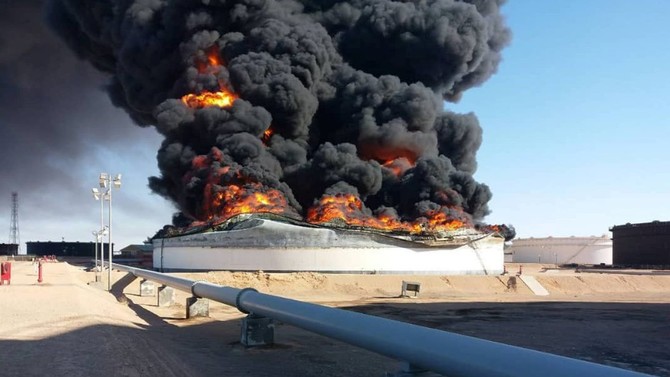
The closure has led to daily production losses of up to 450,000 barrels per day (bpd), and two oil storage tanks were destroyed or badly damaged by fires during the fighting.
For the past week, Haftar’s Libyan National Army (LNA) has been pounding the area with air strikes as it mobilized to retake the ports, and it continued to target its rivals with air strikes on Thursday as they retreated.
Ahmed Al-Mismari, a spokesman for the LNA which Haftar built up during his three-year campaign to seize Libya’s eastern city of Benghazi, said troops had retaken Es Sider by mid-morning and were clashing with opponents as they advanced west.
Mismari said Ras Lanuf, which includes a residential town, an air strip, storage tanks and a refinery, alongside the oil terminal, had also been taken by the LNA.
“Our armed forces fully control the Ras Lanuf district and the enemy suffered large losses in lives and equipment,” he said.
Libya’s national production was cut to between 600,000 and 700,000 bpd from more than one million bpd by clashes in the oil crescent, but NOC Chairman Mustafa Sanalla said he was expecting a quick restart.
“Libyan production is very low but we are going to resume very soon,” he told reporters in Vienna. “After a couple of days we will resume, we start our operations hopefully.”
The NOC has blamed the attack on the terminals on militias led by Ibrahim Jathran, who blockaded oil crescent ports for several years before losing control of them in September 2016 to the LNA.
The LNA has said the Benghazi Defense Brigades, a coalition of anti-Haftar fighters that previously tried to take the oil crescent and advance on Benghazi, were also involved.
Haftar is the dominant figure in eastern Libya and is aligned with a government and parliament based in the east opposed to an internationally recognized government in the capital, Tripoli.
He has controlled Benghazi, which lies northeast of the oil crescent, since late last year.