

East Libyan forces advance rapidly to retake key oil ports

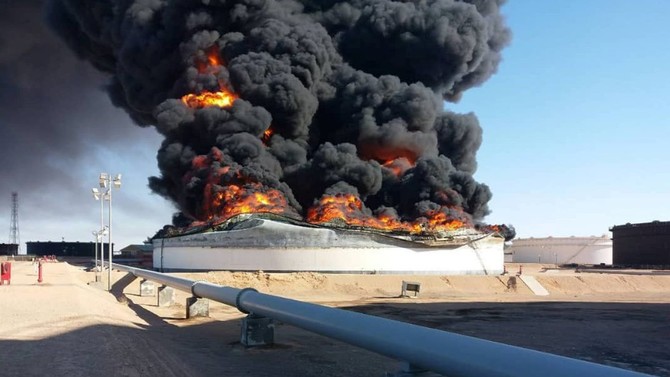
Smoke and flame rise from an oil storage tank that was set on fire amid fighting between rival factions at Ras Lanuf terminal. ( National Oil Corporation via Reuters)
Updated 21 June 2018
Follow

East Libyan forces advance rapidly to retake key oil ports

BENGHAZI, Libya/VIENNA: East Libyan forces said on Thursday they had rapidly retaken the shuttered oil ports of Es Sider and Ras Lanuf, where the head of Libya’s National Oil Corporation (NOC) said he hoped operations would resume in a “couple of days.”

Staff were evacuated from the key terminals in Libya’s eastern oil crescent and exports were suspended last Thursday when armed opponents of eastern-based military commander Khalifa Haftar attacked the ports and occupied them.

The closure has led to daily production losses of up to 450,000 barrels per day (bpd), and two oil storage tanks were destroyed or badly damaged by fires during the fighting.

For the past week, Haftar’s Libyan National Army (LNA) has been pounding the area with air strikes as it mobilized to retake the ports, and it continued to target its rivals with air strikes on Thursday as they retreated.

Ahmed Al-Mismari, a spokesman for the LNA which Haftar built up during his three-year campaign to seize Libya’s eastern city of Benghazi, said troops had retaken Es Sider by mid-morning and were clashing with opponents as they advanced west.

Mismari said Ras Lanuf, which includes a residential town, an air strip, storage tanks and a refinery, alongside the oil terminal, had also been taken by the LNA.

“Our armed forces fully control the Ras Lanuf district and the enemy suffered large losses in lives and equipment,” he said.

Libya’s national production was cut to between 600,000 and 700,000 bpd from more than one million bpd by clashes in the oil crescent, but NOC Chairman Mustafa Sanalla said he was expecting a quick restart.

“Libyan production is very low but we are going to resume very soon,” he told reporters in Vienna. “After a couple of days we will resume, we start our operations hopefully.”

The NOC has blamed the attack on the terminals on militias led by Ibrahim Jathran, who blockaded oil crescent ports for several years before losing control of them in September 2016 to the LNA.

The LNA has said the Benghazi Defense Brigades, a coalition of anti-Haftar fighters that previously tried to take the oil crescent and advance on Benghazi, were also involved.

Haftar is the dominant figure in eastern Libya and is aligned with a government and parliament based in the east opposed to an internationally recognized government in the capital, Tripoli.

He has controlled Benghazi, which lies northeast of the oil crescent, since late last year.


Holdouts flee Lebanon border village after Israeli warning

Updated 7 sec ago
Follow

Holdouts flee Lebanon border village after Israeli warning

  • Some residents in Christian towns and villages refused to join a mass exodus, with dozens in the Alma Al-Shaab area staying put despite the violence.
  • Fears spiked however after an Israeli strike at the weekend killed one resident

NAQOURA, Lebanon: The last residents of a Christian village on Lebanon’s border with Israel fled the area on Tuesday, a UN source and an AFP correspondent said, after locals had for days defied an Israeli order to leave.
Fighting flared last week between Israel and Lebanese militant group Hezbollah as part of a wider regional war, prompting the Israeli military to warn people across swathes of southern Lebanon to flee.
But some residents in Christian towns and villages refused to join a mass exodus, with dozens in the Alma Al-Shaab area staying put despite the violence.
Fears spiked however after an Israeli strike at the weekend killed one resident.
On Tuesday, an AFP correspondent in the nearby Naqura area saw a convoy of vehicles transporting people who had left Alma Al-Shaab, including women, children and the elderly. Their cars were packed with belongings, some strapped to the roofs.
Vehicles from Lebanon’s United Nations peacekeeping force accompanied the convoy to a Lebanese army checkpoint further north, the correspondent said.
A source from the UN Interim Force in Lebanon (UNIFIL) told AFP that more than 80 people had left and the village was now empty, saying they had been transported to areas outside the force’s operations.
UNIFIL had said on Monday that “at the request of the municipality” of Alma Al-Shaab, it was “ready to facilitate the safe movement of civilians who wish to leave.”
Last week, local mayor Shadi Sayah had told AFP that “it is our right to preserve and remain on our land.”
“We are pacifists... a danger to no one,” the mayor said.
The Israeli army announced last week its intention to establish a buffer zone in southern Lebanon, saying the goal was to protect residents of northern Israel from Iran-backed militant group Hezbollah.
The Lebanese army, which had maintained a post in Alma Al-Shaab, withdrew last Tuesday as Israeli forces started incursions into the country.
Many towns and villages along Lebanon’s border have been damaged or destroyed since October 2023, when hostilities erupted between Israel and Hezbollah over the Gaza war, but some predominantly Christian villages have gone relatively unscathed.
Farther east in the village of Qlayaa, a parish priest died on Monday of wounds sustained from Israeli tank fire, sparking anger and fear.
Qlayaa mayor Hanna Daher has urged Lebanese authorities to prevent any armed presence in or around the town, referring to Hezbollah.