

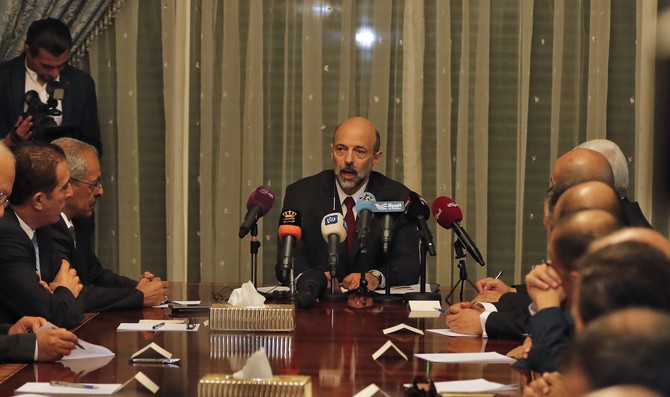
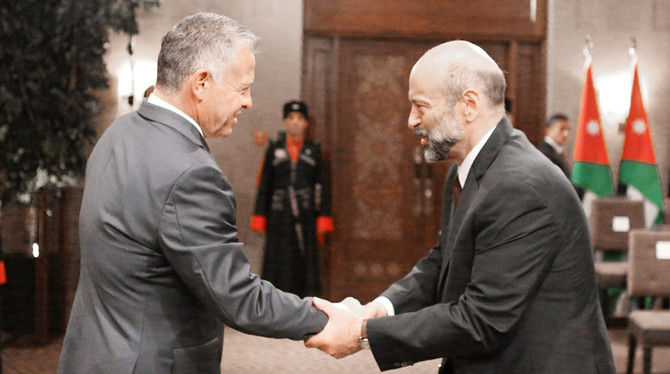

AMMAN: Jordanians who joined street protests that brought down the country’s government earlier this month have expressed disappointment at the make-up of the new Cabinet after it was sworn in yesterday.
King Abdullah appointed Omar Al-Razzaz, a Harvard-educated economist, as prime minister last week. Al-Razzaz succeeds Hani Mulki, who stepped down on June 4 after days of angry demonstrations against austerity measures, including a rise in income tax.
Mohammed Omar, a political activist who took part in the protests, said: “Of the 29 Cabinet members 23 have previously been ministers and 13 were members of the outgoing government.”
Omar said he was still hopeful of wider democratic reforms in Jordan. “I would still like to see a constitutional government created from a Parliament that is elected on the basis of a representative election law and (I would like to see) a reduction of the king’s powers.”
Thousands of Jordanians took part in protests across the country earlier this month to demand the sacking of the government and the abolition of a controversial bill that lowered the minimum taxable income to 8,000 Jordanian dinars ($11,000) for an individual and 16,000 dinars for a family.
The tax increases are a condition of a three-year economic program by the International Monetary Fund that aims to reduce public debt and boost state revenue.
Earlier this month the king intervened to halt a rise in fuel prices, which had also been part of the government’s austerity measures.
In the aftermath of the protests, Saudi Arabia, the United Arab Emirates and Kuwait pledged to extend a $2.5 billion aid package to Jordan. On Wednesday, Qatar pledged $500 million in cash and investments.
Both the foreign minister, Ayman Safadi, and the interior minister, Samir Al-Muabadeen, have kept their posts in the new Cabinet, which includes seven women. Rajai Muasher, one of Jordan’s wealthiest businessmen, was appointed deputy prime minister.
Jumana Ghneimat, the new minister for media affairs, told Arab News she understands protesters’ frustrations.
“They have a right to evaluate us and our work, and our job is to listen to ensure that our government works and (meets) the hopes and aspirations of the entire country.”
In its first meeting, the new government had, as expected, approved a plan to withdraw the controversial income tax law, she said.
Ghneimat, who previously worked as editor-in-chief of the Al Ghad daily newspaper, said the government will be transparent and “communicate with the people.”
The protesters, however, may take some convincing. Rawan Joyoussi’s poster listing their demands became one of the iconic images of the demonstrations and she has mixed feelings about the new Cabinet.
“I was hoping that women would be empowered and I am happy with that,” she said. “But as far as the composition of the rest of the government is concerned, I think we have to play our part to create the mechanisms that will hold the government accountable.”


