MAPUTO: Britain advised citizens on Tuesday against traveling to an area in northeastern Mozambique after a series of attacks by groups with links to Islamic militants.
At least 17 people have been killed — 10 of them beheaded -since May in the town of Palma, near the Tanzanian border. The UK joins in the United States in issuing a warning about the attacks.
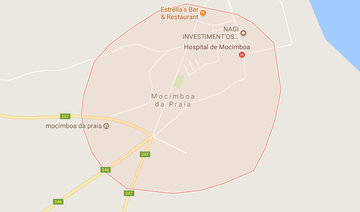
“The Foreign and Commonwealth Office advise against all but essential travel to the districts of Palma, Mocimboa de Praia and Macomia in Cabo Delgado province due to an increase in attacks by groups with links to Islamic extremism,” the office said in a warning posted on its website. Palma is near one of the world’s biggest untapped offshore gas fields, and Anadarko Petroleum is seeking to raise $14 billion to $15 billion for a liquefied natural gas project in the region.
The company has said it was monitoring the situation. It declined to comment on reports that it has suspended work on its project.
Canada-based Wentworth Resources said the security situation was part of the reason it sought a one-year extension for its appraisal license in the region.
“This has prevented safe access to the area for Wentworth staff and contractors. The Company continues to monitor the situation closely,” it said in statement posted on its website.
Six men wielding machetes killed at least seven people and injured four others this month in the predominantly Muslim region. Ten people were beheaded last month, and local media reported at least two were children.
Mozambique has not been a focal point of militant activity in the past and police have been reluctant to ascribe the attacks to Islamists. About 30 percent of Mozambique’s 30 million people are Roman Catholics; about 18 percent are Muslim.

UK issues travel warning after Mozambique attacks
Germany’s Merz visits India to push defense industry ties ahead of EU trade deal
- India, Germany make joint declarations on cooperation in defense, critical minerals, energy
- Merz is accompanied by CEOs of top German companies such as Thyssen, Siemens, Bosch
NEW DELHI: German Chancellor Friedrich Merz met Indian Prime Minister Narendra Modi on Monday to push for defense industry cooperation ahead of India’s awaited free trade agreement with the EU.
Merz’s two-day trip is his first since taking office in May and he is accompanied by German business leaders.
The visit started in Ahmedabad in Gujarat, Modi’s home state, where they held a press conference after a delegation-level meeting and a series of joint declarations, including on strengthening bilateral cooperation in the defense industry, critical minerals, semiconductors, and energy.
“The growing cooperation in defense and security is a symbol of our mutual trust and shared vision,” Modi said, as he thanked Merz for “simplifying the processes” related to defense trade.
“We will also work on a roadmap to enhance cooperation between our defense industries, which will open up new opportunities for co-development and co-production.”
The roadmap would promote long-term industry-level collaboration, including technology partnerships, co-development and co-production of defense platforms and equipment, according to Prof. Ummu Salma Bava, chairperson of the Special Centre for National Security Studies at Jawaharlal Nehru University.
“This defense cooperation marks a transformational shift in the bilateral relations that had till now focused on economic cooperation, and inaugurates a new chapter on a scaled-up defense engagement,” she told Arab News.
“PM Modi indicated that both countries are entering the ‘limitless’ phase in expanding economic cooperation in strategic sectors.”
Germany is India’s most important trading partner in Europe and one of its top partners worldwide, with bilateral trade in goods and services estimated by the Indian Ministry of External Affairs at $50 billion.
In Merz’s delegation are 25 CEOs and industry leaders, including from Thyssen Krupp Maritime Systems, Siemens, DHL Group, Infineon Technologies, Uniper, Airbus Defence and Space.
German media reported that one of the key focuses of the visit is finalizing the details of an $8 billion deal to jointly build submarines in India.
The visit comes as India and the EU — of which Germany is the largest economy — are working on a free trade agreement. It also takes place ahead of an EU-India summit in New Delhi on Jan. 27, where parts of the pact are expected to be finalized.
“The visit of the large business delegation with 25 German CEOs is to tap into the growing economic potential and also further strengthen the bilateral economic relations,” Bava said.
“The signing of the India-EU FTA will further expand trade between India and Germany. Germany is the largest economy in the EU and has a strong base in automobiles, engineering, advanced manufacturing, chemicals and defense industry.”