

Philippine army kills 20 militants, destroys bomb factory

1 / 3
A screen grab from a video supplied by an informant to the military shows Islamist militants, believed to include foreign personalities. Also seen in the picture are bomb making materials. The video was taken inside the BIFF bomb factory destroyed during the military operations on Sunday. (Photo from Army 6ID)
2 / 3
Soldiers hoist the Philippine flag at the remote terrorist heartland in Liguasan marsh in Maguindanao after the clashes with the group of BIFF leader Abu Toraife Sunday morning. (Photo from Army 6ID)
3 / 3
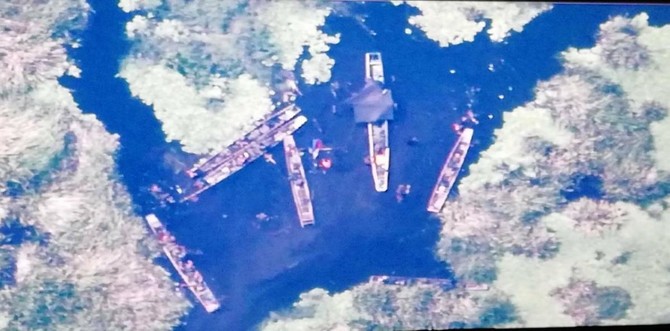
An aerial photo of the BIFF lair used as bomb factory which was the target of the military airstrike in Liguasan marsh in Maguindanao on Sunday. (Photo from Army 6ID)
Updated 12 June 2018
Follow

Philippine army kills 20 militants, destroys bomb factory

  • Operations against the Bangsamoro Islamic Freedom Fighters (BIFF) left 22 people dead, including one civilian and one soldier.
  • Several boats and concealed huts were destroyed by aircraft and artillery attacks by Philippines security forces.

MANILA: The Philippine army is investigating claims that foreign militants were among 20 extremists killed in air and ground assaults against Bangsamoro Islamic Freedom Fighters (BIFF) in Central Mindanao.

On Tuesday, the army said that a two-day operation against the BIFF had left 22 people dead, including one civilian and one soldier.

A senior military official, who declined to be named, told Arab News that before the airstrikes at the BIFF enclave in Liguasan marsh at the boundary of Pagalungan and General Salipada K Pendatun, Maguindanao province, at least 10 foreigners were seen in the area.

“They are foreigners believed to be from Indonesia. The locals in the area call them Indong. There are more or less 10 of them,” the official said.

Singaporean terrorists known as “Mauwiyah” were also believed to be hiding in the area.

The official said that Sunday’s dawn operations had been planned for some time.

All information received by the military was confirmed before the assault was carried out against a BIFF group lead by Esmael Abdulmalik alias Abu Toraife.

Toraife, a radical cleric and skilled bombmaker, is said to be a student of Malaysian terrorist and bomb expert Zulkifli Bin Hir alias Marwan, who was killed in the 2015 Mamasapano raid.

Philippine army units stormed the militants’ hideout with support from the air force.

Brig. Gen. Cirilito Sobejana, 6ID commander, said rockets launched by the military hit the militants’ bomb factory. “The destruction of the factory was manifested by sympathetic detonations of IEDs (improvised explosive devices) when the rockets were fired,” he said.

Unconfirmed reports said at least three foreign militants were among those killed.

A member of the group, Ustadz Anwar Ali, 22, a BIFF bombmaker, and his wife, Asnaya Ali, 20, were arrested. A sniper rifle and M4 carbine were seized.

“The suspects threw their weapons and improvised bombs in the water when we blocked all their escape routes. Ustadz Anwar is known as Abu Omar, a bomb expert in the group,” said Cabunoc.

Several boats and concealed huts destroyed by aerial and artillery attacks.

Government forces hoisted the national flag at the site following the attack. Cabunoc said it was the first time that soldiers had entered the remote marshy hideout.

“Just in time for Independence Day (June 12), we hoisted the Philippine flag in that part of the Liguasan marsh. It was the first time that soldiers were able to enter the area. No government forces have ever been there until today,” said Cabunoc, noting that the remoteness of the area which makes it a favorite hiding place even notorious bandits and criminals.

Cabunoc added the operations, which continued until Monday, showed the military “can each the enemy anywhere they are.”

“We have won the support of the people. Even among the Moro Islamic Liberation Front (MILF) and the general populace we have informants because they don’t want to be associated with these extremist groups,” he said.

Five more BIFF gunmen were killed in separate encounters with soldiers on Monday night.

Capt. Arvin Encinas, 6ID public affairs officer, said the militants staged retaliatory attacks by harassing army detachments and firing at a village in a different area of Maguindanao. One civilian died in the BIFF attacks.


Rohingya refugees hope new leaders can pave a path home

Updated 29 December 2025
Follow

Rohingya refugees hope new leaders can pave a path home

  • Some 1.7 million Rohingya Muslims displaced in Myanmar's military crackdown live in squalid camps in Cox’s Bazar, Bangladesh

COX’S BAZAR, Bangladesh: Rohingya refugees living in squalid camps in Bangladesh have elected a leadership council, hoping it can improve conditions and revive efforts to secure their return home to Myanmar.
Spread over 8,000 acres in Cox’s Bazar in Bangladesh, the camps are home to 1.7 million members of the stateless group, many of whom fled a 2017 military crackdown that is now subject to a genocide probe at the UN court.
In July, the refugees held their first elections since their influx began eight years ago, resulting in the formation of the United Council of Rohang (UCR).
“They are working to take us home,” said Khairul Islam, 37, who back home had a thriving timber business.
The new council has brought him a glimmer of hope amid an uncertain future.
“We can hardly breathe in these cramped camp rooms... all our family members live in a single room,” he said.
“It’s unbearably hot inside. Back in Myanmar, we didn’t even need a ceiling fan. In summer, we used to sit under tall trees,” Islam said, his eyes welling up.
More than 3,000 voters from across 33 refugee camps cast their ballots to elect an executive committee and five rotating presidents to focus on human rights, education and health.
Addressing a gathering at one of the camps, UCR president Mohammad Sayed Ullah urged refugees not to forget the violence that forced the mostly Muslim group to flee Myanmar’s Rakhine state.
“Never forget that we left our parents’ graves behind. Our women died on the way here. They were tortured and killed... and some drowned at sea,” said Sayed Ullah, dressed in a white full-sleeved shirt and lungi.
“We must prepare ourselves to return home,” he said, prompting members of the audience to nod in agreement.

A seat at the table 

“UCR wants to emerge as the voice of the Rohingyas on the negotiation table,” Sayed Ullah later told AFP.
“It’s about us, yet we were nowhere as stakeholders.”
The council is not the first attempt to organize Rohingya refugees.
Several groups emerged after 2017, including the Arakan Rohingya Society for Peace and Human Rights, once led by prominent activist Mohib Ullah.
But he was murdered in 2021.
And even before that, many organizations were shut down after a major 2019 rally, when the Rohingya said they would go home only with full rights and safety guarantees.
“Some newspapers misrepresented us, claiming we wanted to stay permanently in Bangladesh,” Sayed Ullah said.
“Many organizers were detained. The hardest blow was the assassination of Mohib Ullah.”
But trust is slowly building up again among the Rohingya crammed in the camps in Cox’s Bazar.
“Of course we will return home,” said 18-year-old Mosharraf, who fled the town of Buthidaung with his family.
“UCR will negotiate for better education. If we are better educated, we can build global consensus for our return,” he told AFP.

Security threats 

Many refugees have started approaching the body with complaints against local Rohingya leaders, reflecting a slow but noticeable shift in attitudes.
On a recent sunny morning, an AFP reporter saw more than a dozen Rohingya waiting outside the UCR office with complaints.
Some said they were tortured while others reported losing small amounts of gold they had carried while fleeing their homes.
Analysts say it remains unclear whether the new council can genuinely represent the Rohingya or if it ultimately serves the interests of Bangladeshi authorities.
“The UCR ‘elections’ appear to have been closely controlled by the authorities,” said Thomas Kean, senior consultant at the International Crisis Group.
Security threats also loom large, undermining efforts to forge political dialogue.
Armed groups like the Arakan Rohingya Salvation Army and Rohingya Solidarity Organization continue to operate in the camps.
A report by campaign group Fortify Rights said at least 65 Rohingyas were killed in 2024.
“Violence and killings in the Rohingya camps need to stop, and those responsible must be held to account,” the report quoted activist John Quinley as saying.