

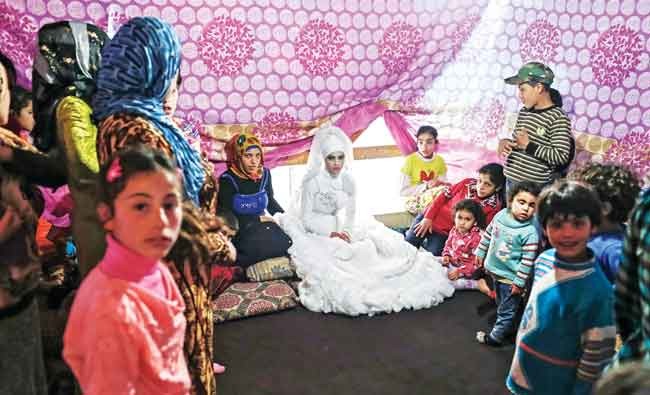

DAMASCUS: Layla was 15 when her parents married her off to the first suitor after her family were forced to leave their home in a Damascus suburb.
Now a mother of three, she works as a manicurist in a beauty salon in Abu Rummaneh, an upscale neighborhood of the Syrian capital.
While still only 20, the wrinkles starting to form around the young woman’s eyes are a hint of the hardship that she has faced — another person suffering from the devastating civil war.
“The money I make here is barely enough to cover our basic needs, so I clean houses on Mondays — my day off,” she said.
“I want my daughters to receive a good education and become independent women, even if I had to mop floors for the rest of my life.”
The rate of child marriage in Syria was less than 7 percent before 2011, but since the war started the figure has more than doubled to 14 percent, according to Syrian Justice Ministry figures.
However, a 2017 report by the Syrian Center for Legal Research and Studies reported another increase of 30 percent since 2015.
For Layla, her trauma started when her family moved from Harasta, in northeastern Damascus, to Jaramana, where they lived with four other impoverished families in a cramped house. Her father was struggling to make ends meet when a 25-year-old microbus driver proposed to his daughter. Her family was glad to have one less mouth to feed, and she welcomed the idea of moving to a less cramped place.
In 2016, Layla’s husband died, leaving her with three daughters and his elderly mother to support.
Damascus-based lawyer and writer, Faten Derkiy, told Arab News that forced displacement and poverty drove families to rid themselves of financial burdens by marrying off their adolescent daughters. “We can, of course, stipulate that this rate doubled in Daesh-controlled territories, where young girls are taken as sex slaves and spoils of war,” he said.
Walaa Ibrahim also thought that getting married would save her from tough living conditions after her family was forced to leave their home in Hajjar Al-Aswad, a city 4 km south of the center of Damascus. After violence erupted there, they moved to rent a small house in Naher Aisha.
At age 17 in 2012, she married her cousin, but almost a year later he disappeared in a conflict area when she was eight weeks pregnant.
She and her 4-year-old son, Hatem, now live with her parents.
“My mother was against this marriage because I was very young, but my father saw no harm in giving his consent,” she said.
“I was young and did not think beyond the wedding dress and party.”
She cannot get a job nor continue her education because her son is disabled and needs her undivided attention.
Um Khaled, Walaa’s mother, said that her grandson’s condition was the result of birth asphyxia. “I shouldn’t have gotten married; it’s a huge responsibility with which no child must be burdened,” Walaa said. “I wish to see my son one day as a great achiever who leads a good life.”
Family lawyer Alia Al-Najjar, who runs her own law firm in Damascus, told Arab News that the problem has been exacerbated by many young men joining the conflict and leaving the country. “The war has resulted in an ideological imbalance that made child marriage very common,” she added.
“Parents believe that marrying off their young daughters would protect them from homelessness and would ensure their honor remains intact under these harsh circumstances.”
The ministry’s figures showed that about 10 percent of child marriages in 2013 were registered at religious courts in Damascus.
Article 16 of the Syrian Personal Status Law stipulates that “the appropriate age for marriage is 17 years old for a girl and 18 for a boy.”
But Article 45 Paragraph 1 of the same law states that if the male has reached puberty and the age of 15 and a female claimed the same and reached 13 and requested to get married, a judge could grant them them a wedding.
The consent of a legal guardian — a father or a grandfather — is required.
Attorney Al-Najjar said: “The judge will ask the two minors to provide certain medical exams as well as documents that prove they are capable of starting a family together.”
“The judge can act as a minor girl’s guardian if she didn’t have one, according to Sharia law, and can give his consent for her marriage if he believes her ready and if the suitor is competent.”
Dr. Lama H., a Damascus-based gynecologist and obstetrician, said that while a judge may rule that a woman has reached the age when she can conceive, “this does not constitute that her physical and mental health won’t be harmed in the process.”
She said: “I’ve seen many cases in which the mother-in-law complained that her son’s adolescent wife had several miscarriages, and it was not easy to explain to her that younger age does not mean stronger body.”
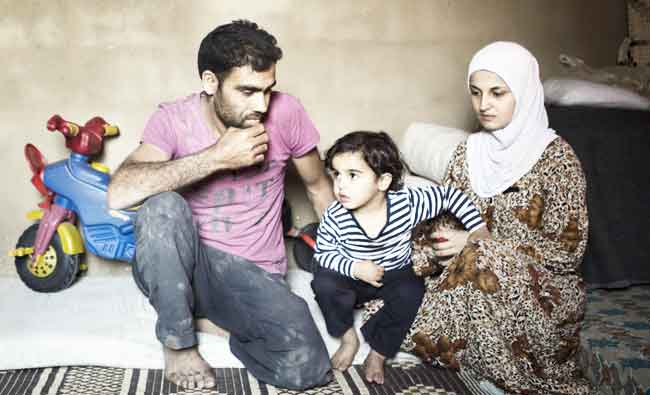
A women in her 40s at Dr. Lama’s office said: “War or no war — it seems the middle ages never left Syria.”
Dr. Caleb Backe, a US-based health and wellness expert, told Arab News: “Women who become pregnant under the age 15 are significantly more likely to experience eclampsia and prenatal convulsions, which can damage the mother and her baby.”
Backe said: “Similarly, adolescent mothers face higher risks of giving birth prematurely, bearing children with low birthweight and other potentially fatal neonatal conditions.
“Additionally, pregnancy and childbirth complications are the number one killer of adolescent women around the world.”
After her husband died and the war forced her and her family to leave their home in Jobar, Umm Feras, 50, saw no better option than to marry off her two daughters, who were 14 and 16 at the time, and look only after herself and her disabled son.
“I believed that by doing so I would have fewer mouths to feed, and their husbands would mold them so that no troubles will arise between them,” she said, rubbing her aching, bony knees.
Now, Umm Feras works as a cleaning lady to support her daughters and their young children after their husbands were arrested and not seen again.
“Now I have to feed them and their five little children, the eldest of whom is five years old,” she added, tears forming in the corners of her eyes.
Dr. Marsha Brown of the Institute for Behavioral Sciences and the Law, told Arab News that child marriage is associated with a number of poor lifetime outcomes.
“Children who are forced to marry frequently have limited or no education, as they are often forced to discontinue school in order to focus on having children and assume full-time household duties,” she said.
“Additionally, child brides often lack the necessary ability and life experience to negotiate their roles within their marriage.
“Unfortunately, research also suggests that child brides are often subjected to increased physical and sexual violence from their spouse.”
“Child brides have a greater likelihood of experiencing suicidal thoughts or engaging in self-harm behavior.”


