KARACHI: As Eid festivities draw closer, shopping centers in the seaside metropolis have opened their gates to welcome the growing number of people every night — and conduct their business activities till dawn.
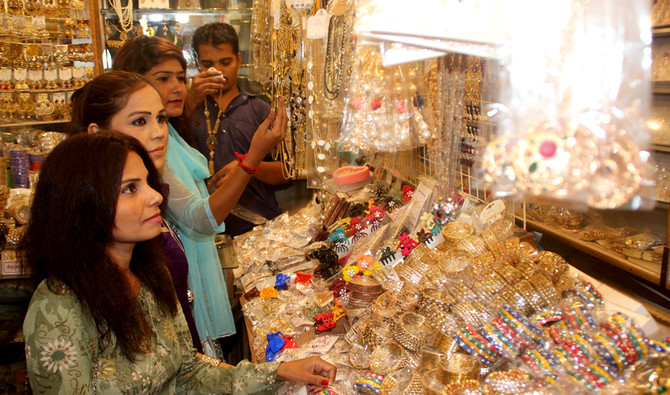
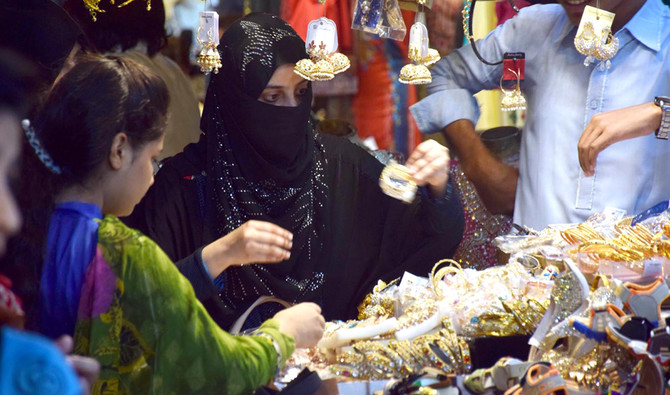
This is true of more than 20 major shopping centers in Karachi that get crowded in the evening after the city’s soaring temperatures cool down.
“All facilities have been provided to carry out business activities in the major shopping centers across the port city,” Atiq Mir, chairman of All Karachi Tajir Ittehad, an umbrella organization of nearly 100 business centers in the city, told Arab News.
He said that an estimated PKR 100 billion of business was expected in the country’s biggest and most densely populated city, as people make arrangements for Eid celebrations. “The mega city is home to 20 million people who are known for their passion for shopping. On this mega event, an average buyer normally spends a minimum of PKR5,000 on shopping. If the situation remains stable, more than PKR 100 billion of business will be done as goods are also transported to other parts of the country from Karachi,” Mir said.
Traditionally, Pakistan undergoes a major shopping frenzy in the last 10 days of Ramadan. These commercial activities culminate hours before the Eid prayer. “We have been advising people to start shopping earlier since they will otherwise get caught in a huge rush during the last few days,” Mir said.
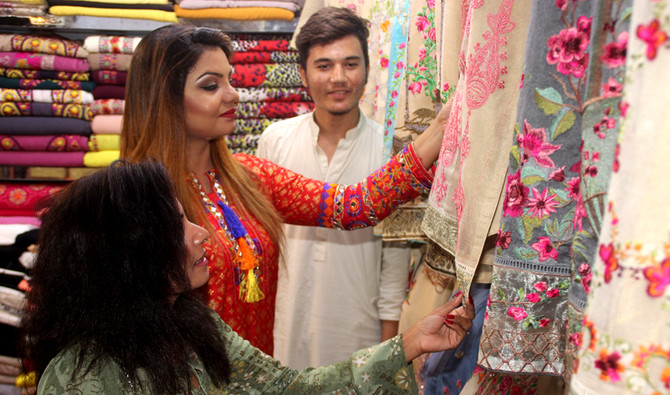
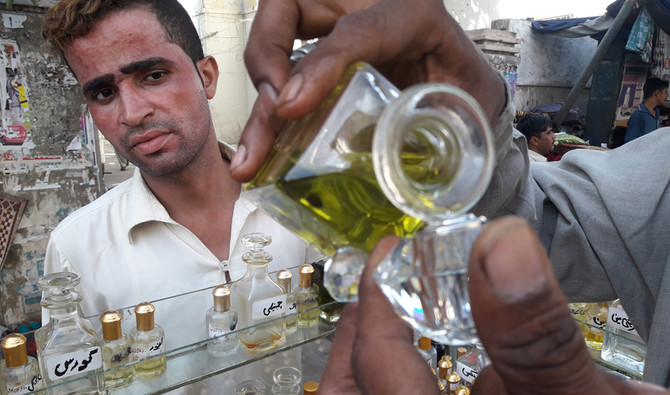
A large number of Pakistanis buy clothes, shoes, children’s garments and jewelry ahead of the Eid celebrations. Demand for unstitched fabrics, perfumes and cosmetics also remain high before the mega festivity.
Apart from producers of local fabric, however, local manufacturers this year may not be able to capture a huge market share since their Chinese counterparts have started aggressively marketing their products.
“There is a huge rush at the Jama Cloth Market as people are busy with Eid shopping. Besides local products, items from China, India and other countries are also displayed in large quantities,” Asif Gulfam, who is part of the Alliance of Arambagh Market Association, told Arab News.
Almost 80 percent of children’s garments available in the local market have been imported from China, Malaysia, Bangladesh, Taiwan and Singapore, Mir said, adding that only unstitched and semi-stitched garments by local manufacturers are in a great demand.
As some shoppers wait for the last days of Ramadan, others prefer to avoid the market hassle that accompanies 11th-hour shopping sprees. “I do not feel comfortable while shopping in a congested environment. Sometimes you find what you are looking for, though you are also forced to make unnecessary compromises quite frequently. It is better to buy stuff in a hassle-free environment,” one shopper, Samina Ahmed, said.
It is only in the recent past that the concept of mega shopping malls in the major urban centers of the country have taken root in Pakistan. Given the cutthroat competition in retail business, these malls in most cases have adversely affected the business of small and medium enterprises.
“Almost 40 percent of our business has shifted to these malls since they offer a better environment to shoppers. You will not see many discount schemes during the last few days of Ramadan since shopkeepers want to cover all their expenses by selling products at maximum prices,” said Muhammad Tahir Khan, joint secretary of a traders’ welfare association in Karachi. “Chinese products can be seen everywhere in shopping centers,” Khan added.
According to Abdullah Zaki, an industrialist and former chairperson of the Pakistan Yarn Merchants Association: “Local industry is suffering up to 20 percent due to the influx of cheap Chinese products. The local industry also suffers due to the inflow of smuggled goods from neighboring Afghanistan.”
In Pakistan, many local charities, philanthropists and humanitarian organizations step forward during Ramadan to provide financial assistance to thousands of poor, making it possible for them to participate in Eid festivities and giving greater impetus to commercial activities in the country.


Eid shopping gains momentum in Pakistan





Eid shopping gains momentum in Pakistan
- More than PKR100 billion of business activities are likely to take place ahead of the festivity.
- Chinese products have deeply penetrated the market, making local manufacturers suffer significant losses.


Imaan Hammam shines in bridesmaid mode
- Attends wedding of best friend and model Cindy Bruna
DUBAI: Supermodel Imaan Hammam recently attended the wedding of her best friend and fellow supermodel Cindy Bruna, who tied the knot with former basketball star and actor Blondy Baruti in an intimate ceremony in Paris.
Bruna, a French-Congolese model best known for her work with Victoria’s Secret and major fashion houses, married in a private celebration attended by close friends and family. She wore a custom gown by Lebanese designer Elie Saab.
Hammam was a part of the bridal party, serving as one of Bruna’s bridesmaids. The Dutch-Moroccan-Egyptian model wore a long, maroon-red gown with a sleeveless silhouette.
The dress was paired with matching elbow-length gloves in the same deep red shade, creating a coordinated and striking look that stood out but was in keeping with the formal event.
On Instagram she posted images with the caption: “Most special weekend celebrating my sis and Blondy. The most beautiful bride … truly. My heart is so full. We danced, we laughed, and we loved every moment.”
The floor-length gown featured clean lines and a streamlined cut, allowing the rich color to take centerstage. Hammam kept her styling minimal, letting the dress and gloves do most of the work.
Hammam and Bruna have been close friends for years, frequently appearing together at fashion events and on international runways.
Hammam is one of the most in-demand models in the industry. She was scouted in Amsterdam’s Centraal Station before making her catwalk debut in 2013 by walking in Jean Paul Gaultier’s couture show.
Hammam has appeared on the runway for Burberry, Fendi, Prada, Bottega Veneta, Marc Jacobs, Moschino, Balenciaga and Carolina Herrera. And starred in international campaigns, including for DKNY, Celine, Chanel, Versace, Givenchy, Giorgio Armani and Tiffany & Co.
Earlier this year, she launched Ayni, an archival platform dedicated to preserving and celebrating Arab artistic expression from her perspective.
“For me, it’s always been so much deeper than just fashion. It is about staying connected to my roots, telling stories that move me and shining a light on the voices that need to be heard.”
She said her hope for Ayni is for it to grow beyond a personal vision and become a “real community.”


