
Director Moustapha Akkad’s masterpiece “The Message” will be screened in Saudi Arabia for the first time after being passed by the country’s censors.
The cinema epic, which chronicles the life of Prophet Muhammad and the birth of Islam, has undergone extensive restoration and will be screened in 4K at Vox Cinemas Riyadh Park during Eid-Al-Fitr.
The Oscar-nominated film was passed by the General Commission for Audiovisual Media (GCAM) at a screening on Thursday.
The film caused controversy when it was released in 1976 and was banned across much of the Arab world.
Now it will be given a widespread release across the region. Only Kuwait has continued its ban on the film.
Akkad’s son, Malek, has lobbied extensively for “The Message” to be screened across the region.
The director’s son has worked tirelessly on the film’s restoration and to reacquaint himself with his father’s work.
“Ironically, even though it’s over 40 years later, probably the biggest challenge has been, once again, all the censorship boards and trying to get them to come around and see this film in a new light,” Akkad said.
“Over the years it has become a favorite, a classic in the region that they play on satellite stations, so a huge portion of the population are familiar with this film. But there is still an old guard on the censorship boards. However, I’m happy to say we have been pretty much successful in a large number of countries and I’m very happy about that.”
The re-release has been made possible by a collaboration between Akkad’s Trancas International and Dubai-based distribution company Front Row Filmed Entertainment.
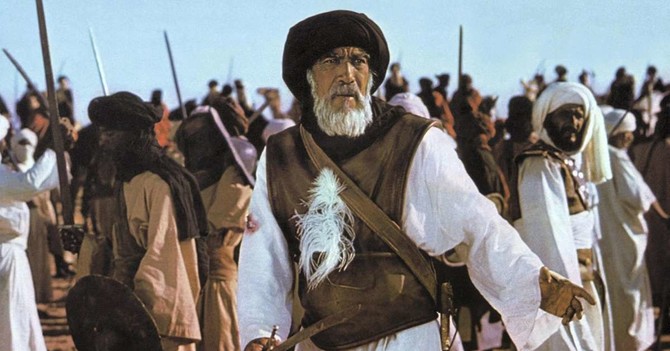
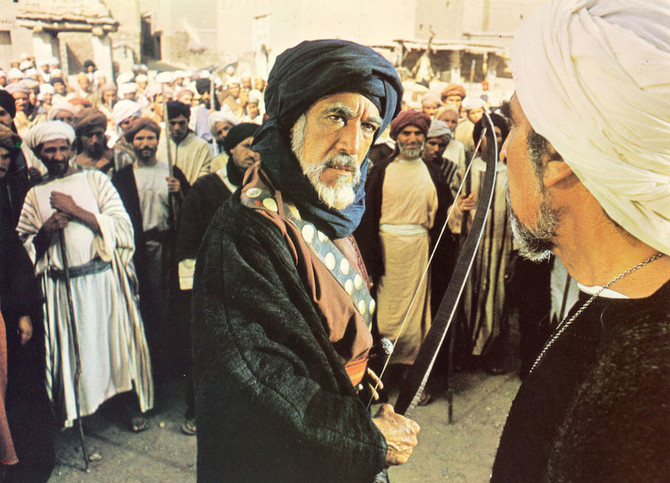
Moustapha Akkad was born in Aleppo, Syria, had began work on the film in 1974, shooting two versions simultaneously — one in Arabic and one in English. The Arabic version featured some of the biggest stars of Arab cinema, including Abdullah Gaith in the lead role of Hamza. In the English version, the role of Hamza was played by Anthony Quinn.
In accordance with Islamic beliefs, Prophet Muhammad was not be depicted on screen nor was his voice heard.