KARACHI: Dwellers of Karachi, a seaside Pakistan metropolis, have kept away from the busiest roads and crowded marketplaces because of high humidity in the air as mercury began to go down after a week of heatwaves.
The temperature in Upper Sindh continued to stick as high as 48C.
“Most parts of the country will remain in the grip of the intense heat, with temperatures above 40C in sub-mountainous areas of Punjab, Khyber Pakhtunkhwa and AJK, and around 50C in interior Sindh, southern and central Punjab and eastern Balochistan,” read a handout issued by the Pakistan Meteorological Department (MET) on Thursday evening. It said that the sea breeze would come back gradually along the coastal belt, bringing the Karachi temperature to the normal range of 35-37C during next week.
Shaukat Ali, an official at the airport office of MET Department, told Arab News on Sunday that the temperature in Larkana and Shaheed Benazirabad cities of Sindh remained 46C during the day. “Mohenjo-Daro remained the hottest city for the day with 48C,” Ali said.
Last month, Karachi, capital of the Sindh province, experienced the highest temperature in May for 37 years on Wednesday when the mercury touched 46C, with 10 percent humidity. Friday, however, witnessed 35C in Karachi but humidity further enhanced, which brought little positive changes to the weather.
“Although the temperature will go down in the coming days, the high level of humidity will give people the feel of a high temperature,” Director Karachi Met Office Abdur Rashid told Arab News. The official sees no respite during the coming days of Ramadan for Karachiites but rules out deaths due to bad weather.
“In the coming days the weather will be warmer due to high humidity and the remaining fasting won’t be easy,” Rashid said, urging people to continue with precautionary measures against heatwaves.
In May, Jacobabad experienced the hottest day of the country, when mercury went up to 51C. “However, the country’s highest temperature of 54C was recorded in May 2017 in the Turbat town of Balochistan,” said Rashid.
Rashid said climate change in Karachi was caused by climate change in the Arabian Sea, which had witnessed radical but strange change recently. Dr. Qamar-Uz-Zaman Chaudhry, special adviser at the World Meteorological Organization, concurred but said there had been warnings about climate change which should have been taken seriously.
“In June 2015, over a thousand people died when heatwaves hit the coastal city but this year there is zero mortality due to awareness among the dwellers of the city,” Executive Director of Jinnah Postgraduate Medical Center Dr. Seemi Jamali told Arab News. “Not a single death has been caused by heatwaves,” she said, refuting a claim by the noted philanthropist Faisal Edhi. “Yes, there were few deaths due to heat depression but no death has been caused by heatwaves, credit for which goes to the media for raising awareness and the Met office for issuing timely early warnings,” she said.
Chaudhry said climate changes were global but locally more plantation in urban units could counter unwanted weathers. “The more plantation, the more greenery and better precautionary measures can help people to escape undesirable consequence of heatwaves,” Chaudhry said.
The deaths of June 2015 and mass awareness have scared people, traders believe. Abdul Samad Memon, owner of a garment shop at Karachi’s Zainab market, said the warning of heatwaves and hot weather had brought a drastic decrease in daytime customers.
“During Ramadan the daytime clientele went down but due to heatwaves it has become almost zero,” Memon told Arab News, saying if the weather didn’t normalize it may affect sales.
Rizwan, who stopped at a fountain at Arts Council Roundabout to take a shower, said he has seen no changes. Unaware of the weather science, Rizwan told Arab News he had been upset by the weather.
“Not everyone can afford to sit at home. I have come out to bring items to my shop,” he said. Rizwan and other passers-by like him have found a comfort in this fountain.


![]()
![]()
![]()

Fall in mercury brings little respite for Karachiites owing to high humidity
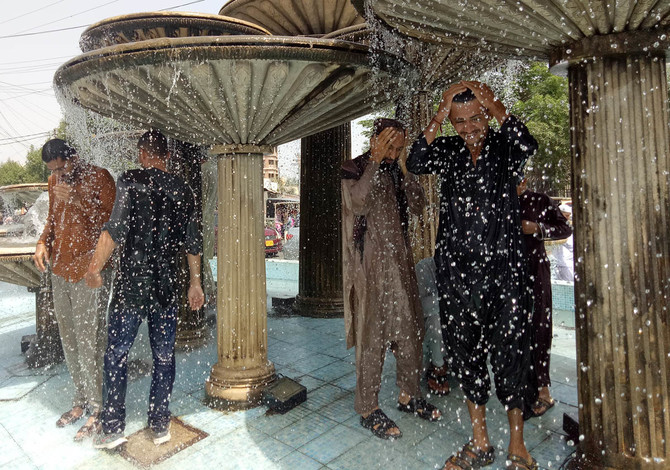

Fall in mercury brings little respite for Karachiites owing to high humidity
- Thousands died in June 2015 when heatwaves hit the seaside Pakistani metropolis for the first time
- In Mohenjo-Daro, the temperature on Friday had soared as high as 50C

Latest updates





© 2026 SAUDI RESEARCH & PUBLISHING COMPANY, All Rights Reserved And subject to Terms of Use Agreement.