DHAKA: Rohingya refugees in Cox’s Bazar are facing a severe crisis of safe drinking water as the water level in coastal areas decreases day by day.
Out of 6,000 shallow tube wells, about 1,500 are out of order, mostly due to a drop in the underground water level and a lack of proper maintenance.
Experts say that the water crises may worsen in the coming days if consumption of underground water continues at the present rate without proper monitoring of the water table.
Zamila Khatun,14, a refugee living with her family of six at Balukhali camp in Ukhia, spends four to five hours in a queue to fill her 12 liters jerrycan to meet daily water needs. “Sometimes it becomes very crucial for me to wait in the scorching heat of the summer. We need to address all our household work including cooking and washing with this little water,” Zamila said.
Abdus Shukur,19, another refugee at Ukhia camp, said: “During the past four days I managed only one shower — yesterday. In my camp area two shallow tube wells have been out of order for the past three months.”
Khairul Alam, country director of Water Aid, Bangladesh, told Arab News that when the shallow tube wells were installed at the end of last year, water was available just under 30-60 feet. But due to continuous extraction and after the dry spell of summer the water level has gone down, adding more suffering to refugee lives.
“In many areas water is now available only under 700-800 feet from the ground. Even deep-tube wells are needed to be repaired frequently in some cases,” Khairul said.
He said that the situation was even worse in the camps of Teknaf as there was no underground water in that area. “The only way to have safe drinking water for these refugees is surface water of the ponds,” Khairul said.
Bangladesh’s Department of Public Health and Engineering is providing safe water by carrying it on trucks from Ukhia. In Teknaf, Oxfam has established a large water body to provide purified and treated water to the refugees as well as the host community.
The Institute of Water Modeling (IWM), an autonomous body under the Water Resources Ministry of Bangladesh, is undertaking intensive research to project the water reserve situation of the Cox’s Bazar area.
It is expected to publish the outcome of this reaserch by the end of June, according to Rittick Chowdhury, executive engineer, Department of Public Health and Engineering, Cox’s Bazar. The research initiative of IWM is jointly financed by Water Aid, BRAC, Muslim Aid, Christian Aid and TR Fund.
“In Ukhia and Balukhali camp areas, some shallow tubewells are not functioning as the water level falls by 1.5-2 feet. And some shallow tubewells are not functioning due to lack of proper maintenance,” Rittick said.
He said that since a large number of shallow tubewells were not functioning, it made the queue longer for refugees to collect safe drinking water.
Rittick identifies Teknaf as a “critical zone” to have underground water as there is not any suitable underground water there. Due to stoney land, boring of water pipes is impossible, he said, and “shallow tubewells also provide salty water due to the proximity to the sea.”
Professor Mashfiqus Salehin, a renowned water expert, said a large number of shallow tubewells extracting ground water every day resulted in the fall of the groundwater table.
Salehin, a professor at the Institute of Water Management, Banglagladesh University of Engineering and Technology, said: “If it is necessary to look after more than one million refugees in such a small area as Cox’s Bazar, we need to have close monitoring on the nature of acquifer of this land in this monsoon. Since the land formation is very rocky, here the water storage system need to be analyzed after the monsoon.”
Otherwise water management system of this zone would be unpredictable, he said.


![]()
![]()
![]()

Rohingya refugees in dire need of water under scorching sun

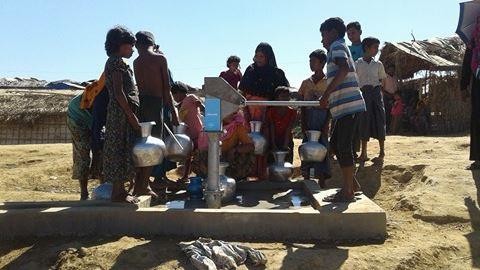
Rohingya refugees in dire need of water under scorching sun
- Experts say that the water crises may worsen in the coming days if consumption of underground water continues at the present rate without proper monitoring of the water table.
- The Institute of Water Modeling (IWM) is undertaking intensive research to project the water reserve situation of the Cox’s Bazar area.


Latest updates


Recommended


© 2026 SAUDI RESEARCH & PUBLISHING COMPANY, All Rights Reserved And subject to Terms of Use Agreement.