Tom Fletcher might be best described as “the anti-diplomat.” Not in the sense that he sees no value in diplomacy, but in his steadfast refusal to live up to the stereotype expected of the ambassadorial profession.
While British ambassador in Beirut, he tweeted his way to acceptance by his hosts with an informal style and social accessibility that was in distinct contrast to the stuffy image of the traditional diplomatic circuit.
He told the BBC that there was not a single Ferrero Rocher in the embassy building — referring to the chocolates jokingly associated with the job after a 1990s TV commercial — and his “Dear Lebanon” farewell blog in 2015 after four years in the job boosted his broad international online appeal.
Now, Fletcher is running a portfolio of careers in the space where business, technology and public policy intersect. He is a visiting professor at New York University in Abu Dhabi, specializing in international relations, and is also involved with the Emirates Diplomatic Academy, the “ambassadors’ finishing school” in the UAE capital.
The former envoy is also chairman of the international board of the UK’s Creative Industries Federation and a member of the United Nations’ Global Tech Panel, as well as continuing a career as a successful author. His book “The Naked Diplomat” explored the interactions between governments, technology and big business, and became an international bestseller.
His experience and Internet renown make him a star attraction on the international forums circuit. He was on a panel in Dubai recently to discuss the findings of the 10th Arab Youth Survey, and afterwards went into some detail on the findings of the poll, which showed — alarmingly for some — that the US was waning in popularity in the region under President Trump and that Russia was increasingly regarded as a friend for young people in the Middle East.
Fletcher told Arab News that there was some reason to be worried about those findings, but also cause for optimism. “We have seen a striking fall in reputation among young people in the region since the US elections. But it was also worth noting the wider admiration for the American people as a whole, which looks quite resilient.
“The Russia results were interesting, because Russia has not always been a stabilizing force in the region. On Trump, they are further confirmation that the election of the leader of the free world created a vacuum. But the lights will eventually come back on in the shining city on a hill,” he said.
The survey seemed also to reveal a generational split in the Arab world, with many youngsters demonstrably not sharing their elders’ view of the US president. “I think that the region has access to the same information as the rest of us, and can take from it a pretty clear assessment of Donald Trump’s reliability. There are clearly some areas of alignment with some countries, such as the rejection of the Iran deal. But the survey shows that people across the region also hear the Trump administration’s wider messaging on the Middle East,” Fletcher said.
The Iranian situation was clearly on his mind, but he said there were alternatives to an escalating confrontation between the US and the Gulf states on the one hand, and the regime in Tehran on the other. “Wherever you stand on the Iran deal, its violation is a concern for regional security. The issue we have to ask ourselves is ‘what is the alternative for restraining Iran’s nuclear potential?’ Personally, I haven’t seen a better answer to that than the existing Iran agreement.
“Of course, the Iran deal in itself isn’t sufficient in reacting to Iran’s wider regional role, not least in Syria. But I worry that it is the hard-liners in Tel Aviv and Tehran who seem keenest to end the agreement,” he said.
A lot of his time in Beirut was spent dealing with the regional fallout from the Syrian crisis, which started just as he began the ambassador’s job. Surely, seven years on and with no solution in sight, that represents a failure of traditional diplomacy?
Fletcher’s response was, well, diplomatic. “Not all has failed. Huge effort has gone into keeping Lebanon relatively stable, despite the scale of the Syria crisis just across the border. Diplomacy has failed on Syria and on Palestine/Israel. But George Mitchell (the American politician credited with helping bring about an end to the Northern Ireland conflict in the 1990s) said that making peace was 700 days of failure and one of success. We have no choice but to keep trying, and to work harder than those who want to see diplomacy continue to stumble,” he said.
Fletcher’s work in the Gulf has enabled him to take a broad overview of developments in the region, and there is no more intriguing situation than in Saudi Arabia, which is going through a rapid transformation of the economy and society under the Vision 2030 strategy. “I think there has been a shift in international opinion on Vision 2030 over the last year. Initially many were curious, and conscious of the obstacles.
“But there is now a growing realization of how important a reform agenda is, especially if it succeeds in creating more opportunity for young people, including women. We all should hope it succeeds — I think it can, but will need maximum involvement of citizens themselves in shaping an open approach,” he said.
Fletcher also has a clear view of the kind of socioeconomic order that will emerge from the transformational policies of regional leaders.
“The Gulf has clearly realized that there is a need to move away from oil dependency well before the oil runs out. The answer has to lie in a knowledge economy. I’m heartened by the kinds of issues that my students at NYU AD want to work on and pioneer. And by the government focus on themes like wellbeing and education reform.
“Twenty-first century skills will need to be at the heart of the school curriculum, with learners encouraged to be curious, to seek out sources of knowledge and wonder, and to learn teamworking and innovation. This is happening increasingly in the larger cities, but there is still work to be done to mainstream knowledge, skills and character in education systems,” he said.
With the power of Big Data coming under scrutiny as never before in cases such as the controversy over Facebook’s role in the political process in the US and elsewhere, Fletcher’s work for the UN is more relevant than ever, and he believes there is a big role for the Gulf states to play in that debate.
“The Middle East needs to ensure it is better represented in the international architecture. It needs to be a key part of the debate about security and liberty online — the UAE Artificial Intelligence Minister (Omar Bin Sultan Al-Olama) is a great example of this. And it needs to help get everyone on to a free Internet,” he said.
Before entering the diplomatic service, Fletcher was an adviser on foreign policy to three British prime ministers, which gives him a unique perspective on the big current issue in the UK — the increasingly bitter process of leaving the EU, or Brexit.
The search for new trading partners has seen a succession of British ministers visiting the Gulf region in a bid to clinch new business. Fletcher does not share the view of some that the UK is destined for insularity and isolation in the post-Brexit world.
“The UK is going through a complex process, but it is always at its best when it has a worldview formed from having actually viewed the world. When it is open minded, outward looking. When it stands for more liberty — rights, trade, thought.
“The creative industries are already showing the way. And the royal wedding was a brilliant reminder of what the UK can be — diverse, modern, self-aware, creative. We all badly needed that reminder,” he said.
Fletcher was the youngest person ever to get a major ambassadorial post, and seems well set to pursue a handsomely paid career in virtually any sector, from international policy-making, to domestic UK politics or the private sector.
But he still regards himself as a diplomat with a creative twist. “I still write diplomat on the landing cards in planes.” And there is a second book in the works, he revealed: “I’ve just finished a murder novel, featuring an ambassador detective,” he said.
It is doubtful there will be a Ferrero Rocher mentioned in the book.


‘Naked Diplomat’ author Tom Fletcher bares all on life as UK ambassador to Lebanon

‘Naked Diplomat’ author Tom Fletcher bares all on life as UK ambassador to Lebanon


Capital concentrates as MENA startups close deals
- Fresh funding flows in even as broader market data points to a slowdown
RIYADH: Startup funding activity across the Middle East and North Africa delivered a mixed picture over the past week, with fresh capital flowing into gaming, fintech, deep tech, and travel, even as broader market data pointed to a slowdown in overall investment momentum.
Saudi Arabia’s Impact46 led a $1 million investment round in Hypemasters, an international game development studio focused on competitive strategy experiences for mobile. The round included participation from GEM Capital.
Hypemasters develops strategy titles designed for competitive depth and precise game mechanics and has attracted more than 7 million players globally.
The studio is currently advancing several new projects, including a title in soft launch, as it looks to expand its reach in markets with sustained demand for strategy games.
“Strategy is one of the most demanding categories in game development, and Hypemasters approaches it with uncommon discipline. Their work shows a clear understanding of what committed players expect from this genre, and we believe their upcoming titles can serve a global audience with genuine depth,” said Basmah Al-Sinaidi, managing partner at Impact46.
“We are pleased to support a team that builds with intention and long-term ambition,” she added.
Boris Kalmykov, CEO and co-founder of Hypemasters, said: “We’re focused on deepening our presence across the region and pushing forward with the next generation of strategy games, including a major new title already in soft launch. Partnering with Impact46 marks an important step for Hypemasters.”
The CEO added that Impact46 shares his company’s long-term vision for building “world-class strategy games” from the MENA region, and the support reinforces his firm’s commitment to expanding its portfolio with high-quality releases.
The investment reflects Impact46’s continued interest in game development and interactive entertainment and aligns with its broader strategy of backing studios building globally oriented titles.
Premialab raises $220m
UAE-headquartered Premialab, a provider of data, analytics, and risk management solutions for quantitative investing, has raised $220 million in a growth investment led by KKR, with participation from existing investor Balderton.
Founded in Hong Kong in 2016 by Adrien Geliot and Pierre Trecourt, Premialab operates a global platform serving the $800 billion quantitative investment strategies market.

Counterfeits don’t just impact economies; they erase identity, creativity and truth. Along with our investors, we’re building a movement to make the world’s stories verifiable again.
Walid Tarabih, founder and CEO of Relik
The company provides benchmarking, performance analysis, and risk analytics tools for institutional investors.
The funding will be used to support global expansion, strengthen core operational systems, and scale Premialab’s execution product, which was developed in partnership with Eurex, to broaden access to quantitative investment strategies.
“Quantitative investment strategies have grown rapidly in scale and importance, yet the market has lacked a truly independent standard for data, analytics and risk. Premialab was built to fill that gap,” said Adrien Geliot, CEO of Premialab.
Relik closes seed round
UAE-based Relik has closed a seed funding round with participation from KBW Ventures, Naatt Holding, Fort Holding, and Ayman Sejiny.
Founded in 2023 by Walid Tarabih and later joined by John Tsioris, Relik is an artificial intelligence-powered authentication platform designed to help collectors, brands, and marketplaces.
The company plans to use the funding to roll out additional products and expand across sectors including sports, luxury, and heritage markets.
“We are ensuring authenticity in a fakeable world,” said Walid Tarabih, founder and CEO of Relik, adding: “Counterfeits don’t just impact economies; they erase identity, creativity and truth. Along with our investors, we’re building a movement to make the world’s stories verifiable again.”
Prince Khaled bin Alwaleed bin Talal Al-Saud, founder and CEO of KBW Ventures, said: “Relik is creating a new global standard for truth and trust. At a time when counterfeiting and AI-generated content are rising, Relik’s mission to protect authenticity carries both cultural and commercial value.”
Nawah raises $23m
Egypt-based deep tech startup Nawah Scientific has raised $23 million in a series A round comprising a mix of equity and debt, marking a decade since the company’s founding.
The round was led by Life Ventures Holding, with participation from Den Ventures, Empire M, AfricInvest, Elsewedy, as well as banks and angel investors.
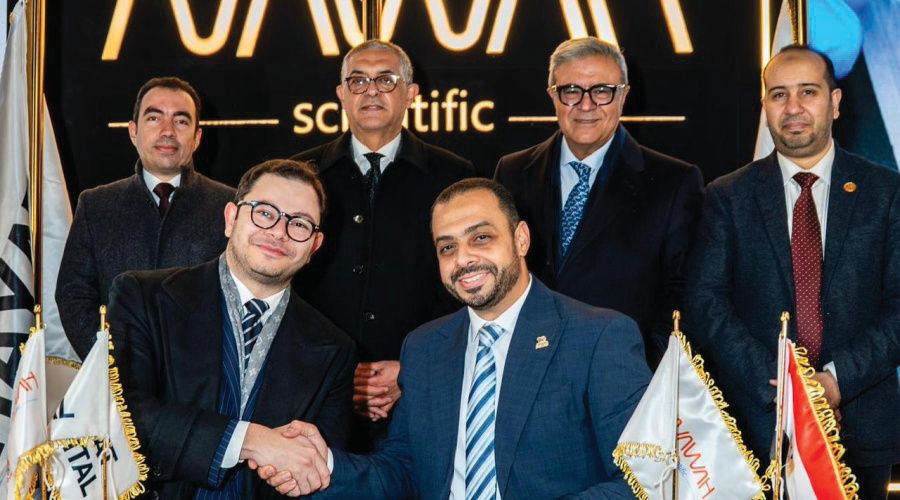
Founded in 2015 by Omar Saqr, Nawah operates a cloud laboratory model that enables remote access to advanced testing services. Its operations span four business units covering life sciences, food and agriculture, pharmaceuticals, and certified reference materials.
The company plans to use the funding to build a global research and development center in Rwanda, double laboratory capacity in Egypt and Saudi Arabia, and expand into North Africa and Europe.
Algeria’s VOLZ raises $5m
Algeria-based travel tech startup VOLZ has raised $5 million in a series A funding round led by a consortium of private investors under Tell Group, with participation from Groupe GIBA.
Founded in 2023 by Mohamed Abdelhadi and Hacene Seghier, VOLZ enables travelers to book flights in Algerian dinars using online payments or cash on delivery, while comparing multiple airlines through a single platform.
Announced at the African Startup Conference in December, the transaction is Algeria’s largest startup funding round in local currency and marks the first exit of the Algerian Startup Fund.
The capital will be used to launch new consumer and corporate travel products, strengthen VOLZ’s position in Algeria, and support expansion across North and West Africa.
MENA startup funding slows in November
Investment activity across the MENA startup ecosystem slowed sharply in November 2025, with 35 startups raising a combined $227.8 million, according to Wamda’s monthly report.
This marked a steep decline from the $784.9 million recorded in the previous month and a 12 percent drop compared to November 2024, pointing to a period of consolidation as investors moderated deployment toward the end of the year.
More than half of the capital raised during the month was driven by a single debt-backed transaction by erad, which propelled Saudi Arabia to the top of the regional rankings. Across 14 deals, the Kingdom attracted $176.3 million, accounting for more than three-quarters of all capital deployed in November.
Despite funding activity spanning 35 startups, capital was concentrated in just 5 markets. After Saudi Arabia’s dominant lead, the UAE followed with $49 million across 14 transactions.
Egypt recorded $1.12 million across 4 deals, while Morocco raised $1.1 million through 2 transactions. Oman saw 1 deal with an undisclosed value, with limited activity reported outside these markets.
Fintech emerged as the most funded sector in November, raising $142.9 million across 9 deals, largely influenced by the same debt-driven transaction.
E-commerce followed with $24.5 million across 6 rounds, while property tech, which topped the charts in October, slipped to 3rd with $18.9 million raised by 3 startups.
Debt financing dominated the month, accounting for more than $125 million through a single transaction.
The remaining capital was largely channelled into early-stage startups, with no later-stage funding rounds recorded in November, underscoring continued investor caution.
From a business model perspective, B2B startups captured the majority of capital, with 20 companies raising $197.1 million.
B2C startups lagged, with 9 companies raising a combined $22.2 million, while the remainder was split across hybrid models.
The gender funding gap showed no signs of narrowing, with male-led startups absorbing 97 percent of the capital raised during the month. Female-led and mixed-gender founding teams accounted for the remaining share.


