

Abbasi, opposition leader fail to reach consensus on caretaker PM

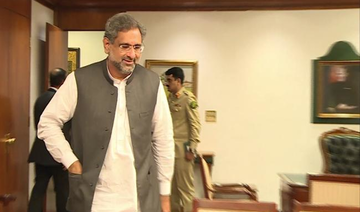
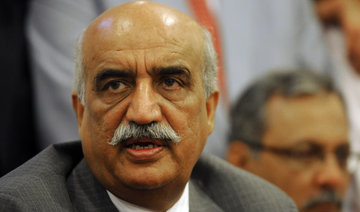
Prime Minister Shahid Khaqan Abbasi, left, and opposition leader Khurshid Shah in a meeting at PM House Tuesday, discussing the nomination of caretaker PM. (Photo courtesy: Press Information Department)
Updated 22 May 2018
Follow

Abbasi, opposition leader fail to reach consensus on caretaker PM

  • Another meeting reportedly scheduled in coming days.
  • The six nominees will be referred to a parliamentary committee.

ISLAMABAD: Prime Minister Shahid Khaqan Abbasi and opposition leader Khurshid Shah on Tuesday failed to reach a consensus on naming a caretaker prime minister.

Another meeting is scheduled in the coming days, local media reported Shah as saying. The government reportedly suggested the names of former chief justices Nasirul Mulk and Tassaduq Hussain Jillani, as well as former State Bank Gov. Dr. Shamshad Akhtar.

Despite the government and opposition being tight-lipped about the selection, social media has been rife with speculation. 

The five names doing the rounds are Akhtar, Jillani, former Ambassador to the UN Abdullah Hussain Haroon, permanent representative to the UN Maleeha Lodhi, and former State Bank Gov. Dr. Ishrat Hussain. Local media report that Lodhi and Akhtar are favorites for the post.

The current government’s term expires on May 31, after which a caretaker administration will be put in place.

But if Abbasi and Shah fail to reach a consensus on an interim prime minister, they will have to make public three names each. 

The six nominees will be referred to a parliamentary committee that will be formed by the National Assembly speaker.

If the committee fails to come to a decision, the matter will be referred to the Election Commission of Pakistan (ECP), which will have the prerogative to choose any one of the six nominees.
Most of Iranian women’s soccer team leave Australia

Updated 5 sec ago
Follow

Most of Iranian women’s soccer team leave Australia

GOLD COAST: The Iranian women’s soccer team left Australia without seven squad members after tearful protests of their departure outside Sydney Airport and frantic final efforts inside the terminal by Australian officials, who sought to ensure the women understood they were being offered asylum.

As the team’s flight time drew nearer and they passed through security late on Tuesday, each woman was taken aside to meet alone with officials who explained through interpreters that they could choose not to return to Iran.

Before the team traveled to the airport, seven women had accepted humanitarian visas allowing them to remain permanently in Australia and were ushered to a safe location by Australian police officers. 

One has since changed her mind, underscoring the tense and precarious nature of their decisions.

“In Australia, people are able to change their mind,” said Australian Home Affairs Minister Tony Burke, who had hours earlier posted photos of the seven women granted humanitarian visas to his social media accounts, their identities clearly visible.

After what Burke described as “emotional” meetings between the remaining women who reached the airport and Australian officials, the rest of the team declined offers of asylum and boarded their flight.

It was a dramatic conclusion to an episode that had gripped Australia since the Iranian team’s first game at the Asian Cup soccer tournament, when they remained silent during their national anthem.