CARACAS: Venezuelans, reeling under a devastating economic crisis, began voting Sunday in an election boycotted by the opposition and condemned by much of the international community but expected to hand deeply unpopular President Nicolas Maduro a new mandate.
Maduro, the political heir to the late leftist firebrand Hugo Chavez, has presided over an implosion of once wealthy oil producer Venezuela’s economy since taking office in 2013.
Hyperinflation, food and medicine shortages, rising crime and broken water, power and transportation networks have sparked growing discontent and violent unrest among Venezuelans.
However the 55-year-old former bus driver is expected to easily defeat his main rival Henri Falcon, a former army officer and state governor who has failed to gain the endorsement of the main opposition leaders, and an evangelical candidate, Javier Bertucci.
Wearing a bright red shirt that identifies him as a “Chavista,” the president arrived early at a Caracas polling station along with his wife Cilia Flores and trusted officials and claimed to be the first person to cast a ballot.
After voting, Maduro called the election a choice between “votes and ballots,” and pledged to respect “the will of the people.”
Maduro, who has a tight grip on the electoral and military authorities, faces a bitterly divided opposition which has called for a boycott.
“Low enthusiasm will likely reduce voter turnout and enable Maduro to control the outcome without major social backlash,” said analyst Risa Grais-Targow of Eurasia Group.
Teresa Paredes, 56-year-old housewife, said that “for the first time in my life I am not going to vote because we are living a dog’s life, without medicines, without food.”
Alvaro Toroa, 64-year-old retiree from the opposition stronghold of eastern Caracas, said he cast his ballot because “this has to be ended. Falcon is able to bring disaffected Chavistas and the opposition.”
Aware of the popular mood, Maduro on Saturday promised an “economic revolution” if re-elected, while Falcon promised to dollarize the economy, return companies expropriated by Chavez, and allow humanitarian aid, something the president rejects.
Some 20.5 million people are eligible to vote in a single-round election to choose a president for a six-year term that will begin in January 2019.
Presidential elections are traditionally held in December, but they were moved up this year by the country’s all-powerful and pro-government Constituent Assembly, catching the divided and weakened opposition off-guard.
The Democratic Unity Roundtable (MUD) opposition coalition, increasingly pinning its hopes for change on outside pressure forcing the socialists to remove Maduro, has won support from the United States, the European Union and 14 countries of the Lima Group who have called for the vote to be postponed.
Maduro is accused of undermining democracy, usurping the power of the opposition-dominated legislature by replacing it with his Constituent Assembly, and cracking down hard on the opposition. Protests in 2017, still fresh in the collective memory, left around 125 dead.
The MUD’s most popular leaders have been sidelined or detained, the boycott their only remaining weapon.
Washington has dismissed the vote as a “sham” to keep Maduro in power, and has slapped sanctions on Caracas in a push to isolate his regime.
Maduro pushed back after casting his ballot.
“Venezuela is a country at peace that deserves respect,” he told reporters. “To the world I say enough — end this ferocious campaign to twist our identity, our reality.”
With this election Venezuela “is on the path to a period of political stability.
“Your vote decides: ballots or bullets, motherland or colony, peace or violence, independence or subordination. Your vote decides, come out to vote,” Maduro said.
Despite holding the world’s largest oil reserves, the country faces ruin, with the IMF citing a drop of 45.0 percent in GDP since Maduro took over in 2013.
The crippled oil industry lacks investment and its assets are increasingly prey to debt settlements as the country defaults.
And worse, the US threatens an oil embargo on top of the sanctions that have hit Venezuela’s efforts to renegotiate its debt.
“The most likely scenario is greater international isolation and economic deterioration,” said Diego Moya-Ocampos of IHS Markit analysts.
“The key factors will be the economy and the army,” added US analyst Michael Shifter. “The country is a powder keg and something could provoke unrest that would be difficult to contain.”
At the Vatican, Pope Francis told thousands of Catholic faithful gathered for mass at Saint Peter’s square that he wanted to dedicate “a special remembrance to my dear Venezuela.”
He then asked that the Holy Spirit grant Venezuela’s “governors and people” the “wisdom to find the path toward peace and unity.”
He also prayed for the inmates who died in a Venezuela prison riot on Thursday.
Polls opened at 6 am (1000 GMT) and are scheduled to close at 6 p.m. (2200 GMT). Some 30,000 police and armed forces personnel were deployed to maintain security.


![]()

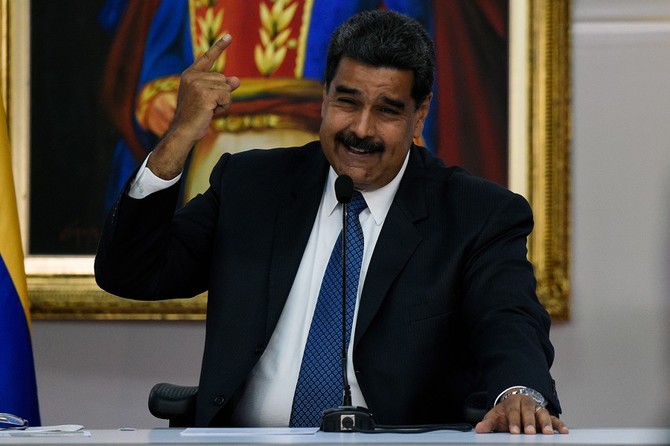
Venezuela’s Maduro eyes second term despite economic woes
Venezuela’s Maduro eyes second term despite economic woes
- Aware of the popular mood, Maduro Saturday promised an “economic revolution” if re-elected
- Maduro, with a tight grip on the electoral and military authorities, faces a bitterly divided opposition which has called for a boycott
Latest updates


© 2026 SAUDI RESEARCH & PUBLISHING COMPANY, All Rights Reserved And subject to Terms of Use Agreement.