

UN renewables drive helps Syrian refugees

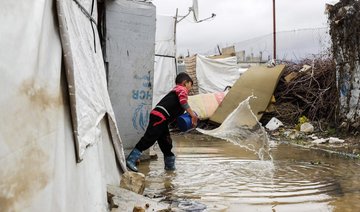
Syrian refugee children play at Azraq refugee camp for Syrians displaced by conflict, in Jordan. (Reuters)
Updated 18 May 2018
Follow

UN renewables drive helps Syrian refugees

  • Displaced people to get access to sustainable energy by 2030
  • Electric power not regarded as a human “right” until now

Aid agencies and governments are transforming the way they provide energy to families forced to flee their homes around the world — including setting up solar power plants at camps for Syrians in Jordan.

Energy has always been needed in the camps and informal settlements home to tens of millions of people uprooted by conflicts or natural disasters.

But it has largely been in the form of polluting diesel generators, fossil fuels for trucks to move relief supplies, or locally harvested firewood for cooking.

That is changing, with UN agencies, aid groups, major refugee-hosting countries and businesses preparing in July to sign up to a global action plan to provide all displaced people with access to sustainable energy by 2030.

“People are beginning to realize that this is an important issue, and something that deserves priority, resources and attention,” said Owen Grafham from the Moving Energy Initiative (MEI), a partnership managed by London-based think tank Chatham House, which is working on the action plan.

In camps, about 90 percent of people lack electricity, while 80 percent rely on firewood and other solid fuels to cook, which are harmful to their health and local forests, according to MEI.

Electric power has not been regarded as a human “right” in emergency situations, unlike shelter, water, food or health care, said Andrew Harper of the UN refugee agency (UNHCR).

“Energy is really not something that is fully taken into account,” he said. But it is “the key to empowering refugees and displaced persons,” added the UNHCR’s director of program support and former representative in Jordan.

In 2012 when Jordan’s Za’atari camp opened — home at one point to as many as 130,000 Syrian refugees — Friday prayers would sometimes be followed by “a riot,” with frustrated, anxious residents destroying things and throwing stones, Harper said.

But once UNHCR began spending up to $450,000 each month on electricity supplied to the camp via a grid connection, refugees used it to set up some 3,000 shops and businesses, and the rampages stopped, he said.

“They started feeling possessive, protective, engaged in the stability of the camp,” he added.

Since last year, two of Jordan’s main refugee camps have used power produced by their own solar plants — one in Za’atari funded by German development bank KfW and the other in Azraq backed by the IKEA Foundation — that can also feed back surplus electricity into the national grid.

Sarah Rosenberg-Jansen, head of humanitarian energy at UK-based charity Practical Action, said Jordan’s government takes the wider view that getting camps connected will improve the country’s infrastructure and support national development.

“They see it as an opportunity, and as a way to change perceptions in host communities that this is good for both of us — not just for refugees,” she told the Thomson Reuters Foundation.

Practical Action is embarking on a project in the north Jordan city of Irbid, also funded by the IKEA Foundation, that will assist landlords renting properties to vulnerable refugee families to install rooftop solar systems for heating water.

Energy underpins many things displaced people need to do in their daily lives, said Rosenberg-Jansen — from charging mobile phones used to contact relatives and transfer money, to washing clothes, lighting, entertainment and moving around.

But the answer is not to distribute energy for free, she added. “There is already a market there (in camps),” with households spending a relatively high proportion of their disposable income on energy, she noted.

Handouts risk destroying that market, and making people worse off by giving them products they do not want, she said.

The forthcoming global action plan will include targets and concrete ways of reaching them, those drafting it said.

UNHCR’s Harper said aid organizations needed to collaborate with business, governments and development banks to overcome barriers to building and operating clean energy services for refugees and displaced people. Problems include high upfront costs, onerous bureaucracy and restrictive regulations.

In Za’atari, for example, UNHCR found refugees were willing to buy electricity but the agency had no mechanism to receive payment.

Arab food and beverage sector draws $22bn in foreign investment over 2 decades: Dhaman 

Updated 28 December 2025
Follow

Arab food and beverage sector draws $22bn in foreign investment over 2 decades: Dhaman 

JEDDAH: Foreign investors committed about $22 billion to the Arab region’s food and beverage sector over the past two decades, backing 516 projects that generated roughly 93,000 jobs, according to a new sectoral report. 

In its third food and beverage industry study for 2025, the Arab Investment and Export Credit Guarantee Corp., known as Dhaman, said the bulk of investment flowed to a handful of markets. Egypt, Saudi Arabia, the UAE, Morocco and Qatar attracted 421 projects — about 82 percent of the total — with capital expenditure exceeding $17 billion, or nearly four-fifths of overall investment. 

Projects in those five countries accounted for around 71,000 jobs, representing 76 percent of total employment created by foreign direct investment in the sector over the 2003–2024 period, the report said, according to figures carried by the Kuwait News Agency. 

“The US has been the region's top food and beverage investor over the past 22 years with 74 projects or 14 projects of the total, and Capex of approximately $4 billion or 18 percent of the total, creating more than 14,000 jobs,” KUNA reported. 

Investment was also concentrated among a small group of multinational players. The sector’s top 10 foreign investors accounted for roughly 15 percent of projects, 32 percent of capital expenditure and 29 percent of newly created jobs.  

Swiss food group Nestlé led in project count with 14 initiatives, while Ukrainian agribusiness firm NIBULON topped capital spending and job creation, investing $2 billion and generating around 6,000 jobs. 

At the inter-Arab investment level, the report noted that 12 Arab countries invested in 108 projects, accounting for about 21 percent of total FDI projects in the sector over the past 22 years. These initiatives, carried out by 65 companies, involved $6.5 billion in capital expenditure, representing 30 percent of total FDI, and generated nearly 28,000 jobs. 

The UAE led inter-Arab investments, accounting for 45 percent of total projects and 58 percent of total capital expenditure, the report added, according to KUNA. 

The report also noted that the UAE, Saudi Arabia, Egypt, and Qatar topped the Arab ranking as the most attractive countries for investment in the sector in 2024, followed by Oman, Bahrain, Algeria, Morocco, and Kuwait. 

Looking ahead, Dhaman expects consumer demand to continue rising. Food and non-alcoholic beverage sales across 16 Arab countries are projected to increase 8.6 percent to more than $430 billion by the end of 2025, equivalent to 4.2 percent of global sales, before exceeding $560 billion by 2029. 

Sales are expected to remain highly concentrated geographically, with Egypt, Saudi Arabia, Algeria, the UAE and Iraq accounting for about 77 percent of the regional total. By product category, meat and poultry are forecast to lead with sales of about $106 billion, followed by cereals, pasta and baked goods at roughly $63 billion. 

Average annual per capita spending on food and non-alcoholic beverages in the region is projected to rise 7.2 percent to more than $1,845 by the end of 2025, approaching the global average, and to reach about $2,255 by 2029. Household spending on these products is expected to represent 25.8 percent of total expenditure in 13 Arab countries, above the global average of 24.2 percent. 

Arab external trade in food and beverages grew more than 15 percent in 2024 to $195 billion, with exports rising 18 percent to $56 billion and imports increasing 14 percent to $139 billion. Brazil was the largest foreign supplier to the region, exporting $16.5 billion worth of products, while Saudi Arabia ranked as the top Arab exporter at $6.6 billion.