

Arab Fashion Week returns to Dubai with Armenian designs

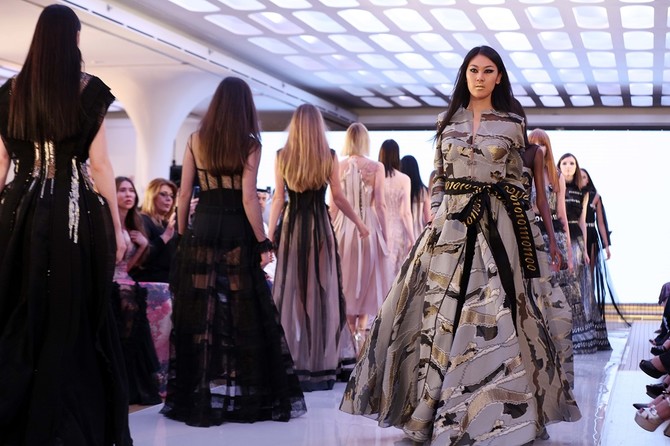
Armenian brand Harmony Yerevan’s debut UAE showing at Arab Fashion Week in Dubai features a highly innovative collection designed especially for the occasion. (Supplied)
Updated 17 May 2018
Follow

Arab Fashion Week returns to Dubai with Armenian designs

LONDON: It’s a little over a month since Arab Fashion Week was held for the first time in Saudi Arabia. Following on from that ground-breaking event, AFW returned to the UAE for the sixth time this week, from May 9 to May 12, with another host of top-drawer designers showcasing their work, often with collections specifically geared to regional consumers, focusing on ready-couture.

Armenian brand Harmony Yerevan’s debut UAE showing at Arab Fashion Week in Dubai features a highly innovative collection designed especially for the occasion.

Founder Lilith Tonakanyan explained to Arab News that the inspiration for the collection is the current craze for crypto currencies such as Bitcoin. Tonakanyan and her design partner, fellow Armenian Michael Danielyan, have used binary code to spell out the word ‘Harmony’ on the designs.

It’s a concept that offers a vivid snapshot of today — but the designs are also the fruit of years of hard work and creative endeavor. The brand is renowned for the detail of its beautifully handcrafted, one-off pieces, favoring natural materials, including leather and silk. Any woman wearing a Harmony Yerevan piece can be assured that no one else will be wearing the same garment.

When thinking of the perfect silhouette for women Tonakanyan said she turns to Christian Dior.  She also cited Yamamoto, Vera Wang and Karl Lagerfeld as designers she admires. “Whether with Chanel, Fendi or his own brand, he has been inspirational,” she said of the latter.

It’s been a tale of two worlds for Tonakanyan: one of austerity as a young woman growing up in the Soviet era, and one of abundance in modern times.

As a child she would make clothes for her dolls and progressed to making her own dresses and designing for friends and relatives. Their feedback? “You should share your dream and give to others.”

She was 20 when Armenia gained its independence from the Soviet Union in 1991. Throughout that time, and in the early years after the restoration of independence, she had to make do with a “very limited range” of fabrics and materials to make the clothes that she so passionately wanted to create.

She majored in finance at university, but never gave up on her creative dream, finally setting up Yerevan fashion house in 2011, and joining up with Danielyan that same year to launch the Harmony Yerevan womenswear label.

Danielyan was just 15 when he enrolled at the Professional Technical Gymnasia in Armenia to study fashion design. He quickly gained national attention, and in 2006 his collection was featured in the opening ceremony of the ‘Year of Armenia in Russia’ at the Kremlin.

Yerevan came to the attention of Armenian fashion followers with its outstanding first collection in 2012. It proved very popular among wives of diplomats and quickly gained a following in Russia, Kuwait and the UAE.

Tonakanyan said she has great admiration for the style of Gulf women. “They admire handcrafted work and detail such as beading and embroidery. They appreciate stylish and feminine clothes that make them stand out,” she observed.

Tonakanyan believes that women — while rightly demanding equal rights with men — have no desire or need to be like them. Rather, she maintained, they wish to celebrate their feminine characteristics.

“Women can be progressive and feminine at the same time,” she said.


At Jazan festival, Suad Al-Asiri paints memory, land and leadership

Updated 13 January 2026
Follow

At Jazan festival, Suad Al-Asiri paints memory, land and leadership

  • Local artist channels personal hardship into works that reflect Jazan’s identity, heritage
  • Jazan: A Nation and a Prince, places region at the heart of a composition featuring Prince Mohammed bin Abdulaziz and Prince Nasser bin Mohammed bin Abdullah bin Jalawi

RIYADH: At the Ahad Al-Masarihah pavilion at Jazan Festival 2026, Suad Al-Asiri’s paintings blend memory, place and personal history, offering visual narratives shaped by beauty and hardship. 

A novelist and visual artist, Al-Asiri has long used art as a storytelling tool. After a near-fatal car accident in March 2024, her work took on a new urgency. Bedridden for 11 months, cut off from the public world for more than a year, she describes that period as one of the most painful in her life — yet also transformative. 

“First of all, praise be to God for granting me life, as the accident was extremely severe,” she said. “By God’s grace, I was given a new life. All my thinking after the accident was about becoming an inspiration to others — about enduring pain and obstacles, and still leaving an impact.” 

Her return to public life came in 2025, when she participated in National Day celebrations with the ministry of interior. By the time she arrived at Jazan Festival, she was ready to channel that experience into her art. 

The centerpiece of her display, “Jazan: A Nation and a Prince,” places the region at the heart of a composition featuring Prince Mohammed bin Abdulaziz and Prince Nasser bin Mohammed bin Abdullah bin Jalawi, governor and deputy governor of Jazan respectively. 

Visitors linger over the details: the painting incorporates coffee beans, sesame and khudair — materials drawn from local products.

“I wanted people to recognize these products immediately,” she said. “They are part of Jazan’s daily life, and using them makes the work more tangible, more connected to everyday experience.” 

The painting sparks conversation. Visitors discuss leadership, identity, and the intimate relationship between people and their environment. 

Beyond the central piece, Al-Asiri presents individual portraits of the two princes, expanding the dialogue into a broader exploration of heritage and memory.  

Her journey into art is tied to her life as a storyteller. Early experiments with charcoal and pencil evolved into abstract art, drawn by its expressive freedom. 

From there, she explored realism, surrealism, and eventually modern art, particularly pop art, which has earned her wide recognition in artistic circles. Her novels and media work complement her visual practice, earning her the title “the comprehensive artist” from the governor.

Yet what stands out most in this exhibition is how Al-Asiri’s personal resilience flows through each piece. Her experience of surviving a devastating accident, enduring months of immobility, and returning to the public eye informs every brushstroke. 

Visitors sense not just her artistic skill, but her determination to turn life’s hardships into inspiration for others. 

Walking through the pavilion, one can see it in the way she blends heritage symbols, southern landscapes, and scenes of daily life. 

Each painting becomes both a document and a dialogue — a celebration of Jazan’s culture, a reflection on identity, and a testament to the power of human perseverance. 

At Jazan Festival 2026, Suad Al-Asiri’s art is a quiet, persistent inspiration for anyone who pauses long enough to listen.