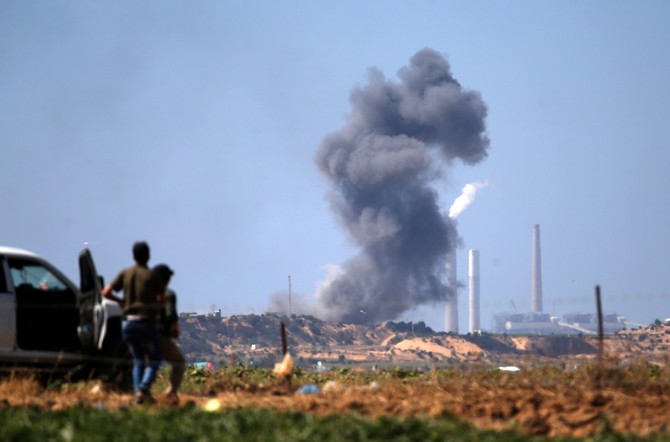
Israeli warplane hits Hamas facility in Gaza during protests: Israel Army

Palestinians look at smoke billowing from the site of an Israeli air strike on a Hamas' military site in Beit Lahia near the border between Israel and the Gaza Strip, east of Jabalia on May 14, 2018. (AFP)
Updated 14 May 2018
Follow

Israeli warplane hits Hamas facility in Gaza during protests: Israel Army

  • The Israeli army said that earlier a warplane and a tank fired at other Hamas "military positions"
  • 52 Palestinians killed by Israeli fire on Gaza border since March 30

JERUSALEM: Israel's air force hit a Hamas base in the Gaza Strip on Monday, the military said, as bloody clashes between protesters and soldiers raged along the strip's border with Israel.
"A fighter jet struck five terrorist targets in a military training facility belonging to the Hamas terror organisation in the northern Gaza Strip," a military statement said.
"The strike was conducted in response to the violent acts of the last few hours being carried out by Hamas along the security fence."
The border clashes left at least 37 Palestinians dead from Israeli fire and hundreds wounded in the conflict's bloodiest day in years.
The dead included a 14-year-old, according to the Gazan health ministry, which also provided the overall death toll.
The Israeli army said that earlier a warplane and a tank fired at other Hamas "military positions" after Hamas gunmen allegedly fired at Israeli forces.
There had already been weeks of protests and clashes along the Gaza border, with at least 91 Palestinians killed by Israeli fire there since March 30.
No Israelis have been wounded and the military has faced criticism over the use of live fire.
Monday's surge in violence came as a White House delegation and Israeli officials gathered for the contentious inauguration of a US embassy in Jerusalem.
It was the bloodiest day in the Israeli-Palestinian conflict since a 2014 Gaza war.


How a Syrian refugee built a global mental health lifeline for displaced communities

Updated 9 sec ago
Follow

How a Syrian refugee built a global mental health lifeline for displaced communities

  • Jin Dawod created Peace Therapist to deliver anonymous, culturally sensitive therapy to refugees in four languages worldwide
  • Self-funded platform has provided 70,000 sessions across Turkiye, Syria and Europe, partnering with UN agencies after disasters

DUBAI: When Jin Dawod fled the Syrian civil war as a teenager and sought refuge in Turkiye, she carried with her the invisible weight of displacement — fear, uncertainty and isolation.

Years later that experience would shape Peace Therapist, a digital psychological support platform she founded in 2018 to provide accessible mental health care in four languages to refugees.

Dawod told Arab News that while adjusting to life in Turkiye, she realized there was little support available in Arabic for refugees struggling with their mental well-being.

During her second year studying computer engineering, she decided to build a solution: an online therapy platform connecting refugees with psychologists in their mother tongue. 

Jin Dawod, a refugee from Syria, created Peace Therapist to deliver online therapy to displaced people in four languages. (Supplied)

“After the civil war in Syria and my personal experience with it, I found out most of the refugees don’t have space to feel, to express, to talk, or even to ask questions,” she told Arab News.

Since its launch, Dawod said the social enterprise has delivered more than 70,000 sessions across Turkiye, Syria and Europe, helping thousands begin the process of healing.

“I wanted to make a solution that is accessible, anonymous, and in the mother language for the people who are reaching out for help,” she said.

The need is stark. According to the World Health Organization, refugees and migrants exposed to adversity are at greater risk of depression, anxiety, post-traumatic stress disorder and psychoses, sometimes leading to suicide. 

Kurdish children and their families fleeing a government advance through Kurdish-controlled areas arrive in the Kurdish Syrian city of Qamishli on January 19, 2026. (AFP)

In some countries, psychoses are more prevalent among migrants, linked to cumulative social disadvantage throughout their journey.

The WHO reports that 22 percent of people who have experienced war or conflict in the previous decade will suffer from depression, anxiety, PTSD, bipolar disorder or schizophrenia. 

Yet refugees and migrants often face barriers that limit both access to and acceptance of mental health services, including discrimination, language gaps and concerns over confidentiality.

Peace Therapist operates through three models. The first provides direct support to individuals, no matter where they are. 

Kurds fleeing a government advance through Kurdish-controlled areas arrive in the Kurdish Syrian city of Qamishli on January 19, 2026. (AFP)

“Anyone anywhere can reach out to these therapists from anywhere in the world, if they are speaking the four languages that we are supporting we can give them psychological support and mental health services needed,” Dawod said.

The second model focuses on partnerships with organizations, including UN agencies and nonprofits. After the devastating Syria-Turkiye earthquake in 2023, Dawod shared a helpline on social media for those affected.

Within hours, she said, 200 requests for support poured in from refugees and Turkish nationals traumatized by the 7.8 magnitude quake and its aftershocks.

“We worked with ILO and we supported six survivors in Syria and Turkiye and we later matched them with job opportunities. Also, we worked with UNHCR and with the SPARK organization,” she said. 

Jin Dawod, a refugee from Syria, created Peace Therapist to deliver online therapy to displaced people in four languages. (Supplied)

SPARK, an independent non-governmental organization, partners with UN agencies to help young people, women and refugees in fragile states access education, employment and entrepreneurship.

The third model — and, Dawod insists, the most important — is the social plan, which offers free sessions to refugees and disadvantaged groups.

“Our social plan is the heart of Peace Therapist,” Dawod said. “That is why Peace Therapist was born in the first place. And we don’t want to forget why it was born in the first place — to support refugees.”

Sustaining that free support is also the greatest challenge; the platform is self-funded. 

Kurds fleeing a government advance through Kurdish-controlled areas arrive in the Kurdish Syrian city of Qamishli on January 19, 2026. (AFP)

“We don’t have a specific government or organization that is sponsoring Peace Therapist. We are independent and we are self-managing,” Dawod said, calling on the international community to collaborate and expand access to mental health services.

Her work has earned global recognition, including the 2024 UNHCR Nansen Refugee Award for Europe and the Youth Leadership and Innovation Award by the Global Forum on Migration and Development, bringing her to platforms such as the UN and the European Parliament.

“We are so happy to be recognized globally. We have many global awards like the Nansen Refugee Award and the UN Action Award ... we are honored to have these amazing awards,” she said.

But the accolades are secondary.

“We want to always be there in the field and always be touching the people who are reaching out for us. Because the biggest award for us is the feedback that we are having from the people who are reaching out,” she said. 

Jin Dawod, a refugee from Syria, created Peace Therapist to deliver online therapy to displaced people in four languages. (Supplied)

The UN reports that by the end of April 2025, around 122 million people were forcibly displaced worldwide — the highest level on record. UNHCR said that as of 2025, 1.2 million mental health consultations and psychosocial support services had been provided globally.

The WHO stresses that effective mental health care for displaced populations requires culturally sensitive, multidisciplinary approaches that integrate social support, legal assistance and community engagement.

Peace Therapist’s team now includes more than 150 psychologists from diverse cultural backgrounds.

“That is so important, to be able to support the people with the cultural, culturally sensitive services,” said Dawod. “We have psychologists from Lebanon, Iraq, Palestine, Syria, of course, Turkiye and many other Arab countries, and also international experts.”

The platform also uses artificial intelligence to match users with therapists based on their needs and the psychologist’s expertise. 

Kurds fleeing a government advance through Kurdish-controlled areas arrive in the Kurdish Syrian city of Qamishli on January 19, 2026. (AFP)

“When we are providing psychological support, it’s really important to match with the right psychologist because it could be also harmful more than it can be useful when you are matched to the wrong person,” Dawod said.

For many refugees, stigma, racism and discrimination further delay seeking help, the WHO notes, worsening mental health outcomes.

“There is already a lot of stigma on mental health, and we don’t want people to lose the encouragement of having and asking for help,” Dawod added.

As displacement reaches record levels, digital platforms like Peace Therapist are increasingly viewed by humanitarian organizations as scalable solutions in conflict and post-conflict settings. 

WHO’s Comprehensive Mental Health Action Plan 2013-2030 emphasizes promoting mental wellbeing and addressing disparities in access to care, particularly for refugees and migrants.

For Dawod, however, the mission remains deeply personal.

“Peace Therapist was born because of war, so our mission is always to build peace — inner peace and peace in the world. It all starts from inside of us.”