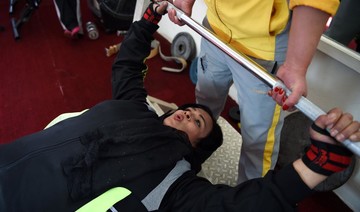
Her sinews stretched above the neckline of a long-sleeved training top, 20-year-old Egyptian Sara Samir propels a barbell carrying more than 90 kilos above her head, before the weights smash back to earth.
Even before this impressive lift, it’s clear Samir has a commanding presence in the national team’s weightlifting hall in Cairo.
She has become something of a trendsetter since winning bronze in the 69kg class at the 2016 Olympic Games — the first female Egyptian Olympian to be presented with a medal on the podium.
“After I won the medal in Rio, girls started weightlifting in a big way in Ismailiya,” she said with a beaming smile, referring to her home province.
But it wasn’t always like that for Samir, who competes under the name “Sara Ahmed.”
“People would tell me things like ‘Oh, you weightlift? Can you carry me?’” she said of her experience aged 11, when she first began training.
On the back of her Olympic success, the number of girls competing seriously in weightlifting has surged nearly tenfold.
“Female participants in weightlifting championships were no more than 30 or 40 girls,” said Mohamed Eldib, head coach of the national weightlifting team, after he supervised Samir and her peers in the southern Cairo district of Maadi.
Now more than 300 girls are registered with the Egyptian Weightlifting Federation, he said.
“Winning forms a strong motivation for female athletes ... and gives hope in the possibility of accomplishing wins, whatever the difficulties,” sports analyst Mohamed Seif told AFP.
The challenges include a “lack of interest of the family which cares first about the boy” since girls are expected to stop practicing sport when they get married, Seif said.
Girls are encouraged to take part in other sports such as swimming or gymnastics, he said, rather than weightlifting or athletics.
Before Samir’s bronze, Egypt had not won a single weightlifting medal since 1948 — a drought of nearly 70 years.
Her triumph was followed the same day by another bronze won by male weightlifter Mohamed Mahmoud.
Samir is completely absorbed by her training. “Her whole mind is weightlifting,” said her coach proudly.
She has also benefited from supportive parents — as a girl, it was Samir’s father who accepted her wish to start weightlifting and took her to training.
Months later, she won a gold medal in Egypt’s national championships in the under-14 age group. At just 13, she joined the national team.
But Samir is not the only Egyptian woman to have made it big on the world weightlifting stage.
Years after competing, compatriot Abeer Abdelrahman is due to be handed Olympic medals retroactively, after podium winners were stripped of their medals due to testing positive for doping.
Abdelrahman had originally come fifth in both the 2008 Olympics in Beijing and the 2012 Olympics in London.
In 2016, she was informed she had won a silver medal in London, and a few months later that she would be awarded a bronze medal for Beijing.
And last year, Shaimaa Khalaf, 26, won silver and bronze at the US World Championships in the +90kg weight category.
But despite such major successes, weightlifting and other sports are not the government’s top priority — a spot reserved for football in Egypt.
“The state usually reacts at the moment of the accomplishment ... and then as time passes we forget and focus on football,” said Seif.
Eldib said that while state funding covers the national team’s needs, the lack of funding for gyms limits potential champions because many people do not have access to weightlifting training.
All of Samir’s medals since she began competing — more than 50, she said — are gold, except for two bronze, including the Rio Olympic medal.
Her secret?
“It all depends on how much you want to achieve,” she said, echoing her coach Eldib, who believes girls “have higher levels of tolerance in training than boys.”


![]()

Egyptian weightlifter Sara Samir raises the bar for women
Egyptian weightlifter Sara Samir raises the bar for women
- She became the first Egyptian Olympian to be presented with a medal on the podium
- Number of girls competing seriously in weightlifting has surged nearly tenfold


Latest updates


© 2026 SAUDI RESEARCH & PUBLISHING COMPANY, All Rights Reserved And subject to Terms of Use Agreement.