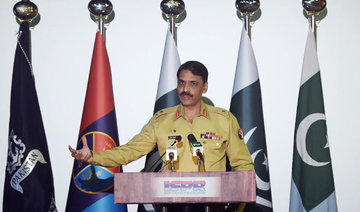
ISLAMABAD: Pakistan’s Chief of Army Staff, General Qamar Javed Bajwa, has made Forbes magazine’s annual list of The World’s Most Powerful People for the first time, ranked 68th.
Placement on the 75-strong chart is based on four factors: the number of people the person has power over; the financial resources they control; their influence in multiple spheres; and how actively they wield their power to change the world.
“Javed Bajwa joins the world’s most powerful at a time when the rift between India and Pakistan is improving, partly thanks to his efforts,” Forbes wrote. “Although the president is his boss on paper, Pakistan’s Chief of Army Staff is de facto the most powerful person in the nuclear-armed state.
“Two years into his tenure as the head of the world’s sixth-largest army, Bajwa has established himself as a mediator and proponent of democracy.”
Chinese President Xi Jinping tops the list, while Russian President Vladimir Putin and US President Donald Trump are ranked second and third, respectively.
Bajwa is one of 17 new entrants on the list. Of these, Saudi Crown Prince Mohammad bin Salman, the Kingdom’s de facto leader, is the only one who made the top 10, at number eight. Indian President Narendra Modi is ninth on the list and French President Emmanuel Macron is 12th. German Chancellor Angela Merkel, the only woman in the top 10, was ranked fourth.
Forbes’ annual ranking identifies one person out of every 100 million “whose actions mean the most”.
“There are nearly 7.5 billion humans on planet Earth, but these 75 men and women make the world turn,” the magazine said.

Pakistani army chief ranked 68th-most powerful person in world by Forbes magazine
- General Qamar Javed Bajwa is one of 17 new entrants on the annual list
- “Javed Bajwa joins the world’s most powerful at a time when the rift between India and Pakistan is improving, partly thanks to his efforts,” Forbes wrote
Interoceanic Train derails in southern Mexico, killing at least 13 and injuring dozens
- he Interoceanic Train linking the states of Oaxaca and Veracruz went off the rails Sunday as it passed a curve near the town of Nizanda
- Mexican President Claudia Sheinbaum says 13 people died and another 98 people were injured when a train derailed
MEXICO CITY: Officials said a train accident in southern Mexico killed at least 13 people and injured dozens, halting traffic along a rail line connecting the Pacific Ocean with the Gulf of Mexico.
The Interoceanic Train linking the states of Oaxaca and Veracruz went off the rails Sunday as it passed a curve near the town of Nizanda.
“The Mexican Navy has informed me that, tragically, 13 people died in the Interoceanic Train accident,” Mexican President Claudia Sheinbaum posted on X, adding that 98 people are injured, five of them seriously.
She said she instructed the secretary of the navy and the undersecretary of human rights of the Ministry of the Interior to travel to the site and personally assist the families.
In a message on X Sunday, Oaxaca state Gov. Salomon Jara said several government agencies had reached the site of the accident to assist the injured.
Officials said that 241 passengers and nine crew members were on the train when the accident occurred.
The Interoceanic Train was inaugurated in 2023 by then President Andres Manuel Lopez Obrador. The rail service is part of a broader push to boost train travel in southern Mexico, and develop infrastructure along the isthmus of Tehuantepec, a narrow stretch of land between the Pacific Ocean and the Gulf of Mexico.
The Mexican government plans to turn the isthmus into a strategic corridor for international trade, with ports and rail lines that can connect the Atlantic and Pacific Oceans. The Interoceanic train currently runs from the port of Salina Cruz on the Pacific Ocean to Coatzacoalcos, covering a distance of approximately 180 miles (290 kilometers).
The Interoceanic Train linking the states of Oaxaca and Veracruz went off the rails Sunday as it passed a curve near the town of Nizanda.
“The Mexican Navy has informed me that, tragically, 13 people died in the Interoceanic Train accident,” Mexican President Claudia Sheinbaum posted on X, adding that 98 people are injured, five of them seriously.
She said she instructed the secretary of the navy and the undersecretary of human rights of the Ministry of the Interior to travel to the site and personally assist the families.
In a message on X Sunday, Oaxaca state Gov. Salomon Jara said several government agencies had reached the site of the accident to assist the injured.
Officials said that 241 passengers and nine crew members were on the train when the accident occurred.
The Interoceanic Train was inaugurated in 2023 by then President Andres Manuel Lopez Obrador. The rail service is part of a broader push to boost train travel in southern Mexico, and develop infrastructure along the isthmus of Tehuantepec, a narrow stretch of land between the Pacific Ocean and the Gulf of Mexico.
The Mexican government plans to turn the isthmus into a strategic corridor for international trade, with ports and rail lines that can connect the Atlantic and Pacific Oceans. The Interoceanic train currently runs from the port of Salina Cruz on the Pacific Ocean to Coatzacoalcos, covering a distance of approximately 180 miles (290 kilometers).
© 2025 SAUDI RESEARCH & PUBLISHING COMPANY, All Rights Reserved And subject to Terms of Use Agreement.