PAHOA, Hawaii: A large explosion in Hawaii’s Kilauea volcano on Wednesday may mark the beginning of more violent, explosive eruptions that could spray rocks for kilometers and dust nearby towns in volcanic ash and smog, the US Geological Survey said.
Kilauea, Hawaii’s most active volcano, erupted on Thursday, and a powerful earthquake shook the crater the next day. Lava flows from fissures on its flank have destroyed at least 36 homes and other buildings, and caused the evacuation of some 2,000 residents.
The USGS warned that more violent eruptions at the crater could begin mid-May, shooting rocks weighing several tons for over half a mile (1 km), hurling pebble-sized projectiles several miles (km) and dusting areas up 20 miles (32 km) away with ash.
“This is the first of perhaps more events like that to come,” Tina Neal, the scientist in charge of the USGS Hawaiian Volcano Observatory said on a conference call of Wednesday’s blast which shot projectiles from the crater.
The town of Hilo some 25 miles (40 km) northeast of Kilauea on Hawaii’s Big Island and the village of Pahoa 24 miles (39 km) east, could be exposed to volcanic air pollution, or so-called vog, and a layer of ash should explosive eruptions begin and prevailing wind directions shift, Neal said.
Such steam-driven explosions would be triggered by water running into the crater’s falling lava lake should it drop below the level of groundwater.
Geologists cautioned that Kilauea’s past explosions had been relatively small on a global scale, and while ash from the volcano posed a nuisance as an eye and respiratory irritant, it was not a serious health hazard. “We don’t anticipate there being any wholesale devastation or evacuations necessary anywhere in the state of Hawaii,” said Donald Swanson of the Hawaiian Volcano Observatory.(USGS)
Hawaii County Civil Defense said all 1,900 residents of the Leilani Estates and Laipuna Garden areas, around 25 miles (40 km) east of the crater, had been evacuated. Lava oozing from two new fissures in the area had paused but sulfur dioxide gas was still a hazard.
Exposure to very high levels of the gas, which causes acid rain, can be life-threatening, according to the Agency for Toxic Substances and Disease Registry.
Evacuee David Nail was anxious to learn if his house had been destroyed. He was asleep on the couch when a fissure opened up 2,000 feet (610 meters) away, spewing out lava and gas.
“It sounded like 10 or 20 jet engines,” said Nail. The 57-year-old, who recently retired to the area from Orange County, California, said he had seen drone footage showing lava flowing up his driveway, causing two propane tanks to explode.
He tried to reach his house on Tuesday, but he and his neighbors were blocked by a 20-foot-tall (6-meter-tall) wall of lava.
“All we could do was sit there and cry,” he said.
Fourteen fissures have opened since Kilauea’s vents started spraying fountains of lava up to 300 feet (90 meters) into the air on Thursday and about 104 acres (42 hectares) of land have been covered with lava.
Kilauea has been in a state of nearly constant eruption for 35 years. It predominantly blows off basaltic lava in effusive eruptions that flow into the ocean but occasionally experiences more explosive events.
A powerful magnitude 6.9 earthquake on the volcano’s south flank shook the area on Friday. It was the second largest of the last century in Hawaii. More earthquakes and eruptions have been forecast, perhaps for months to come. Hawaii’s Volcanoes National Park, where Kilauea is located, remains open to tourists, albeit with some restrictions.
(Reporting by Terray Sylvester; Writing by Andrew Hay; Editing by Jonathan Oatis and Sandra Maler)


![]()

Geologists warn of violent eruptions by Hawaii's Kilauea volcano
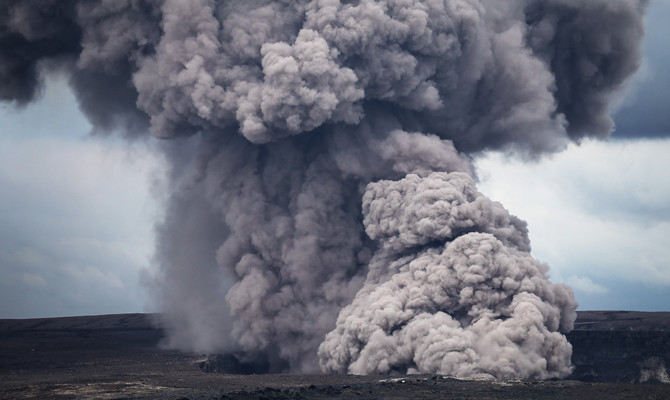
Geologists warn of violent eruptions by Hawaii's Kilauea volcano
- The US Geological Survey warned that more violent eruptions at the crater could begin mid-May.
- Lava flows from fissures on its flank have destroyed at least 36 homes and other buildings, and caused the evacuation of some 2,000 residents.
Related


Latest updates


Recommended


© 2026 SAUDI RESEARCH & PUBLISHING COMPANY, All Rights Reserved And subject to Terms of Use Agreement.