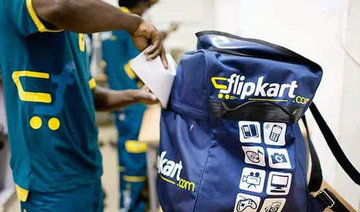
NEW YORK: Walmart will soon reach shoppers in India’s massive consumer market directly, as it takes control of the online retailer Flipkart that’s known for its ubiquitous delivery drivers on their motorcycles with oversized backpacks.
The $16 billion controlling stake, announced Wednesday, is the largest acquisition yet by the world’s largest retailer.
Retail sales are being fueled by a hot economy in India, and both Walmart and Amazon have pushed hard to catch up to Flipkart and become the first major US retailer to establish a substantial foothold in the country.
The move, like Walmart’s decision last month to sell its British unit, Asda, reflects the company’s focus on areas with the potential to grow as it tries to narrow the online gap between itself and Amazon.
Online buying in India has exploded in recent years, and Flipkart had net sales of $4.6 billion in its latest fiscal year, That’s a fraction of Walmart’s latest annual revenue of $485.8 billion, but the company sees big long-term potential. Walmart believes India, which has 1.3 billion people, could be the world’s top five-e-commerce markets within the next five years.
“We are actively working to shape the portfolio of geographies and businesses we’re in, in order to set the company up for success for another generation,” Walmart CEO Doug McMillon said in a conference call Wednesday.
Flipkart is, in some ways, an echo of Amazon. Founded in 2007 by two college friends and former Amazon employees, Flipkart began life as an online bookseller.
In a country where many still see paying online with credit or debit cards as risky, Flipkart earned millions of customers in its early years by allowing buyers to pay cash on delivery. It now allows for a variety of payments, from credit cards to gift cards to direct bank transfers.
Flipkart also focused early on mobile phone users, and in 2016 became the first app in India to reach 50 million users.
The Bangalore-based company has acquired a string of other companies in recent years, from fashion e-commerce company Myntra to mobile payment firm PhonePe. Flipkart now has over 100 million registered users and more than 100,000 registered sellers. Flipkart’s supply chain arm, eKart, is established more than 800 cities and makes 500,000 deliveries daily.
Flipkart’s success and Indian law that puts limits on foreign retailers made it an attractive target, and rumors swirled about Amazon also circling Flipkart long after it was reported to be in talks with Walmart.
Foreign retailers, including Walmart, have faced years of political resistance to opening brick-and-mortar outlets in India, where mom-and-pop store owners wield enormous influence.
Walmart’s business in India was previously focused on small businesses. Its Best Price stores, owned and operated by its India division, are only open to members that are all licensed businesses.
Whether the Flipkart deal signals a change remains unclear, but the Flipkart purchase gives Walmart far more influence in India — both politically and economically — and positions it to shift quicker into retail outlets if the regulatory landscape changes.
Walmart will now own about 77 percent of Flipkart, with the rest held by some existing shareholders, including co-founder Binny Bansal, Tencent Holdings, Tiger Global Management and Microsoft Corp. The acquisition surpasses Walmart’s $10.8 billion deal to buy Britain’s Asda in 1999 and its acquisition two years ago of online retailer Jet.com for more than $3 billion.
The deal hasn’t gone down well with the tens of millions of small traders who for years used political muscle to slow the arrival of international retailers.
It is “a clear attempt to control and dominate the retail trade of India by Walmart,” the Confederation of All India Traders said, adding that it would encourage predatory pricing, hurt Indian businesses and create an uneven playing field. The group says it represents some 60 million businesses.
Meanwhile, Amazon is also still fighting hard in India, with founder Jeff Bezos crowing last month that Amazon.in had the most-downloaded shopping app in India for 2017.
“Amazon.in is the fastest growing marketplace in India, and the most visited site on both desktop and mobile,” Bezos said in a letter to shareholders.
The global stakes for both Amazon and Walmart are high. Walmart, which operates stores under various banners in 27 countries outside the US, has faced strong headwinds in its outward expansion.
In China, where more than 700 million people are online, it has struggled to compete with homegrown online giants like Alibaba Group Holding Ltd. and local retail chains like Sun Art Retail Group Ltd. Walmart opened its first store in China in 1996 and has just over 400 stores now. It also has a strategic alliance with Alibaba’s rival, JD.com. Amazon also faces stiff competition in China from Alibaba and JD.com.
Walmart closed 60 stores in Brazil, or 10 percent of its outlets two years ago as it tries to restructure its business.
For the opportunity in India, Walmart will absorb some short-term pain. It expects earnings for the current fiscal year to be hurt by 25 to 30 cents per share. “This is clearly an investment for the future,” said Charlie O’Shea, Moody’s lead retail analyst in a note.
Shares of Walmart Inc. dropped more than 3 percent in trading Wednesday.


![]()

Walmart makes a $16 billion bet on India’s booming economy
Walmart makes a $16 billion bet on India’s booming economy
- Wallmart is set to take control of the online retailer Flipkart that’s known for its ubiquitous delivery drivers on their motorcycles with oversized backpacks
- The $16 billion controlling stake is the largest acquisition yet by the world’s largest retailer.

Latest updates


© 2026 SAUDI RESEARCH & PUBLISHING COMPANY, All Rights Reserved And subject to Terms of Use Agreement.