Iran in new crackdown on Arab minority

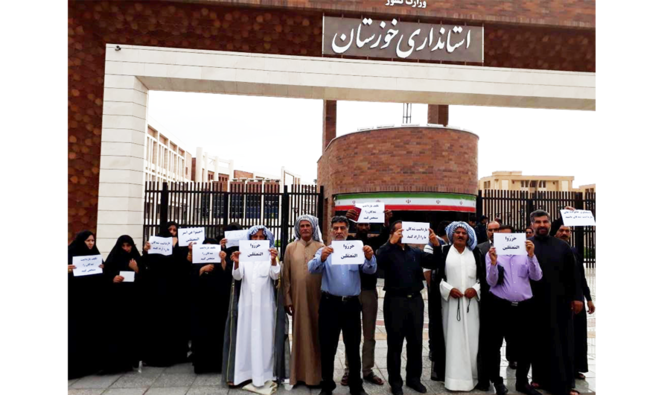
Families of prisoners in Ahvaz protest in front of the governor's office in Ahvaz, Iran, on April 16, 2018. (Handout via REUTERS)
Updated 04 May 2018
Follow

Iran in new crackdown on Arab minority

  • Hundreds detained in city of Ahvaz, the regional capital of Khuzestan, where most of Iran’s Arabs live.
  • Ahvaz rights group says protesters are being held on charges including separatism, militancy or being “agents of Saudi Arabia.”

LONDON: Iranian security forces have arrested hundreds of ethnic Arabs as the Tehran regime steps up its repression of protesters in the restive southwestern Khuzestan province.

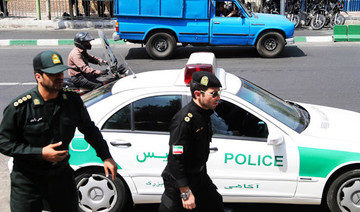
Police have a launched a new crackdown in the city of Ahvaz amid protests against utility cuts, poverty, discrimination and Iran’s involvement in foreign wars.

Ahvaz Human Rights Organization says that of the hundreds detained, it has identified 70. They are being held on charges including separatism, militancy or being “agents of Saudi Arabia.” Dozens have also been summoned, interrogated and released.

Released prisoners said they had come under pressure from security forces, especially the Islamic Revolutionary Guard Corps, not to talk about their detention. They said they were subjected to routine beatings, threats and torture with electric shocks.

Ahvaz is the regional capital of Khuzestan, where most of Iran’s Arabs live. They joined nationwide protests in January against economic mismanagement and corruption, and clashes broke out between police and demonstrators.

Sporadic protests continued there after they died away elsewhere, as Arabs voiced anger at barriers to fair employment and political rights in a region that accounts for 85 percent of Iran’s oil wealth.

Another cause of unrest is drought, exacerbated by the diversion of water supplies to ethnically Persian provinces such as Isfahan. Protesters say Iran should not be spending money in Syria, Iraq and Yemen while Iranians are struggling.

At a protest in Ahvaz, protesters drew parallels with the Syrian city of Aleppo, where Iran is building power plants.  “Ahvaz is like Aleppo, it has no electricity, no water,” they chanted at the rally before police broke it up.

Among the hundreds arrested in recent weeks was Ma’edeh Shabaninejad, 15, who has been accused of inciting violence through her poetry.  Security forces raided her home and confiscated her poems.

“Resist, my homeland, there is not much left of you,” one of her verses said. “Soon you will hear in your sky the sound of smiles and liberation’s call.” The girl’s father, Sahid Shabaninejad, said: “I am amazed the Iranian government is afraid of a 15-year-old girl.”

Israeli FM urges Jews to move to Israel a week after Sydney attack

Updated 22 December 2025
Follow

Israeli FM urges Jews to move to Israel a week after Sydney attack

  • “Today I call on Jews in England, Jews in France, Jews in Australia, Jews in Canada, Jews in Belgium: come to the Land of Israel! Come home!” Saar said

JERUSALEM: Israeli Foreign Minister Gideon Saar called on Sunday for Jews in Western countries to move to Israel to escape rising antisemitism, one week after 15 were shot dead at a Jewish event in Sydney.
“Jews have the right to live in safety everywhere. But we see and fully understand what is happening, and we have a certain historical experience. Today, Jews are being hunted across the world,” Saar said at a public candle lighting marking the last day of the Jewish festival of Hanukkah.
“Today I call on Jews in England, Jews in France, Jews in Australia, Jews in Canada, Jews in Belgium: come to the Land of Israel! Come home!” Saar said at the ceremony, held with leaders of Jewish communities and organizations worldwide.
Since the outbreak of the war in Gaza, sparked by Hamas’s unprecedented attack on Israel on October 7, 2023, Israeli leaders have repeatedly denounced a surge in antisemitism in Western countries and accused their governments of failing to curb it.
Australian authorities have said the December 14 attack on a Hanukkah event on Sydney’s Bondi Beach was inspired by the ideology of the Islamic State jihadist group.
On Tuesday, Prime Minister Benjamin Netanyahu urged Western governments to better protect their Jewish citizens.
“I demand that Western governments do what is necessary to fight antisemitism and provide the required safety and security for Jewish communities worldwide,” Netanyahu said in a video address.
In October, Saar accused British authorities of failing to take action to curb a “toxic wave of antisemitism” following an attack outside a Manchester synagogue on Yom Kippur, the holiest day in the Jewish calendar, in which two people were killed and four wounded.
According to Israel’s 1950 “Law of Return,” any Jewish person in the world is entitled to settle in Israel (a process known in Hebrew as aliyah, or “ascent“) and acquire Israeli citizenship. The law also applies to individuals who have at least one Jewish grandparent.zz