

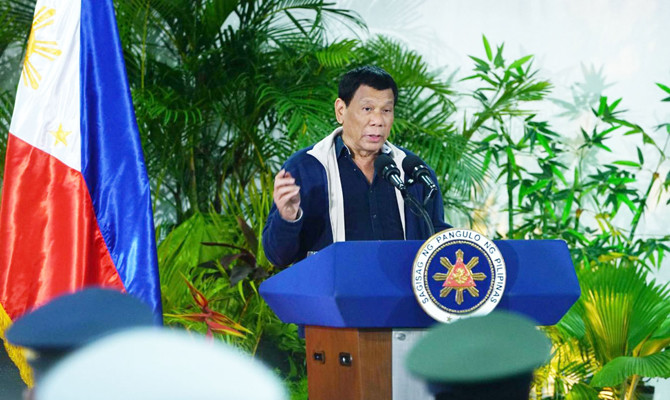

MANILA: A veteran Filipino diplomat on Sunday urged the Philippine and Kuwaiti governments to try quiet diplomacy to repair their damaged ties.
"(I)t’s up to the respective governments to repair whatever damage is done through quiet diplomacy, not through press releases or press conferences,” said former Foreign Affairs Undersecretary Lauro Baja as Philippine President Rodrigo Duterte scrapped a proposed labor deal with Kuwait and announced a permanent ban on Filipinos working there.
Duterte made his dramatic announcement shortly after calling on 260,000 Filipinos in Kuwait to return home amid an escalating diplomatic crisis between the two countries.
Arriving in Davao early on Sunday after his visit to Singapore for the ASEAN summit, Duterte said he was saddened by the turn of events and had been planning to go to Kuwait for a scheduled signing of a proposed agreement to ensure protection of overseas Filipino workers there.
“The ban stays permanently. There will be no more recruitment, especially for domestic helpers,” Duterte told reporters at Davao international airport.
The Philippine government suspended the deployment of Filipino workers to Kuwait in February following the death of Joanna Demafelis, a maid whose body was found stuffed in a freezer. Since then, both countries have been negotiating an agreement to provide better protection and treatment for Filipinos working in the Arab nation.
Amid the growing diplomatic crisis, experts and lawmakers are advising the Philippine president to rethink his decision and find a diplomatic solution to the problem.
Concerns were raised that the situation may go beyond the Kuwaiti borders and spill over to other countries, affecting the livelihoods of more than 2 million Filipinos in the region.
Hope for a happy compromise
Baja told Arab News that relations between the two countries are generally good.
“Kuwait needs our workers for their economy, and we need Kuwait for our overseas workers,” he said.
Both countries “have valid reasons for their actions,” Baja said.
“I hope a happy compromise between these competing concerns can be made and I am hopeful it can be done through diplomacy,” he said.
Baja expressed concern that the situation “may go beyond the Kuwaiti borders and spill over to the other countries” in the Middle East.
“If that happens, it will be very costly because we have up to 3 million Filipinos there (Middle East),” he said. “So whatever solutions we have, this should be done through quiet diplomacy and maybe cut back on strong words. Let the tensions simmer.
“What Kuwait did was an extreme measure, declaring our ambassador persona non grata. But to some extent we must also understand them because we violated some of their laws,” he said.
'Gambling with workers' lives'
Opposition Senator Risa Hontiveros accused Duterte of “gambling with the lives and employment of hundreds of thousands of overseas workers in Kuwait.”
"It is extremely reckless, shortsighted and uncaring. President Duterte should stop gambling with the lives and employment of thousands of OFWs, and the welfare of their families, in a desperate attempt to break the diplomatic impasse with Kuwait. This is not a game. We are talking about the lives and future of our OFWs and their loved ones,” Hontiveros said.
“Are we even talking about the same Philippines? President Duterte is promising our OFWs jobs back in our country when he can’t even sign an Executive Order (EO) to address labor contractualization and protect the workers’ security of tenure. His administration doesn’t even have an alternative economic strategy to the country’s labor export policy,” the senator said.
Meanwhile, migration and recruitment expert Emmanuel Geslani said that more than 100,000 skilled overseas workers in the oil-rich kingdom were unlikely to heed Duterte’s call for them to return to the country.
“The skilled workers are needed in Kuwait by the government and private sector, and they hold lucrative jobs. There is nothing for them in the Philippines and their current jobs pay two or three three times more than earned previously,” Geslani said.
“That is why most of these overseas workers are working abroad, thousands of kilometers away from their families. There are no jobs in the country that can match their present positions in Kuwait,” he said.


