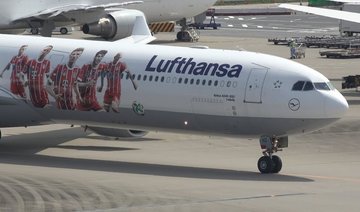
MUNICH: Bayern Munich are among European football’s most storied names, five-time Champions League winners, serial Bundesliga winners and a model of financial prudence in an era of nine-figure transfer fees.
So why have some fans begun protesting against the stewardship of the club?
The answer, in a word, is Qatar, which has strengthened its long-standing ties with Bayern amid a near year-long standoff with Saudi Arabia, Egypt, Bahrain and the United Arab Emirates, who accuse the 2022 World Cup hosts of supporting terrorism.
In August last year, Qatar’s Hamad International Airport expanded its sponsorship of Bayern Munich in a €10-million-a-year deal ($12 million) that put the $17 billion airport’s logo on the shirt sleeves of Germany’s most successful football club. Then, in February Bayern announced that the logo of state-owned Qatar Airways’ would be added to its shirt sleeves, replacing Hamad International, AFP reported, in what was described as a five-year deal that would be worth more annually than the 2017 agreement with Doha’s airport.
The relationship goes beyond mere sponsorship; Qatar owns a 14.6 percent stake in Volkswagen, according to the automaker’s website, while Volkswagen subsidiary Audi owns 8.3% of Bayern.
Bayern have also held their winter training camp in Doha for the past eight years and, pressed on the club’s failure to publicly castigate Qatar for the dire conditions for workers in its construction industry, chief executive Karl-Heinz Rummenigge in January said: “The situation of the workers in Qatar has improved through football, although of course they can still get better,” claiming Germany’s foreign minister Sigmar Gabriel had told him as much.
The former German international’s words attracted scorn from Bayern fans’ group Munich’s Red Pride, which responded by holding up banners in a home game against Werder Bremen quoting Rummenigge’s claim that the situation for low-paid workers in Qatar was improving alongside a picture of his face in which his eyes were replaced by red tomatoes.
“In Germany ‘tomatoes in his eyes’ is an adage that means someone doesn’t see obvious things or especially in our case wants to take people for fools,” a spokesman for Munich’s Red Pride told Arab News.
“And even though there are marginal improvements in labor conditions — which are difficult to judge — it’s not to the credit of greedy organizations like FIFA or functionaries of our club, but rather (due to) human rights organizations.”
Other Bayern fan groups echo those misgivings.
“Among many supporters, the prevailing view of Qatar’s sponsorship is negative,” said Rick Joshua, a senior figure in The Red Dragons, Bayern Munich’s London supporters’ group.
“I’m not keen on the Qatar deals because of human rights issues and the hush-up surrounding the World Cup bid. It doesn’t really sit too well with me. Whenever we reach the winter break and the team goes off to Qatar, that’s when I switch off.”
Bayern declined to answer specific questions from Arab News in regard to the club’s relationship with Qatar, instead providing a statement from Rummenigge.
“We’re seeing a positive development as far as the (current) situation in Doha is concerned,” he said, citing the United Nations Labour Organization’s decision in November to end an investigation into the rights of migrant workers in Qatar and Doha’s pledge to phase out the kafala system, which ties an employee to their employer and has been likened to slavery.
“As a representative of the whole football family, FC Bayern plays its part toward ensuring this can be achieved,” said Rummenigge. “We are engaged in a global competition with the best European clubs. But our partners in Doha are also aware of our beliefs. We talk about these matters confidentially, and trust continues to grow with every conversation. That is the most important prerequisite for change.”
The International Labour Organization (ILO) has launched a three-year technical cooperation program in which it will work with Qatar to improve employment conditions and recruitment practices, ensure timely payment of wages and better protect against forced labor.
Laborers were working more than 72 hours per week at eight of 19 contractors engaged in construction work for the 2022 World cup, an independent audit published in March found. The Impact report described these practices as “critical” non-compliance to the supposed limit of 60 hours per week, while laborers at five other firms were working 60-72 hours per week.
The report, while acknowledging some progress, also detailed various other malpractices, and Human Rights Watch believes Bayern must do more to press for immediate and lasting change in Qatar.
“Bayern should address this issue. They try not to talk about it, saying that in private they tell the Qataris what they should do, but won’t do that in public,” Wenzel Michalski, Human Rights Watch’s (HRW) Germany director, told Arab News.
“I don’t buy it. Why say things in private that you wouldn’t say in public? It’s kind of a lame excuse.”
Joshua said Rummenigge’s claim that Bayern were helping achieve lasting change in Qatar by engaging the Qataris privately was unconvincing and inadequate.
“There may be fewer workers collapsing with heat exhaustion, for example, but big problems remain. What we want is progress toward a situation we can say comfortably I don’t actually mind dealing with this country rather than going in with reservations,” he said.
“It’s not just the failure to speak out — perhaps it’s understandable that you wouldn’t criticize a third party you’re trying to secure a business deal with — but also Bayern’s claims that changes are being made to improve the situation in Qatar. Are they really? The evidence suggests otherwise.
“For all the free trips the board members are given, for all the Rolex watches that are shipped back, it really has not made that much of a difference.”
Bayern’s website includes a section on the club’s values, noting its laudable achievements in helping save the likes of Borussia Dortmund and Eintracht Frankfurt from financial ruin and its long-standing charity work, as well as its 270,000 members which make it the biggest club in the world by that metric.
“Be successful, but never forget the weak: FC Bayern is committed to this ideal of the “reputable businessman,“” the club’s website states. “FC Bayern is also aware of its responsibility to the community, above and far beyond football … Those who are successful must help those who are weak.”
Bayern’s timid stance regarding Qatar contradicts these values, according to HRW’s Michalski.
“Sports should be about fair play and what happens to migrant workers is not fair. There are improvements and we acknowledge that, but these improvements are mainly on paper or on those construction sites where big international companies are building the (World Cup) stadiums, for example,” said Michalski, noting HRW was not against the club receiving sponsorship from Qatar but that it should use its prestige to better influence decision makers in Doha.
“All the other construction sites which are for infrastructure needed to host the World Cup, these aren’t checked, and we don’t know what’s going on there,” added Michalski.
“Bayern Munich can really help improve the lives of hundreds of thousands of people who work long hours in the heat for little money.”
WHY ARE BAYERN TAKING QATARI MONEY?
- Bayern strolled to a sixth straight league title this season, with the Bavarian giants’ financial might and ability to buy their domestic rivals’ best players turning the German league into little more than a procession. Yet competing against European football’s elite has proved tougher, both on and off the field.
- Bayern won the Champions League in 2013, the club’s third appearance in the final in four years, but have since failed to get past the semifinals and in terms of revenue are slipping behind Europe’s big three of Manchester United, Barcelona and Real Madrid, despite being utterly dominant domestically in a country that boasts Western Europe’s largest population and biggest economy.
- Germany’s domestic league cannot command a premium in terms of broadcast income and sponsorship versus its continental rivals — the Premier League earned £2.4 billion ($3.3 billion) in broadcast revenues 2016-17, dwarfing the €628 million euros ($778 million) Germany’s Bundesliga is estimated to have received last season.
- Germany’s egalitarian ownership rules require that clubs, with a few exceptions, be majority-owned by their members, preventing wealthy benefactors from taking control, unlike in the Premier League where foreign business magnates have acquired most clubs, enhancing competitiveness and helping bring in a slew of superstar players that in turn swell commercial and consumer interest in England’s top flight.
- German ticket prices are less than half those of England, The Telegraph reported, meaning Bayern have sought to maximize their commercial partnerships, such as with Qatar, to remain competitive on the continental stage.
- Bayern’s commercial income is the biggest in football globally, providing 58 percent of the club’s revenue in 2016-17, which totaled €587.8 million, down from €592 million a year earlier, according to Deloitte’s annual Money League. That compares with 46 precent at Barcelona, 45 percent at Real Madrid and 48 percent at Manchester United, with Bayern the only one of that quartet to suffer a revenue decline last season in home currency terms.