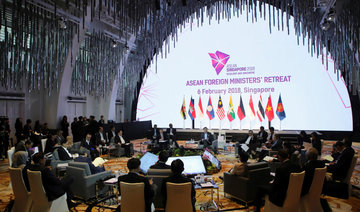
SINGAPORE: Southeast Asian leaders are expected to rally against protectionism at a summit in Singapore this weekend amid fears that tit-for-tat tariffs between the US and China could escalate into a global trade war.
A region of around 650 million people, Southeast Asia is home to some of the world’s fastest growing economies, thanks largely to the benefits of free and open trade.
But officials and analysts have warned that an escalation of trade tensions between the world’s two biggest economies poses a risk to the region’s growth.
Leaders from the 10-country Association of Southeast Asian Nations (ASEAN) are expected to pledge to fight protectionism when they meet in the city-state on Saturday, according to a draft of their final statement seen by AFP.
The statement warns of “uncertainties surrounding global economic recovery, the rising trends of protectionism, and global policy uncertainties.”
“We reiterated our strong commitment to open and inclusive regionalism, free and open markets and underscored the critical importance of the rules-based multilateral trading system,” it says.
US President Donald Trump sent shockwaves around the world last month when he imposed tariffs on steel and aluminum imports.
He also authorized tariffs on about $50 billion worth of Chinese exports in response to Beijing’s alleged theft of American intellectual property.
Beijing has responded by slapping duties on key US agricultural exports, in measures intended to target the American president’s support base.
Trump accuses China of driving up a yawning, $337 billion trade deficit with the United States through unfair trade practices.
The Southeast Asian leaders will also welcome Friday’s historic summit between North Korean leader Kim Jong Un and South Korea’s President Moon Jae-in, while calling on Pyongyang to get rid of its atomic weapons.
Regional foreign ministers met Thursday before the leaders’ summit, and “ASEAN feels there is a greater chance for peace in the Korean Peninsula,” a diplomat, who asked not to be named, said.
On the disputed South China Sea, the leaders are expected to take note of “the concerns expressed by some leaders on the land reclamations and activities in the area, which have eroded trust and confidence, increased tensions and may undermine peace, security and stability in the region.”
Four ASEAN states — Brunei, Malaysia, the Philippines and Vietnam — have laid partial claims to the sea, pitting them against China which asserts sovereignty over almost the entire area.
China rankled its smaller neighbors when it carried out massive land reclamations in the sea, and is now putting up structures, which analysts say include runways and military facilities.

Southeast Asian leaders to vow to fight protectionism
Arab food and beverage sector draws $22bn in foreign investment over 2 decades: Dhaman
JEDDAH: Foreign investors committed about $22 billion to the Arab region’s food and beverage sector over the past two decades, backing 516 projects that generated roughly 93,000 jobs, according to a new sectoral report.
In its third food and beverage industry study for 2025, the Arab Investment and Export Credit Guarantee Corp., known as Dhaman, said the bulk of investment flowed to a handful of markets. Egypt, Saudi Arabia, the UAE, Morocco and Qatar attracted 421 projects — about 82 percent of the total — with capital expenditure exceeding $17 billion, or nearly four-fifths of overall investment.
Projects in those five countries accounted for around 71,000 jobs, representing 76 percent of total employment created by foreign direct investment in the sector over the 2003–2024 period, the report said, according to figures carried by the Kuwait News Agency.
“The US has been the region's top food and beverage investor over the past 22 years with 74 projects or 14 projects of the total, and Capex of approximately $4 billion or 18 percent of the total, creating more than 14,000 jobs,” KUNA reported.
Investment was also concentrated among a small group of multinational players. The sector’s top 10 foreign investors accounted for roughly 15 percent of projects, 32 percent of capital expenditure and 29 percent of newly created jobs.
Swiss food group Nestlé led in project count with 14 initiatives, while Ukrainian agribusiness firm NIBULON topped capital spending and job creation, investing $2 billion and generating around 6,000 jobs.
At the inter-Arab investment level, the report noted that 12 Arab countries invested in 108 projects, accounting for about 21 percent of total FDI projects in the sector over the past 22 years. These initiatives, carried out by 65 companies, involved $6.5 billion in capital expenditure, representing 30 percent of total FDI, and generated nearly 28,000 jobs.
The UAE led inter-Arab investments, accounting for 45 percent of total projects and 58 percent of total capital expenditure, the report added, according to KUNA.
The report also noted that the UAE, Saudi Arabia, Egypt, and Qatar topped the Arab ranking as the most attractive countries for investment in the sector in 2024, followed by Oman, Bahrain, Algeria, Morocco, and Kuwait.
Looking ahead, Dhaman expects consumer demand to continue rising. Food and non-alcoholic beverage sales across 16 Arab countries are projected to increase 8.6 percent to more than $430 billion by the end of 2025, equivalent to 4.2 percent of global sales, before exceeding $560 billion by 2029.
Sales are expected to remain highly concentrated geographically, with Egypt, Saudi Arabia, Algeria, the UAE and Iraq accounting for about 77 percent of the regional total. By product category, meat and poultry are forecast to lead with sales of about $106 billion, followed by cereals, pasta and baked goods at roughly $63 billion.
Average annual per capita spending on food and non-alcoholic beverages in the region is projected to rise 7.2 percent to more than $1,845 by the end of 2025, approaching the global average, and to reach about $2,255 by 2029. Household spending on these products is expected to represent 25.8 percent of total expenditure in 13 Arab countries, above the global average of 24.2 percent.
Arab external trade in food and beverages grew more than 15 percent in 2024 to $195 billion, with exports rising 18 percent to $56 billion and imports increasing 14 percent to $139 billion. Brazil was the largest foreign supplier to the region, exporting $16.5 billion worth of products, while Saudi Arabia ranked as the top Arab exporter at $6.6 billion.