

History goes under the hammer as London celebrates Islamic art

Updated 27 April 2018
Follow

History goes under the hammer as London celebrates Islamic art

  • Leading auction houses this week embarked on an 1,800-year artistic odyssey with treasures from across the region
  • A painting by the late Egyptian painter Mahmoud Said fetched the highest bid £633,000

LONDON: For aficionados of Middle Eastern art, London was the place to be this week. During the biannual Islamic Art Week, the big auction houses held sales of everything from antiquities to modern-art installations, with many works receiving well above their estimates.
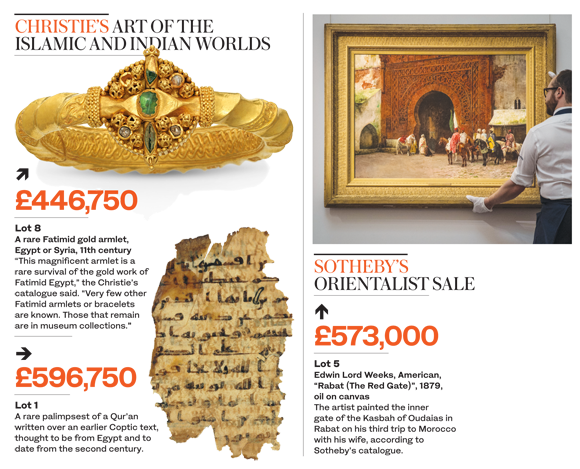
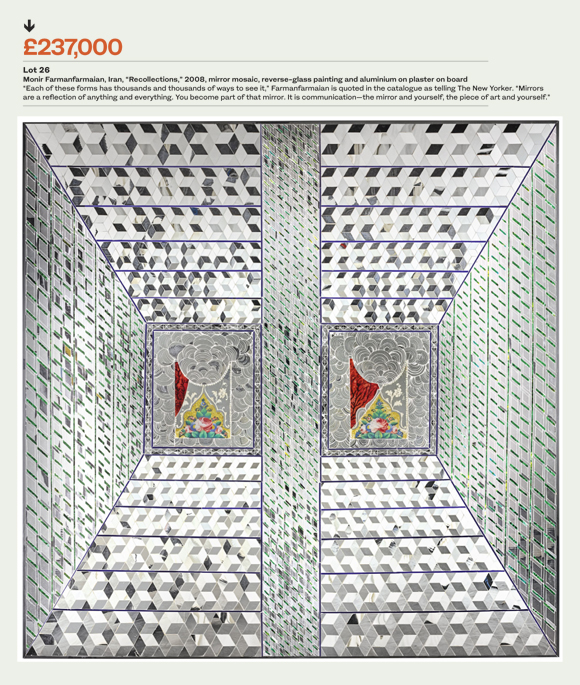
Sotheby’s 20th Century Art/Middle East on Tuesday featured two Saudi artists, Ahmed Mater and Maha Malluh, alongside works by  Morocco’s Farid Belkahia, Lebanon’s Paul Guiragossian, Iraq’s Shakir Hassan Al-Said and Syria’s Louai Kayali. A painting by the late Egyptian painter Mahmoud Said, often a record-setter at auctions of Arab art, fetched the highest bid: “Adam and Eve,” at £633,000 (it was estimated at £300,00-£500,000). 

The same day, Sotheby’s held the seventh season of its Orientalist Sale, with Edwin Lord Weeks’ painting “Rabat (The Red Gate)” drawing the highest bid at £573,000, above its estimate of £200,000-£300,000.

At Bonham’s, a pair of gold pendant earrings from the collection of Maharani Jindan Kaur, the mother of the last Sikh ruler of the Punjab, sold for £175,000, eight times the original estimate. 
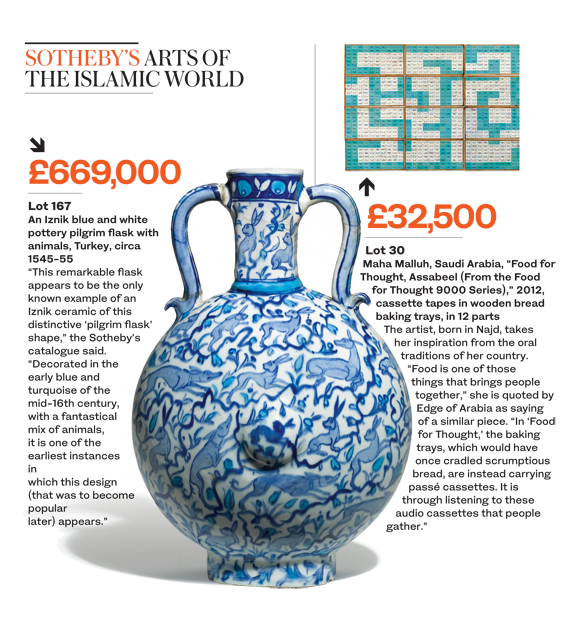
At Sotheby’s Arts of the Islamic World auction on Wednesday, an Iznik pottery flask raised the highest price, £669,000, well above the estimated £60,000-£80,000.

The Christie’s auction on Thursday featured Art of the Islamic and Indian Worlds, including Oriental rugs and carpets. A rare palimpsest of a Qur’an written over an earlier Coptic text, thought to be from Egypt and to date back to the second century, was bought for £596,750.
Living Pyramid to bloom beyond Desert X AlUla

Updated 01 March 2026
Follow

Living Pyramid to bloom beyond Desert X AlUla

ALULA: Desert X AlUla officially closed on Feb. 28, but one of its most striking installations — the Living Pyramid —will continue to flourish. 

Tucked away within a lush oasis surrounded by ancient rock formations, Agnes Denes’ creation fuses art and nature, offering a living testament to resilience and connection.

Through her current rendition of The Living Pyramid for Desert X AlUla 2026, Denes seeks connection, likening it to bees constructing a new hive after disaster.

The pyramid structure is teeming with indigenous plants, forming layered patterns that echo the surrounding desert landscape. 

It blends harmoniously with the rocky backdrop while proudly standing apart.

“There is no specific order for the plants other than not to place larger plants on the very top of the pyramid and increase the number of smaller plants up there,” Iwona Blazwick, lead curator at Wadi AlFann in AlUla, told Arab News.

Native plants cascading down the pyramid include Aerva javanica, Leptadenia pyrotechnica, Lycium shawii, Moringa peregrina, Panicum turgidum, Pennisetum divisum, Periploca aphylla and Retama raetam. 

Aromatic and flowering species such as Thymbra nabateorum, Rhanterium epapposum, wild mint, wild thyme, Portulaca oleracea, tamarisk shrubs, Achillea fragrantissima, Lavandula pubescens, Salvia rosmarinus, and Ruta graveolens form distinct layers, adding color, texture and subtle fragrance to the pyramid.

“Each Living Pyramid is different. The environment is different, the people are different. I’m very interested in the different societies that come together on something so simple,” Denes said in a statement.

“Connection is what’s important; connection is what the world needs. I keep comparing us to a lost beehive or an anthill. And I wrote a little poem: This. And this is. Bee cries out. Abandon the hive. Abandon the hive,” she said.

Denes was born in Budapest, Hungary, in 1931 and is now based in New York. While the 95-year-old has not made it physically to the site in Saudi Arabia, she designed this structure to cater to the native plants of the area.

Her Living Pyramid series has certainly taken on reincarnations over the past decade. 

It debuted at Socrates Sculpture Park in New York in 2015, was recreated in Germany in 2017, appeared in Türkiye in 2022, and then London in 2023. 

In 2025, she showcased a version at Desert X 2025 in Palm Springs, California, and Luxembourg City. 

Most recently, in 2026, at Desert X AlUla.

While officially part of Desert X AlUla, the Living Pyramid stands apart and is housed separately, a short drive away from the other art works.

“The (Living Pyramid) artwork will stay for around a year, to showcase a full year’s effect on the plants throughout the different seasons,” Blazwick said.

After the year is up, it won’t go down. The plants will continue its metamorphosis beyond the pyramid. 

“The plants will be replanted and will have a new home within an environment that will suit their needs,” Blazwick concluded.