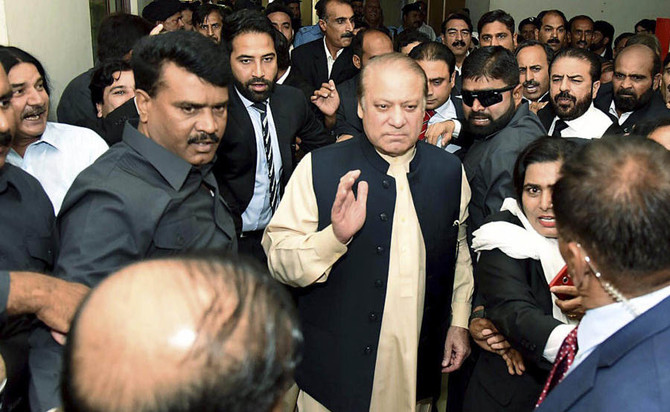
Nawaz Sharif flying back to Pakistan with his daughter

In this photo released by Pakistan Muslim League, Pakistani deposed Prime Minister Nawaz Sharif, center, arrives at an anti-corruption court in Islamabad, Pakistan, Tuesday, September 26, 2017. (File photo: Pakistan Muslim League via AP)
Updated 22 April 2018
Follow

Nawaz Sharif flying back to Pakistan with his daughter

  • The former premier and his family are facing corruption charges in the wake of the apex court’s verdict against them in the Panama case
  • PM Abbasi says the Sharifs will not choose self-imposed exile

ISLAMABAD: Former prime minister, Nawaz Sharif, and his daughter, Maryam, will reach Pakistan tonight after spending a few days in London.
The two most prominent leaders of the ruling Pakistan Muslim League-Nawaz (PML-N) party had flown to the United Kingdom on Wednesday to visit the ex-premier’s ailing wife, Kalsoom Nawaz, who is undergoing cancer treatment in that country.
Some of their political rivals had criticized their departure from Pakistan, claiming that they were facing serious financial allegations and their prolonged absence from the country could jeopardize the accountability process against them.
Maryam Nawaz, however, assuaged these fears when she tweeted on Sunday: “At the Heathrow, leaving for Islamabad shortly.” She added that she “will arrive [in Pakistan] in the wee hours to be at the court.”

On Saturday, Prime Minister Shahid Khaqan Abbasi also rejected the possibility that Sharif and his daughter would take advantage of their visit to the UK and turn it into a self-imposed exile.
Sharif had also issued a similar statement, saying: “I will not act like Pervez Musharraf and will return to the country soon.”
While the primary purpose of his visit to London was to meet his wife and interact with her doctors, the former premier also met Abbasi, who was invited to a Commonwealth conference, and discussed with him the issue of choosing the interim prime minister.
Once the Sharifs return to Pakistan, they will face court cases again and continue their party’s struggle to win the next general elections.

UN’s top court opens Myanmar Rohingya genocide case

Updated 12 January 2026
Follow

UN’s top court opens Myanmar Rohingya genocide case

  • The Gambia filed a case against Myanmar at the UN’s top court in 2019
  • Verdict expected to impact Israel’s genocide case over war on Gaza

DHAKA: The International Court of Justice on Monday opened a landmark case accusing Myanmar of genocide against its mostly Muslim Rohingya minority.

The Gambia filed a case against Myanmar at the UN’s top court in 2019, two years after a military offensive forced hundreds of thousands of Rohingya from their homes into neighboring Bangladesh.

The hearings will last three weeks and conclude on Jan. 29.

“The ICJ must secure justice for the persecuted Rohingya. This process should not take much longer, as we all know that justice delayed is justice denied,” said Asma Begum, who has been living in the Kutupalong refugee camp in Bangladesh’s Cox’s Bazar district since 2017.

A mostly Muslim ethnic minority, the Rohingya have lived for centuries in Myanmar’s western Rakhine state but were stripped of their citizenship in the 1980s and have faced systemic persecution ever since.

In 2017 alone, some 750,000 of them fled military atrocities and crossed to Bangladesh, in what the UN has called a textbook case of ethnic cleansing by Myanmar.

Today, about 1.3 million Rohingya shelter in 33 camps in Cox’s Bazar, turning the coastal district into the world’s largest refugee settlement.

“We experienced horrific acts such as arson, killings and rape in 2017, and fled to Bangladesh,” Begum told Arab News.

“I believe the ICJ verdict will pave the way for our repatriation to our homeland. The world should not forget us.”

A UN fact-finding mission has concluded that the Myanmar 2017 offensive included “genocidal acts” — an accusation rejected by Myanmar, which said it was a “clearance operation” against militants.

Now, there is hope for justice and a new future for those who have been displaced for years.

“We also have the right to live with dignity. I want to return to my homeland and live the rest of my life in my ancestral land. My children will reconnect with their roots and be able to build their own future,” said Syed Ahmed, who fled Myanmar in 2017 and has since been raising his four children in the Kutupalong camp.

“Despite the delay, I am optimistic that the perpetrators will be held accountable through the ICJ verdict. It will set a strong precedent for the world.”

The Myanmar trial is the first genocide case in more than a decade to be taken up by the ICJ. The outcome will also impact the genocide case that Israel is facing over its war on Gaza.

“The momentum of this case at the ICJ will send a strong message to all those (places) around the world where crimes against humanity have been committed,” Nur Khan, a Bangladeshi lawyer and human rights activist, told Arab News.

“The ICJ will play a significant role in ensuring justice regarding accusations of genocide in other parts of the world, such as the genocide and crimes against humanity committed by Israel against the people of Gaza.”