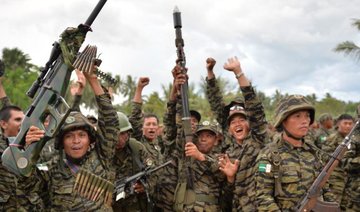
MANILA: The new armed forces chief in the Philippines took up his post with a pledge to drive Daesh from the Philippines while also extending an olive branch to Filipino militants and insurgents.
Army Lt. Gen. Carlito Galvez became the country’s 50th military chief on Wednesday, replacing the retiring Gen. Rey Leonardo Guerrero.
President Rodrigo Duterte led the change of command ceremony at Camp Gen. Emilio Aguinaldo.
In a speech at the ceremony, Galvez called on all enemies of the state to choose peace. “It is time for rebuilding and reconciliation among Filipinos,” he said.
“It is the best time to walk the path of peace. I now extend to our misguided brothers and sisters a chance to end all conflicts,” he added.
He noted that that for decades, Filipinos have fought fellow Filipinos. Communist rebels, Galvez said, have brought misery and enmity among Filipinos, while Abu Sayyaf and other local groups have terrorized communities. He added though that many members of these insurgent and militant groups had already abandoned their illegal activities and begun rebuilding their lives.
“Hundreds of our comrades have already stocked arms and abandoned your hopeless cause. They have seen by themselves that our government is a just and fair government. Your armed forces... invite you to abandon your pointless struggle and return home to your families and your community,” said Galvez.
Galvez pointed out that violent extremism remains a threat as shown by the destructive fighting in Marawi City, which was attacked by members of the Daesh-inspired Maute Group in May last year.
The Marawi crisis lasted almost five months.
“Daesh and the battle of Marawi have just very recently shown us how truly destructive violent extremism can be. We have won many battles but we have yet to win the war,” he said.
“Violent extremists and their corrupted ideology remain a threat. Too much (blood) has been spilled. Too many lives have been lost to terror and hate,” he added.
He called on all peace-loving Filipinos, including “our Muslim brothers and sisters,” to join the AFP in the fight against all forms of violent extremism.
“We will pursue with even more vigor our campaign to end insurgency and terrorism. And with your indispensable help, we will ultimately win,” he said,
“Together, we shall render the cause of insurgency irrelevant for it can only thrive where discord prevails. Together we shall defeat the Abu Sayyaf and all other terrorist group for terrorism only works when people are divided and afraid. Together we shall drive Daesh and other violent extremists from our shores for extremism dies in the light of a people united and strong,” he added.
For the first time, leaders of the two major Muslim revolutionary groups, the Moro Islamic Liberation Front (MILF) and the Moro National Liberation Front (MNLF), attended the change of command ceremony.
Galvez expressed his full support to the peace process with the armed groups.
“Even though we soldiers are warriors, we shall always prepare the path of peace. Hence we shall support all peace initiatives of the government,” he said.
“We shall more vigorously work hand in hand with government agencies, non-government organizations and other stakeholders to address the underlying cause of conflict. We shall keep our door open with all peaceful possibilities.
“We look forward to the final peaceful political resolution of conflict in Mindanao,” Galvez continued, as he vowed to further strengthen existing peace mechanisms and revitalize the peace and development offices of AFP unified command levels.

New Philippine military chief vows to drive Daesh out
- New military chief seeks cooperation of mainstream Muslim groups in fighting violent extremists
- For the first time, leaders of the two major Muslim rebel groups attended the Philippine military's change of command ceremony
Trump takes unconventional approach to communicating to the public about war in Iran
- The communications strategy opened Trump to criticism that he hadn’t done enough to explain the rationale and objectives of the war
Typical of an unconventional presidency, the Trump administration waited more than 48 hours to make any live, public communication to the American people about why it had decided to go to war with Iran.
President Donald Trump discussed why he launched the attack prior to a White House ceremony honoring military heroes on Monday but took no questions from reporters. Earlier in the day, Defense Secretary Pete Hegseth and Joint Chiefs of Staff Chairman Dan Caine briefed journalists at the Pentagon.
The two days previous, Trump delivered two pretaped statements that were released on Truth Social, the social media site owned by the president’s media company, and granted telephone interviews to more than a dozen journalists — several of which produced fragmented responses that, to some, clouded as much as they cleared up.
The communications strategy opened Trump to criticism that he hadn’t done enough to explain the rationale and objectives of the war, even as the American military suffered its first casualties. By contrast, Israeli Prime Minister Benjamin Netanyahu, who has teamed with the US against Iran, delivered two statements the day the war began and addressed reporters Monday at the site of a missile attack that killed nine people. The Israeli military has held multiple press briefings each day.
“The American people need a commander in chief, and he has been absent in that role,” Rahm Emanuel, White House chief of staff under President Barack Obama, said on CNN Monday. Emanuel, a Democrat, is contemplating a run for the presidency in 2028.
An unconventional strategy leads to criticism
Peter Baker, chief White House correspondent for The New York Times, wrote on social media that “after Trump launched a new war on Iran, he did not rush back to the White House to make an Oval Office address to rally the nation as other presidents have done. He stayed at Mar-a-Lago to attend a glitzy political fundraiser.”
That post provoked a response from Steven Cheung, White House communications director. “Imagine being a reporter so consumed with Trump Derangement Syndrome that he wants President Trump to mimic the failed policies of the past. The truth is that President Trump spent the majority of his time monitoring the situation in a secure facility, in constant contact with world leaders, and made multiple addresses to the nation that garnered hundreds of millions of views. He also took dozens of calls with reporters.”
The calls included one with Baker’s colleague at The Times, Zolan Kanno-Youngs. Trump’s mobile phone number is known to many of the reporters who cover him, and the president often takes their calls for on-the-spot interviews. Besides The Times, he spoke in the aftermath of the attack to journalists for ABC, CBS, NBC, CNN, CNBC, Fox News Channel, The Atlantic, The Washington Post, Axios, Politico and an Israeli television station.
Most of the calls were brief and marginally illuminating; Politico’s Dasha Burns said Trump answered but said he was too busy to talk. The public couldn’t hear what Trump said in the interviews and was dependent upon what the journalists chose to report on the conversations.
“I spoke to President Trump today and he told me that the operation in Iran is going to go very fast,” Libby Alon, a reporter for Channel 14 News in Israel, wrote about her interview on X. “It’s doing very well, and (will) make the people of Israel very happy, and the people of the world very happy.”
The Times reported that in its six-minute chat, Trump “offered several seemingly contradictory visions of how power might be transferred to a new government — or even whether the existing Iranian power structure would run that government or be overthrown.”
In one of his two conversations with Trump, ABC News’ Jonathan Karl said when he asked about the death of Iranian Ayatollah Ali Khamenei, the president said: “I got him before he got me. They tried twice. Well I got him first.” CNN’s Jake Tapper went on the air minutes after his conversation Monday, saying Trump told him “the big one is coming soon,” an apparent reference to a future attack.
Asked for comment, White House spokeswoman Anna Kelly said: “President Trump is the most transparent and accessible president in American history. The American people have never had a more direct and authentic relationship with a president of the United States than they have with President Trump.”
Hegseth briefing concentrates on friendly reporters
Pentagon reporters learned late Sunday about Hegseth’s briefing. Reporters from The Associated Press, Reuters, ABC, CBS, NBC, CNN, Fox News Channel and Stars & Stripes were permitted into the briefing room, but Hegseth did not call on them. Instead, he took questions from NewsNation and Trump-friendly outlets like the Daily Caller, Daily Wire, One America News and the Christian Broadcasting Network. Most mainstream news outlets left their regular stations at the Pentagon last fall rather than agree to Hegseth’s rules restricting their work.
Hegseth denounced the “foolishness” of people wanting to know details of the operation in advance, such as whether Americans would commit to more than air power, and said the operation would continue as long as it took to achieve objections. He initially ignored NBC News’ Courtney Kube when she called out a question: “President Trump put a four-week time limit on it. Are you saying he’s wrong?”
Later, Hegseth denounced Kube for asking “the typical NBC sort of gotcha-type question. President Trump has all the latitude in the world to talk about how long it might take — four weeks, two weeks, six weeks, it could move up, it could move back. We’re going to execute at his command the objectives he set out to achieve.”
Unlike Pentagon briefings in past administrations, reporters were given assigned seats, with the Trump-friendly outlets seated in front. Jennifer Griffin, Hegseth’s former colleague at Fox News Channel who left the Pentagon with other reporters after not accepting his new rules, was seated in the last row.