Afghan security forces claim to have cut strategic Taliban route

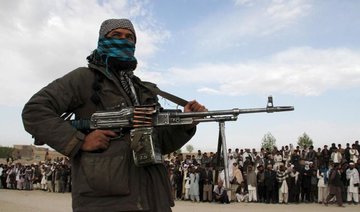
Afghan security forces stands next to Taliban militants as they are to the media in Ghazni province on April 14, 2018. Afghan security forces arrested five Taliban militants during an operation in Ghazni province, officials said. (AFP)
Updated 19 April 2018
Follow

Afghan security forces claim to have cut strategic Taliban route

  • Officials say supply line from Pakistan was frequented by militants who crossed into southeast provinces.
  • The Enzergai Kando supply route was used by the Taliban to move between Pakistan and Afghanistan.

KABUL: The Afghan government said on Wednesday that the seizure of a major Taliban arms supply line in Paktia province will contribute to a significant drop in violence in the country’s southeast region.
Military officials earlier confirmed on Tuesday that security forces cut off a vital Taliban supply line running through the rugged Dand-e-Pathan district of Paktia near the Pakistan-Afghanistan border known as the Durand Line.
The supply route, called Enzergai Kando, was used by the Taliban to transport logistics and weapons for conducting attacks in neighboring provinces, including areas near Kabul, the officials said.
“This was a very important, strategic supply line for the terrorists,” Gen. Mohammed Radmanesh, Defense Ministry spokesman in Kabul, told Arab News.
Security forces claim to have flushed out the Taliban from the area after an overnight military offensive.
“We now have a presence there and will build permanent checkposts on various parts of the route. This was a route used by the Taliban for years for transporting arms inside Afghanistan,” said Brig. Gen. Shour Gul Pathan, commander of Afghanistan’s 203 Thunder Army Corps, while talking to Arab News by phone from the area.
The Taliban used this strategic route to reach deep into the Khost, Logar and Ghazni provinces of Afghanistan and launch attacks. New border checkposts are likely to control the cross-border attacks as security forces plan to expand their presence in the area.
“The future plan of 203 Thunder Army Corps is to establish border checkpoints in areas including Khowjkaram, Enzergai Kando and Nari Kando,” Brig. Gen. Shour Gul said.
The seizure of the route came after days of operations by Afghan troops in the region, he said, adding that the militants had suffered heavy losses as a result.
The Taliban could not be reached immediately for comment.
The development comes after weekend clashes between Pakistani and Afghan security forces along the disputed border areas, including Dand-e-Pathan. At least three Pakistani forces and two civilians were killed in an exchange of fire that ended with both sides agreeing to a cease-fire.
The Afghan government has long maintained that the Taliban enjoy safe havens and support in Pakistan but Islamabad denies the allegations.
Taliban militants, overthrown in a US-led invasion in late 2001, are active in many parts of Afghanistan.
Earlier on Wednesday, the group claimed to have killed a key border commander of the Afghan security forces in an explosion in the southern city of Kandahar. Officials confirmed that Col. Janan Mama, along with several bodyguards, died as a result of a magnet bomb attached to his vehicle.


UN’s top court opens Myanmar Rohingya genocide case

Updated 12 January 2026
Follow

UN’s top court opens Myanmar Rohingya genocide case

  • The Gambia filed a case against Myanmar at the UN’s top court in 2019
  • Verdict expected to impact Israel’s genocide case over war on Gaza

DHAKA: The International Court of Justice on Monday opened a landmark case accusing Myanmar of genocide against its mostly Muslim Rohingya minority.

The Gambia filed a case against Myanmar at the UN’s top court in 2019, two years after a military offensive forced hundreds of thousands of Rohingya from their homes into neighboring Bangladesh.

The hearings will last three weeks and conclude on Jan. 29.

“The ICJ must secure justice for the persecuted Rohingya. This process should not take much longer, as we all know that justice delayed is justice denied,” said Asma Begum, who has been living in the Kutupalong refugee camp in Bangladesh’s Cox’s Bazar district since 2017.

A mostly Muslim ethnic minority, the Rohingya have lived for centuries in Myanmar’s western Rakhine state but were stripped of their citizenship in the 1980s and have faced systemic persecution ever since.

In 2017 alone, some 750,000 of them fled military atrocities and crossed to Bangladesh, in what the UN has called a textbook case of ethnic cleansing by Myanmar.

Today, about 1.3 million Rohingya shelter in 33 camps in Cox’s Bazar, turning the coastal district into the world’s largest refugee settlement.

“We experienced horrific acts such as arson, killings and rape in 2017, and fled to Bangladesh,” Begum told Arab News.

“I believe the ICJ verdict will pave the way for our repatriation to our homeland. The world should not forget us.”

A UN fact-finding mission has concluded that the Myanmar 2017 offensive included “genocidal acts” — an accusation rejected by Myanmar, which said it was a “clearance operation” against militants.

Now, there is hope for justice and a new future for those who have been displaced for years.

“We also have the right to live with dignity. I want to return to my homeland and live the rest of my life in my ancestral land. My children will reconnect with their roots and be able to build their own future,” said Syed Ahmed, who fled Myanmar in 2017 and has since been raising his four children in the Kutupalong camp.

“Despite the delay, I am optimistic that the perpetrators will be held accountable through the ICJ verdict. It will set a strong precedent for the world.”

The Myanmar trial is the first genocide case in more than a decade to be taken up by the ICJ. The outcome will also impact the genocide case that Israel is facing over its war on Gaza.

“The momentum of this case at the ICJ will send a strong message to all those (places) around the world where crimes against humanity have been committed,” Nur Khan, a Bangladeshi lawyer and human rights activist, told Arab News.

“The ICJ will play a significant role in ensuring justice regarding accusations of genocide in other parts of the world, such as the genocide and crimes against humanity committed by Israel against the people of Gaza.”