JEDDAH: All the world’s a stage, wrote Shakespeare — and that is certainly true of Saudi Arabia, where theater life is enjoying a renaissance thanks to the country’s social reforms.
Theater in the Kingdom is embarking on a leap forward, Bakheet Al-Amri, chairman of the theater committee for the Saudi Arabian Society for Culture and Arts (SASCA) told Arab News.
“Thanks to Vision 2030’s reforms, a strong theatrical movement is on the way,” he said.
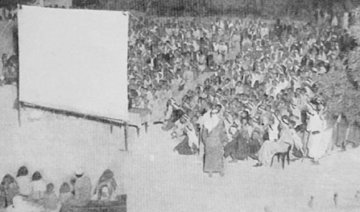
Theater activities in the Kingdom can be traced back to 1928, when one of the earliest plays, “Dialogue Between the Ignorant and Educated,” was staged for King Abdul Aziz in Qassim.
In the early 1960s, Arabic theater became popular in the Kingdom after Sheikh Ahmed Alsibaai created a stage group in Makkah and established the Quraish House of Islamic Storytelling.
More recently, the General Entertainment Authority has sponsored productions such as “Khawatir Shabaha: Memoirs of a Ghost,” which was staged at Dar Al-Hekma University.
Al-Amri said that plays have always been popular in the Kingdom.
SASCA, based in Riyadh, has 16 branches, with groups in Jeddah, Madinah and Al-Baha.
“These groups create various theatrical activities, be it social, experimental, melodramatic or duodramatic — there are so many types,” he said.
“All these schools of theater offer an experience. There are no clubs, just theatrical groups performing in different places.”
Theater life has always been active in the Kingdom, Al-Amri said, with children’s plays, women’s plays and light shows.
“The Saudi Arabian Society for Culture and Art will have a stage that matches Saudi Vision 2030 standards, and there will be plays in Jeddah on a monthly basis,” said Al-Amri
SASCA has been active for about 40 years, fostering different artistic fields, such as literature and visual arts.
Saudi actor Naif Al-Daferi, 29, said that theater is making a strong comeback in the Kingdom.
“When you want food, you go to a restaurant; when you want to check on your health, you go to the hospital; and when you want entertainment, you go to the theater,” he said. “It is something that unites all members of the family.”
The young Saudi actor developed his passion for theater while studying with leading Egyptian performer Ashraf Abdel Baqi.
“Theater is life. As Shakespeare said: ‘All the world’s a stage.’ Life is big, and the stage gathers it all in one place,” Al-Daferi said.
“The stage is a place to express your feelings. It means everything to me. Even in my free time, I visit the theater.
“And once I’m on stage, I feel like the whole world is mine.”


![]()

Reforms raise the curtain on Saudi Arabia’s theater revival
Reforms raise the curtain on Saudi Arabia’s theater revival
- In the early 1960s, Arabic theater became popular in Saudi Arabia
- Theater activities in the Kingdom can be traced back to 1928


Latest updates




© 2026 SAUDI RESEARCH & PUBLISHING COMPANY, All Rights Reserved And subject to Terms of Use Agreement.