Afghanistan, Pakistan agree on cease-fire after border clashes

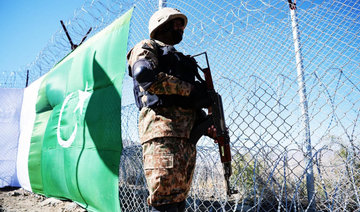
In this file photo, a soldier stands guard along the border fence outside the Kitton outpost on the border with Afghanistan in North Waziristan, Pakistan Oct. 18, 2017. (REUTERS)
Updated 16 April 2018
Follow

Afghanistan, Pakistan agree on cease-fire after border clashes

  • Bodies of deceased Pakistani soldiers handed over
  • Fencing of Pakistan-Afghanistan border angers Afghan locals

KABUL: Afghan and Pakistani forces observed a cease-fire on Monday after clashes that killed several people on the Durand Line, the disputed border between the neighbors.
Sunday’s clashes erupted after Pakistani troops began building installations in remote mountainous areas close to Afghanistan’s eastern Khost province, Afghan government officials said.
The move by Pakistan sparked armed resistance from locals in Khost who were later joined by security forces, resulting in an exchange of artillery and heavy fire that killed at least three Pakistani soldiers and two Afghan civilians, the officials added. 
“There was sporadic artillery fire last night but it’s calm now,” Kamal Nasir Osoli, a lawmaker from Khost, told Arab News on Monday. “Based on an agreement between the two countries, there’s a cease-fire for now.” 
Afghan Defense Ministry spokesman Mohammed Radmanesh confirmed news of the truce, saying: “Pakistan had vowed that there will be no repeat of clashes again in the region.”
The bodies of the deceased Pakistani soldiers were “honorably handed over,” he said, adding that the clashes happened in three areas.
Afghan and Pakistani forces in recent years have clashed on many occasions in various parts of the Durand Line drawn by Britain, which ruled the region in the 19th century, leading to the separation of hundreds of thousands of people from their relatives and tribes. 
Unlike Islamabad, successive Afghan governments have not recognized the line as an international border. The fencing of the Pakistan-Afghanistan border has angered Afghan locals and Kabul.
Afghanistan has repeatedly accused Pakistan of shelling and firing rockets at eastern regions, including Khost. Islamabad says it targets those involved in cross-border terrorist activities.
The latest clashes in Khost came less than two weeks after the visit by Pakistan’s prime minister to Kabul, at the invitation of the Afghan government, to start a new chapter in their relations.


Venezuela aims to boost oil output but sanctions stand in the way, VP says

Updated 4 sec ago
Follow

Venezuela aims to boost oil output but sanctions stand in the way, VP says

  • Sanchez called the recent capture of Nicolas Maduro a “dark day” for the country

DUBAI: Venezuela’s Vice President for Economy Calixto Ortega Sanchez said on Wednesday that his country needed vast foreign investment and sanctions relief to tap its huge oil reserves and restart its ailing economy.

“We know that the reference for Venezuela is that (it is) the country with the biggest oil reserves, and we want to stop being known for this, and we want to be known as one of the countries with the highest production levels,” Sanchez said.

Responding to questions by American journalist Tucker Carlson, Sanchez called the recent capture of Nicolas Maduro a “dark day” for the country but said Venezuela was working to reestablish a relationship with the US, which he described as a “natural partner” for the country.

“The Venezuelan people and authorities have shown that they are ready to peacefully move forward and to build opportunities,” he said during a session at the World Government Summit.

Sanchez, who headed Venezuela’s central bank, said the most pertinent issue facing his country is continued US sanctions.

Despite failing to result in regime change, the sanctions had effectively stifled the economy from growing, he added.

He said the Venezuelan government was now working to reform its laws to allow foreign investment and hoped the US would ease sanctions to aid their work.

“The first decisions that interim President Rodriguez took was to go to the National Assembly and ask for reform to the hydrocarbon law … this law will allow international investors to go to Venezuela with favorable conditions, with legal assurance of their investments,” he added.

“The economy is ready for investment. The economy is ready for the private sector; it is ready to build up a better future for the Venezuelan people.”

Sanchez played down inferences by Carlson that his government had been taken over, insisting that the regime still held authority in the country. He said the country had set up two funds to receive money from oil production that would fund better welfare and social conditions for Venezuelans.

“Allow us to have access to our own assets … we don’t have access to our own money,” he added.

“If you allow us to function like a regular country, Venezuela will show extraordinary improvement and growth.”